Study Finds Sperm Whale Calls Share Vowel-Like Features With Human Speech, Raising New Questions About Animal Language
A UC Berkeley and Project CETI study finds sperm whale codas contain slow-varying, vowel-like acoustic patterns, challenging the view of clicks as simple signals and suggesting richer, potentially language-like structure that AI may help decode.
- New acoustic evidence: UC Berkeley analysis identifies slow-changing resonant patterns in sperm whale codas resembling human vowel features (Source: UC Berkeley news release).
- Challenges prior models: Findings dispute the idea that whale clicks are only simple, impulse-like signals and instead suggest structured, information-carrying sequences.
- AI-driven decoding: Project CETI is building datasets and using machine learning with the long-term aim of translation and two-way communication (See Project CETI and The Audacious Project overview).
What the researchers found
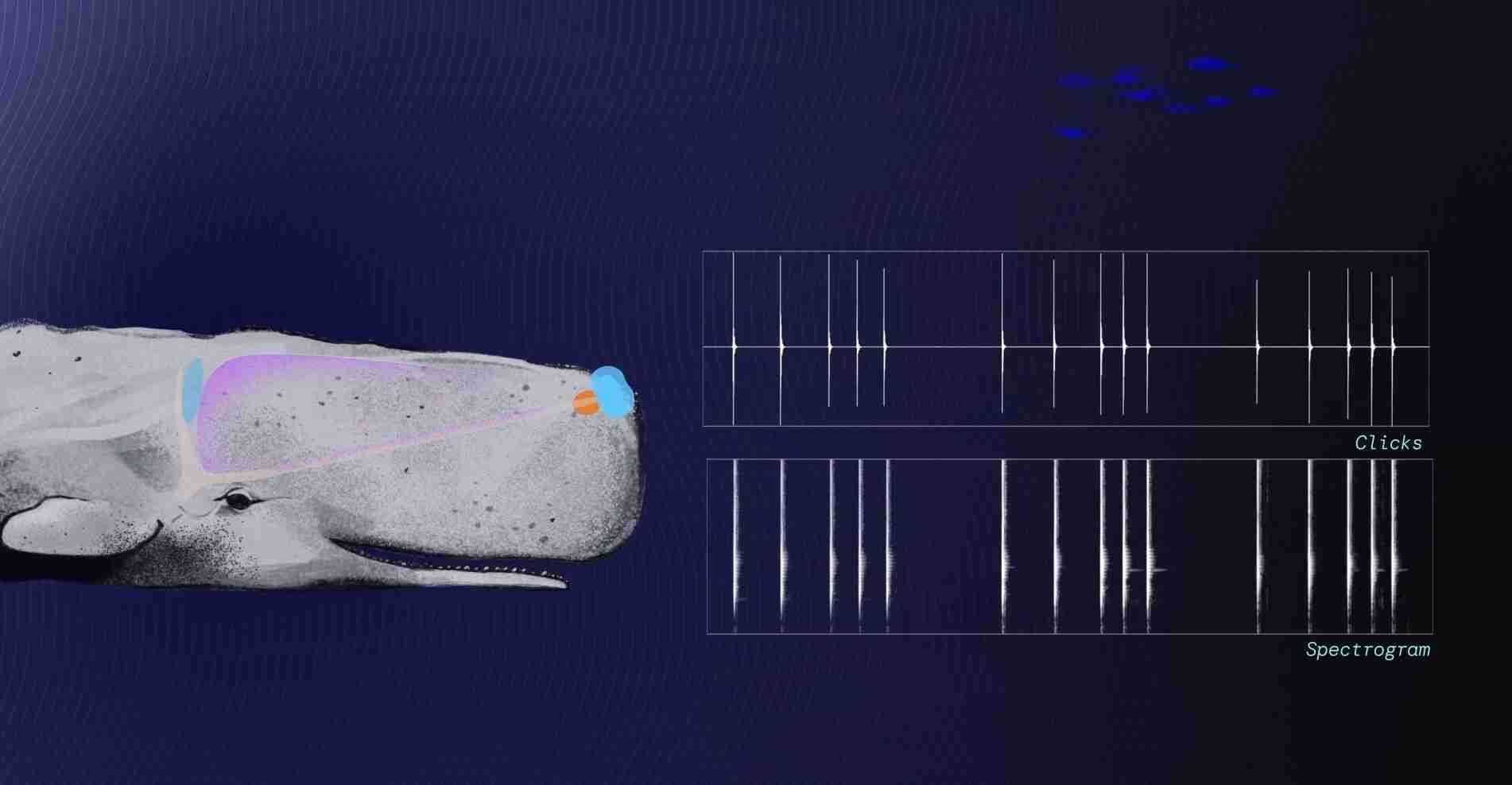
UC Berkeley linguists and collaborators at Project CETI analyzed recordings of sperm whale codas — sequences of clicks whales use to communicate — and identified slow-varying acoustic patterns that align with features of human vowels. The team’s acoustic work shows clicks can be grouped into patterns that vary in pitch and resonance over time, rather than appearing only as isolated impulses.
“They’re more like very, very slow vowels,” said Gašper Beguš, a linguistics professor at UC Berkeley, as quoted in the university report (UC Berkeley news release).
The analysis emphasizes that the temporal modulation — the way acoustic energy changes slowly across click sequences — is a key characteristic resembling vowel behavior in human speech systems. Researchers stress this is an acoustic analogy, not evidence that whales produce vowels via the same anatomy humans use.
Project CETI’s approach and tools
Project CETI (the Cetacean Translation Initiative) combines high-quality acoustic and behavioral data with advanced AI and robotics. The initiative collects recordings and contextual behavior using non-invasive drones and sensors, especially near Dominica, and trains machine learning systems to detect patterns, dialects and structure in whale calls (see Project CETI and The Audacious Project overview).
The group uses unsupervised machine translation–inspired methods to mine correspondences between sounds and contexts. Their dataset-building emphasizes ethical, low-impact recording methods to preserve natural behavior while increasing the clarity and quantity of data available for analysis.
Why vowels matter
In human language, vowels are central to distinguishing words because they carry resonant, time-varying information shaped by the vocal tract. Discovering similar acoustic building blocks in sperm whale codas suggests these animals may be able to produce sounds that serve as carriers of structured information over time.
The authors do not claim whales speak like humans. Rather, they highlight a shared acoustic property — slow-changing resonant patterns — that could support complex signaling systems if combined and sequenced in meaningful ways.
Scientific and ethical implications
For scientists, the discovery opens new questions about the evolution of complex communication and the role of acoustic structure in social animals. Sperm whales form long-lived family groups with rich social bonds; if calls contain structured elements, they could be central to coordination, culture and social life.
For ethicists and conservationists, evidence of complex communication strengthens arguments for protection and respectful stewardship. Project CETI pairs research with outreach to increase public support for whale conservation and to inform policy debates about how humans interact with marine megafauna.
How certain are the findings?
Researchers are careful to distinguish acoustic similarity from linguistic equivalence. The term “vowel-like” refers to resemblance in acoustic patterning, not identical production mechanisms. Humans shape vowels with a vocal tract; sperm whales generate clicks using nasal systems. The key result is the presence of slow-varying patterns that could carry temporally extended information (Source: UC Berkeley news release).
More data and peer-reviewed analyses are needed to map these acoustic features to specific meanings or grammatical structures across populations.
Potential long-term goals
Project CETI envisions decoding larger portions of sperm whale communication and, eventually, establishing two-way communication. Achieving that requires mapping patterns to meanings and contexts and adapting unsupervised AI methods from human language translation to a non-human system. Success could create new tools for studying animal intelligence and reshape ethical frameworks for interspecies communication (See Project CETI and The Audacious Project overview).
Implications for Utah
Economic and technological opportunity: Utah’s tech sector and universities could offer machine learning, robotics and signal-processing expertise to projects like Project CETI, creating jobs and research partnerships for institutions such as the University of Utah and Brigham Young University.
Education and outreach: The study offers STEM curriculum material, public lectures and potential remote collaborations that could engage Utah students in AI, marine biology and linguistics.
Conservation, policy and values: New findings may influence federal and international policy that affects industry and conservation funding. Utah communities that emphasize stewardship and pragmatic policy may find the research aligns with faith and community values while also calling for balanced, science-based approaches.
Security and privacy: As AI platforms record and analyze animal signals, Utah’s cybersecurity and cloud businesses could help ensure secure, ethical data sharing and platform compliance.
Sources and further reading
- UC Berkeley news release on the study
- Project CETI official site
- Project CETI overview on The Audacious Project
This reporting is based on findings and statements published by UC Berkeley and Project CETI and on descriptions of Project CETI’s goals and methods available from the organization’s public materials. Additional data and peer-reviewed analyses will be needed to map whale acoustic patterns to specific meanings and to assess how broadly these vowel-like properties apply across sperm whale populations.