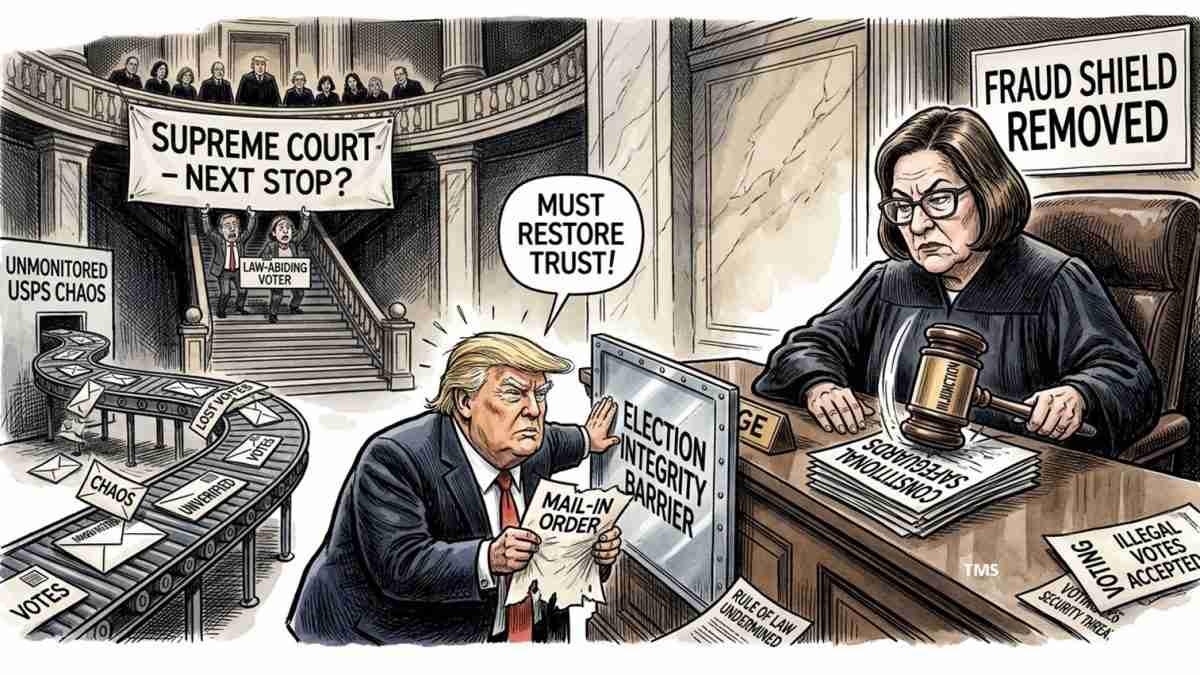
WASHINGTON, Aug. 28 (Nationwide Times) — U.S. District Judge Indira Talwani has temporarily blocked the U.S. Postal Service from putting new mail-voting requirements into effect, giving states a 14-day pause as a legal fight over President Donald Trump’s election order moves through the courts.
Talwani’s order, issued Aug. 27 from the U.S. District Court in Boston, restored a nationwide halt on the postal service’s implementation of the plan. The order is set to be considered at a hearing on Sept. 3, when the court will weigh whether to issue a longer-lasting injunction.
The case is one of several challenges to Trump’s March executive order. The litigation includes cases brought by Democratic-led states, voting-rights organizations and the Democratic Party. A separate case in the U.S. District Court for the District of Columbia has also challenged the postal service’s role in the plan.
What would the postal service have to do?
The postal service’s final rule, issued Aug. 21, would require states to provide lists of voters who are eligible to receive mail ballots. It would also require states to use a specified envelope format that includes a reviewed, unique barcode.
The requirements are tied to Trump’s executive order, which seeks to create a federal voter list and give the postal service a role in election-related procedures. States and voting-rights groups argue that the administration cannot impose those requirements through the order and postal-service rule.
The courts have not issued a final ruling on whether Trump’s executive order is lawful. The latest order is temporary and addresses whether the postal service may begin carrying out the plan while the case continues.
Why did Talwani issue another order?
Talwani had previously issued nationwide protection against the postal service’s implementation. After the Supreme Court issued a procedural order on Aug. 24, she lifted that earlier preliminary injunction and reconsidered the dispute after the postal service issued its final rule.
Talwani then issued the new temporary restraining order. In it, she wrote that states would not have enough time or money to redesign mail ballots, obtain approval for the designs, produce the ballots, update election systems, train election officials and upload voter data before the midterm elections.
A temporary restraining order is an emergency measure. It is designed to preserve the existing situation for a short period while a judge considers whether a broader injunction is needed. It does not resolve the underlying case.
What did the Supreme Court decide?
The Supreme Court’s Aug. 24 unsigned order affected Talwani’s earlier injunction but did not decide whether Trump’s executive order or the postal-service requirements violate federal law.
The justices wrote that their action did not mean that every government step taken to implement the executive order would be lawful. “On that score, time will tell,” the court said.
That language left room for the legal challenge to continue. The administration and the challengers may ask federal appeals courts to intervene, and the dispute could return to the Supreme Court.
Why is the timing important?
The new rule was issued shortly before states are expected to prepare for mail voting in the midterms. Talwani’s order says states would face major logistical demands if they had to change ballot designs, election systems and procedures on short notice.
The administration’s position in the litigation is that the executive order and postal-service rule should be allowed to proceed. Challengers contend that the plan would interfere with state control over elections and impose requirements that states cannot meet on the available timetable.
Earlier in the dispute, U.S. District Judge Carl J. Nichols in Washington declined to immediately block the executive order in May, saying the request was premature because the postal service had not yet issued its rule. In June, Talwani issued an injunction covering 23 mostly Democratic-led states and Washington, D.C. On July 1, U.S. District Judge Emmet Sullivan in Washington issued a nationwide order blocking the postal service from implementing the plan, citing a 2020 settlement involving the agency.
The successive rulings reflect separate cases and overlapping challenges. The court records described in the litigation do not establish that the executive order is invalid. For now, Talwani’s 14-day order prevents the postal service from enforcing the disputed requirements while the next stage of the case is considered.