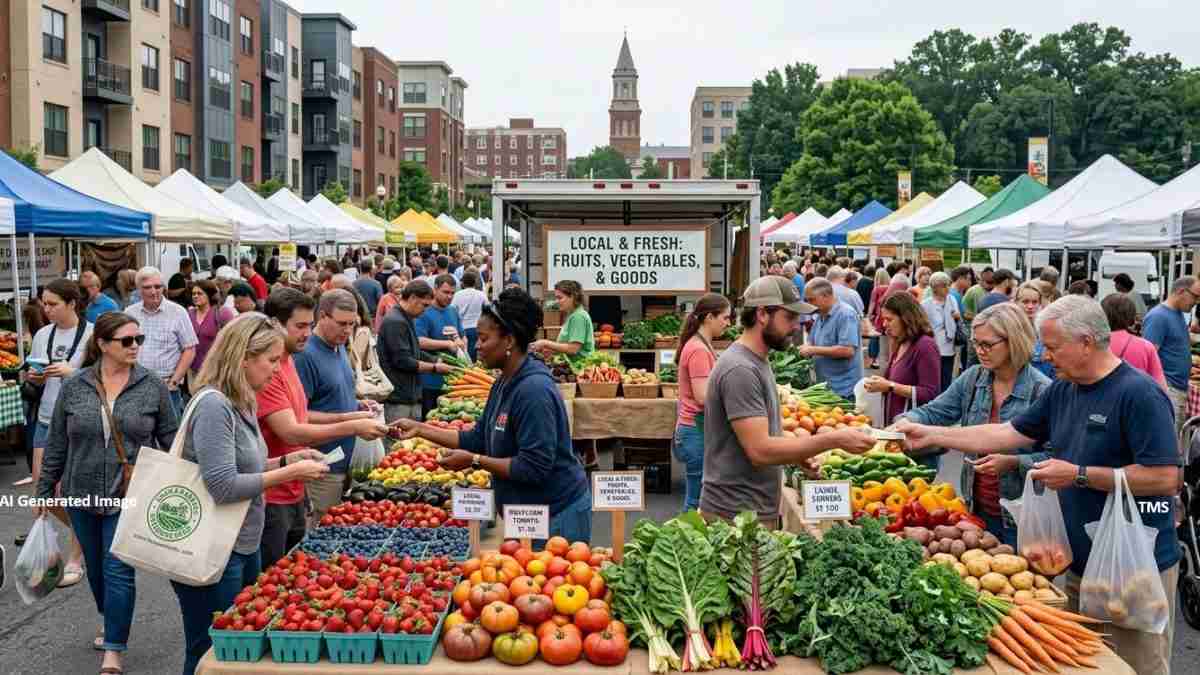
COLUMBUS, Ohio, Aug. 10 (Nationwide Times) — Farmers markets in several parts of the United States are seeing a rush for locally grown lettuce as consumers avoid some grocery-store produce during a cyclospora outbreak linked by federal investigators to iceberg lettuce supplied by Taylor Farms de Mexico.
Some vendors have sold out within minutes of opening. In Ohio, Sara Hill, executive director of the Ohio Farmers Market Network, said vendors were selling out within 30 to 60 minutes. At Michigan’s East Lansing Farmers Market, a vendor identified as Kastner sold 158 heads of romaine over two days and later sold out of roughly 30 to 40 heads 10 minutes before the market opened.
The reports show strong demand in several regions, but they do not establish that farmers-market sales have risen nationwide. The Farmers Market Coalition’s program director, Darlene Wolnik, said market managers had reported sales increases of 15% to 30%.
What is cyclospora?
Cyclospora is a parasite that can cause an intestinal illness called cyclosporiasis. The infection can spread when people eat food or drink water contaminated with the parasite.
The Centers for Disease Control and Prevention and the Food and Drug Administration have investigated illnesses associated with iceberg lettuce supplied by Taylor Farms de Mexico. Taylor Farms voluntarily recalled or removed iceberg lettuce sourced from central Mexico on July 17, according to the reports. The product was distributed in multiple states.
The supplied reports cite different case totals and affected-state counts, depending on the date and the way cases were counted. They do not provide a single final nationwide total.
Why are shoppers turning to local farms?
For many shoppers, local produce appears to offer a shorter and more visible supply chain. Customers can often ask farmers where and how crops were grown, while the produce may travel fewer steps before reaching a market.
That does not mean locally grown lettuce is immune from contamination. Public-health and food-safety guidance cited in the reports says local produce can also carry risks. A shorter supply chain may reduce some opportunities for contamination, but it is not proof that a particular farm’s lettuce is safer.
The shift has been especially visible at markets in Ohio, Michigan, New York, Tennessee, Illinois and Indiana.
At Oliver’s Produce, a family-owned farm and market in upstate New York, owner Sawyer Oliver said lettuce sales rose from 700 heads in July of the previous year to 1,500 heads in the referenced July. “We actually sold out last Friday, ahead of the weekend,” Oliver said.
Ray Tyler of Rose Creek Farms told WTVF that his lettuce at the Franklin Farmers Market in Tennessee was nearly gone two hours earlier than usual. He said the farm normally had some lettuce left at noon but was nearly sold out by 10 a.m.
In Michigan, vendor Nicholas Corrion of Corrion Farms described a sharp increase in foot traffic at the East Lansing market. Kastner said the previous two weeks had been “incredible” and that the vendor was “completely sold out all the time.”
What happened to grocery-store lettuce sales?
NielsenIQ data showed U.S. fresh-lettuce unit sales fell 9% in the week ending July 18, according to Reuters. Separate reports described declines in packaged-salad sales and at some restaurant chains, but those figures came from different sources and covered different businesses and periods.
The change reflects consumer caution, not necessarily a finding that all grocery-store lettuce is contaminated. The investigation focused on a specific supply chain involving iceberg lettuce, and the reports do not provide a complete list of affected stores or restaurants.
Michigan officials later said shoppers could resume buying lettuce, according to Reuters. Even so, concern continued at some markets and grocery stores.
How should fresh produce be handled?
The CDC advises people to wash their hands and rinse fresh fruits and vegetables under running water before preparing or eating them. Rinsing does not make contaminated produce risk-free, but it can remove dirt and some germs from the surface.
Shoppers should also follow notices from the FDA, the CDC and state health departments about recalls or products that should not be eaten. Buying from a farmers market can provide more information about a product’s origin, but food-safety precautions still apply to lettuce and other fresh produce wherever it is purchased.