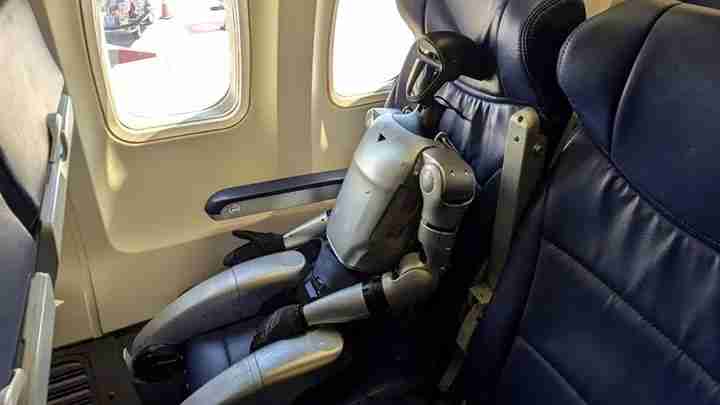
Humanoid robot delays Southwest flight after oversized battery flagged; Bebop later boards without power
A Southwest Airlines flight from Oakland to San Diego was delayed over an hour April 30, 2026, after a 70–75-pound humanoid robot named Bebop triggered safety concerns when its oversized lithium battery was flagged and confiscated.
Key takeaways
- Flight delayed: Southwest Flight 1568 (OAK→SAN) was held for roughly an hour after a robot’s battery was flagged.
- Device: Bebop, a 4-foot, ~70–75 lb humanoid event robot owned by Elite Event Robotics, later boarded without its battery.
- Cause: The robot’s lithium battery exceeded airline/TSA limits and was removed; the robot and case also exceeded a 100‑pound threshold.
- Coverage: Gate footage and interviews were shared by media outlets including Fox News, NDTV and multiple YouTube clips.
What happened at the gate
Passengers at Oakland’s gate reported Bebop became an instant attraction as staff and travelers filmed the 4‑foot robot dancing, taking high‑fives and interacting with children and adults. Elite Event Robotics’ handler, identified in interviews as Eily Ben‑Abraham, said the robot drew a crowd while staff tried to manage boarding.
Weight and seating: The robot plus its transport case exceeded Southwest’s 100‑pound limit for carry/checked items. As a workaround, the handler purchased an extra seat and registered Bebop as an inanimate object; the device was moved from an aisle to a window seat to comply with carry‑on rules.
The safety hold
After boarding, crew members flagged Bebop’s lithium battery as exceeding the airline’s and TSA limits. Airline staff requested removal of the battery and directed the handler to the carrier’s hazardous‑materials/confiscation process. The removal and subsequent safety checks delayed departure by about an hour; Bebop ultimately flew without its battery.
Airline statement: Southwest confirmed a passenger purchased a seat for a device and that the battery exceeded the maximum allowable size, emphasizing crew professionalism and passenger safety.
Coverage and interviews are available from Fox News and NDTV, with on‑scene video posted to YouTube (clip 1) and YouTube (clip 2).
Regulations and risks: why the battery mattered
Lithium‑ion batteries pose fire and thermal‑runaway risks and are strictly regulated for air transport. The TSA and airlines cap allowed battery sizes for passenger cabins and require special packaging, labeling and prior approvals for larger cells. Crew enforcement of these rules aims to reduce inflight fire hazards.
Elite Event Robotics noted Bebop had flown previously without incident; the Oakland→San Diego leg’s complication appears tied to a difference in declaration or stricter enforcement. The company said it will fly Bebop battery‑less on future legs to avoid similar disruptions.
Passenger reactions and public debate
Traveler responses ranged from delight — filming and praising the robot’s interactions — to frustration over missed connections and extra costs. Social media debates labeled the incident a publicity stunt or argued the robot should be treated as cargo, not a passenger. One passenger alleged roughly $400 in expenses due to the delay.
Broader questions emerged about whether interactive robots should travel under passenger rules or freight procedures, and how companies should declare large batteries to avoid disrupting other travelers.
Logistics after the flight
Because Bebop’s battery was removed in Oakland, handlers arranged alternate shipping. Family members reportedly drove more than five hours and overnighted the battery to a Chicago hotel so the robot could be reunited with its power source ahead of a scheduled event. Elite Event Robotics posted on Instagram that the delay was “delayed but worth the wait” and that Bebop remained popular with crowds.
Questions for industry and regulators
- How should companies that rent interactive robots transport them safely and efficiently?
- Should airlines require prior hazardous‑materials declarations for devices with large lithium batteries?
- Is purchasing an extra passenger seat an appropriate way to move large devices, or should carriers require freight procedures?
- How can vendors and flyers avoid passenger delays while complying with safety rules?
Implications for Utah
Economic and logistical: Utah’s growing events and tech economy — from Salt Lake trade shows to Park City conferences — may face ripple effects when rented equipment causes travel delays. Event planners should confirm battery ratings and carrier policies, and consider shipping batteries as cargo or using ground transport to reduce risk.
Safety and regulation: Local authorities can promote clear guidance on declared hazardous items, pre‑approved shipping and labelling to balance safety with commerce. Conservative priorities of order and safety align with enforcing predictable rules that protect travelers and event schedules.
Contracts and liability: Utah businesses contracting robotics vendors should specify shipping responsibilities and contingency plans to avoid unexpected costs from delays or missed appearances.
Sources
- Fox News Digital: “Airline flight delayed by bizarre reason after humanoid robot triggers safety query”
- NDTV Offbeat: “Humanoid Robot Travelling For Work Delays Southwest Flight For Over An Hour In California”
- YouTube video (clip 1)
- YouTube video (clip 2)
Reporting and verification drew on interviews, social media posts, and on‑scene video available in the links above.