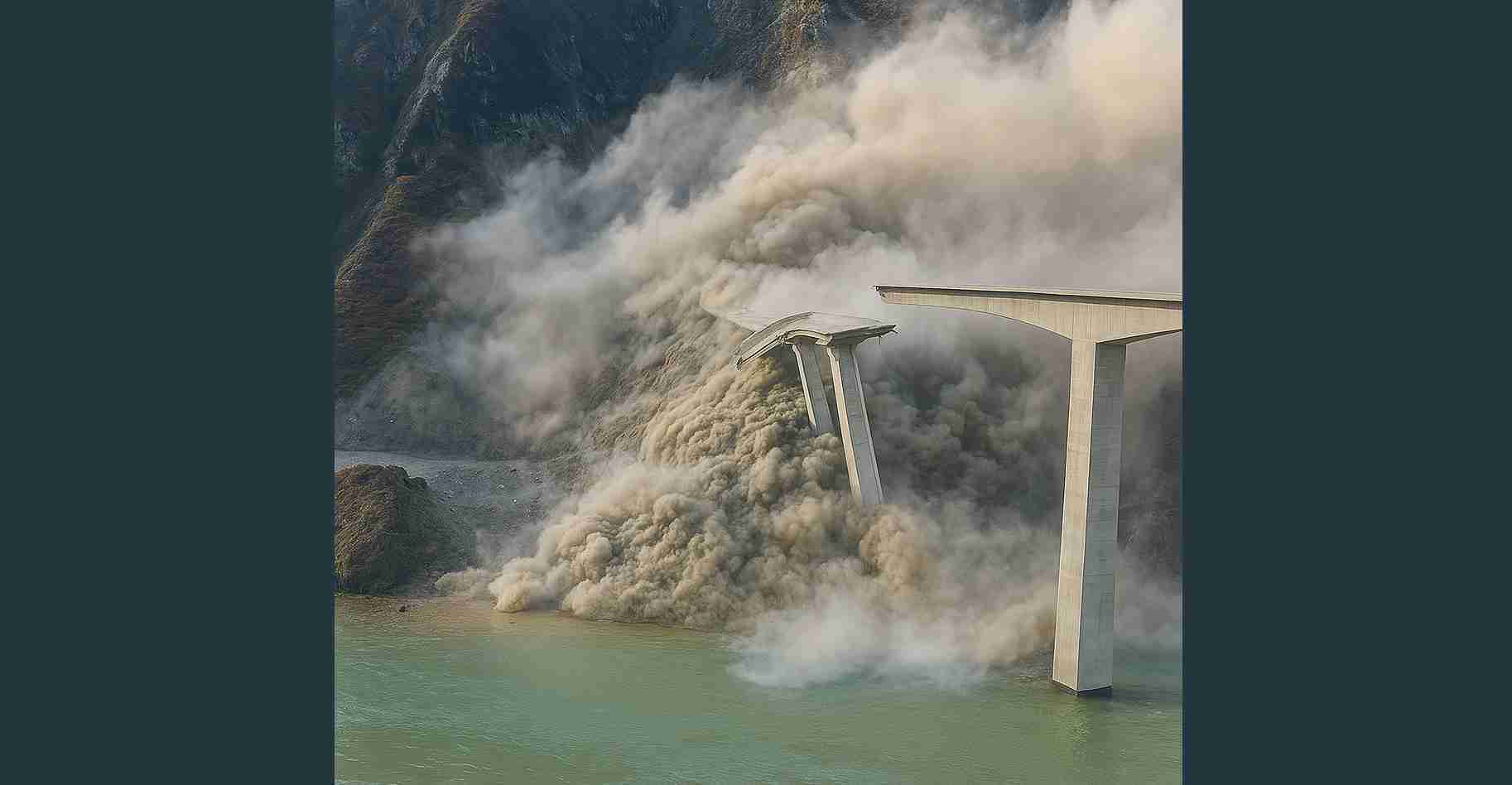
Hongqi Bridge collapse: Newly opened 758-meter highway span in Sichuan falls after massive landslide; no injuries reported
On Nov. 11, 2025, a section of the recently completed 758‑meter Hongqi Bridge in Sichuan, China, collapsed when a massive landslide struck its supporting mountainside — the bridge had been closed beforehand and no injuries were reported.
Key takeaways
- Immediate cause: A major landslide hit the mountainside under the span, sending part of the bridge into the river below.
- Prevented harm: Authorities closed the bridge about 24 hours earlier after detecting cracks and ground movement, likely preventing casualties.
- Project context: The Hongqi Bridge, completed in early 2025, is a 758‑meter highway span on a strategic route linking central China with Tibet.
- Broader issues: The collapse raises urgent questions about geological surveys, landslide mitigation, engineering design and construction oversight in mountainous terrain.
The collapse and what video shows
Shortly before the failure on Nov. 11, dramatic video footage captured a sudden break and a segment of the bridge plunging into the river. Footage highlights the steep slopes, a large dust and debris cloud and the abrupt nature of the slide. Additional angles and reporting appear in further footage.
“Police closed the bridge roughly 24 hours before the structure failed,” according to reporting tied to the shared footage, a decision credited with preventing injuries.
Bridge details and strategic purpose
The Hongqi Bridge is a 758‑meter highway structure completed and opened to traffic in early 2025 as part of a new route intended to improve travel between central China and Tibet. Built in rugged, landslide‑prone terrain, the span represented a major infrastructure investment and a logistical link for regional transport.
Safety actions taken before the collapse
Local authorities reported detecting cracks and signs of ground movement the day before the collapse and subsequently closed the bridge to traffic. That proactive closure, enacted about 24 hours prior, is widely credited with preventing injuries or deaths.
Questions about geological surveys and construction standards
Investigators and the public are expected to examine three key areas:
- Pre‑construction geological surveys: Were slope instabilities and long‑term risks sufficiently mapped and factored into siting and design?
- Engineering and design margins: Did the bridge’s design include adequate safety margins and mitigation measures for landslide forces?
- Construction oversight: Were materials, methods and inspection records consistent with required standards for such terrain?
While early reports emphasize the landslide as the immediate trigger, the public debate will focus on whether those forces exceeded reasonable design assumptions or whether planning and enforcement failures contributed.
Ongoing investigations and information gaps
As of Nov. 12, 2025, Chinese authorities had not publicly assigned blame between an overwhelming natural event and potential construction or planning flaws. Officials are expected to seek engineering records, geological surveys, monitoring data and inspection logs to determine compliance and causation.
Transparency, the pace of the inquiry and access to original documents will shape both domestic and international assessments of responsibility and lessons learned.
Regional response and immediate actions
Local emergency teams and provincial officials secured the site, assessed remaining structural risks and focused on slope stabilization. Because the bridge had been closed in advance, no motorist rescues were needed; resources instead went to safety inspections and debris management. Media footage shows personnel and equipment working amid ongoing dust and rockfall.
Implications for Utah
Although the Hongqi Bridge collapse occurred abroad, it carries practical lessons for Utah policymakers, contractors and residents, particularly in mountain regions prone to slope instability.
Economic impact
- Supply chains and trade: Utah firms reliant on overland routes through Asia may not face immediate disruption from this single failure, but the event underscores the fragility of transportation links and the value of supply‑chain diversification.
- Project costs and scrutiny: High‑risk terrain increases true project costs; Utah taxpayers benefit from rigorous oversight and conservative cost‑benefit analyses for mountain infrastructure.
Political consequences
- Regulation and oversight debates: The collapse will fuel calls for stricter permitting, independent reviews and contractor accountability — themes common in Utah policy discussions.
- Public trust: High‑profile failures abroad can erode confidence in large projects at home unless leaders emphasize rigorous, independent reviews.
Social effects
- Public safety focus: The incident highlights the value of monitoring slope movement and issuing timely closures to protect lives.
- Workforce implications: Stronger vetting and higher standards can shift work toward long‑term maintenance, inspection and monitoring roles.
Cultural relevance
Respect for terrain is a cultural priority in Utah’s mountain communities. The Hongqi Bridge collapse reinforces conservative preferences for cautious development where natural hazards are evident.
Practical applications for residents
- Ask questions: Residents should press officials for published geological studies and contingency plans before approving major projects.
- Support monitoring technology: Funding sensors, remote surveillance and early‑warning systems can reduce risk on mountain roads.
- Emergency readiness: Know alternate routes, carry emergency kits and review family plans for sudden closures or landslide events.
Sources
Primary public records and video reporting include the widely circulated footage and follow‑up coverage. See video footage and additional footage for visual documentation of the event.