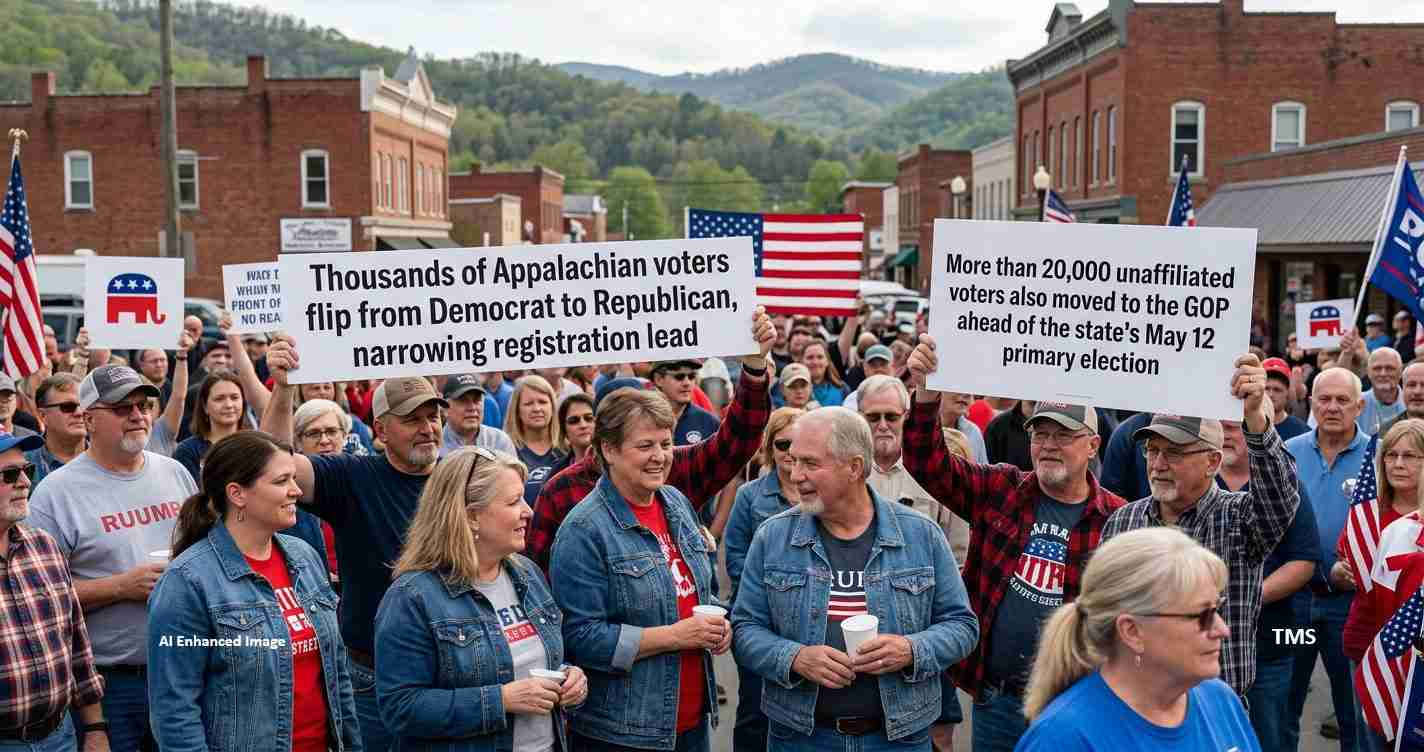
Wave of party switching drives Republican voter gains in West Virginia ahead of closed primary
West Virginia has seen more than 68,000 voters change party affiliation since Jan. 31, 2024, with large flows into the GOP ahead of the state’s closed May 12 primary — a shift reshaping primary dynamics and prompting legislative responses.
Key takeaways
- 68,235 party changes tracked since Jan. 31, 2024, according to Secretary of State Kris Warner’s office.
- Major inflows to GOP: 16,910 Democrats and 20,003 unaffiliated voters registered Republican; net gains reflect pre-primary switching.
- Closed primary rules are cited by party leaders as a primary driver; lawmakers passed House Bill 4710 tightening candidate-affiliation rules.
- Implication: short-term tactical switches can influence primaries, but independents still shape general-election math.
Main content
What the numbers show
Officials in Charleston and county clerks compiled data showing a spike in switches into the Republican Party in the weeks and months before the May 12 closed primary. Of the 68,235 total changes tracked since Jan. 31, 2024, a majority came from Democrats and unaffiliated voters moving to the GOP.
The full breakdown, according to the secretary of state’s figures posted April 23:
- 16,910 Democrats → Republican
- 20,003 Unaffiliated → Republican
- 12,299 Democrats → Unaffiliated
- 7,559 Republicans → Unaffiliated
- 5,211 Unaffiliated → Democrat
- 2,399 Republican → Democrat
Totals as of April 23 show 519,756 registered Republicans, 327,089 Democrats and 301,933 independents, for more than 1.19 million registered voters; rolls were to be finalized by the April 28 deadline (secretary of state data).
“The data show both directional movement into the GOP and churn among all groups,” reflecting that some switches are tactical while others may be more permanent.
Why the closed primary matters
West Virginia’s closed primary system restricts each party’s primary ballot to its registered voters. Del. Josh Holstein, chairman of the West Virginia Republican Party, told local reporters the spike is tied directly to that rule: voters seeking influence in competitive GOP contests often switch to Republican to gain a ballot — a dynamic party leaders flagged as a major driver of recent switching.
Democrats acknowledge broader movement
State Democratic Chair Del. Mike Pushkin characterized the trends as a “broad change across the state, not a one-way shift,” noting significant movement from Democrats to unaffiliated and some smaller flows into the Democratic roll. That perspective underscores the churn behind the headline GOP gains.
Legislative reaction: tighter rules for recent switchers
The party-switching wave prompted lawmakers to act. In February the House approved House Bill 4710 (79–13). The law extends the required continuous party affiliation for candidates from 60 days to 180 days before filing (effective Jan. 1, 2027), mandates electronic verification, and formalizes a process for party chairs to challenge recent switchers.
Proponents say HB 4710 is designed to prevent strategic switching intended solely to influence a closed primary, and it gives parties clearer tools to challenge opportunistic candidacies.
Historical context
West Virginia’s political realignment toward the GOP has been underway for years. A notable inflection point came in 2017 when then-Gov. Jim Justice announced a party switch at a rally — a moment that symbolized and accelerated a broader shift (2017 turning point).
What experts note
Political strategists say last-minute registration shifts are common before closed primaries. Some switches are purely tactical — tied to a single primary — while others indicate deeper ideological realignment. Analysts caution that registration figures don’t always predict long-term party loyalty; churn is a mix of both motives. The passage of HB 4710 signals the state’s intent to limit purely tactical moves (state data; legislative reporting).
Implications for Utah
Practical lessons for Utah party leaders and campaigns:
- Monitor registration trends ahead of closed primaries and educate voters on deadlines and rules.
- Consider whether candidate-affiliation windows or challenge processes similar to HB 4710 merit discussion locally.
- Recognize that primary registration surges don’t automatically translate to general-election majorities if independents remain decisive.
- Encourage consistent engagement with the voter base to minimize last-minute tactical switching by opposing campaigns.
Sources and further reading
- More than 68K West Virginians change political parties over last 2 years, SOS office says — News From The States
- West Virginia House passes bill changing deadline for candidates to switch political parties — The News & Sentinel
- Background: West Virginia governor expected to switch parties at Trump rally — ABC News
Reporting note
Registration totals and detailed party-switch counts come from Secretary of State Kris Warner’s office and were current as of April 23; voter rolls were scheduled for finalization April 28 ahead of the May 12 primary.