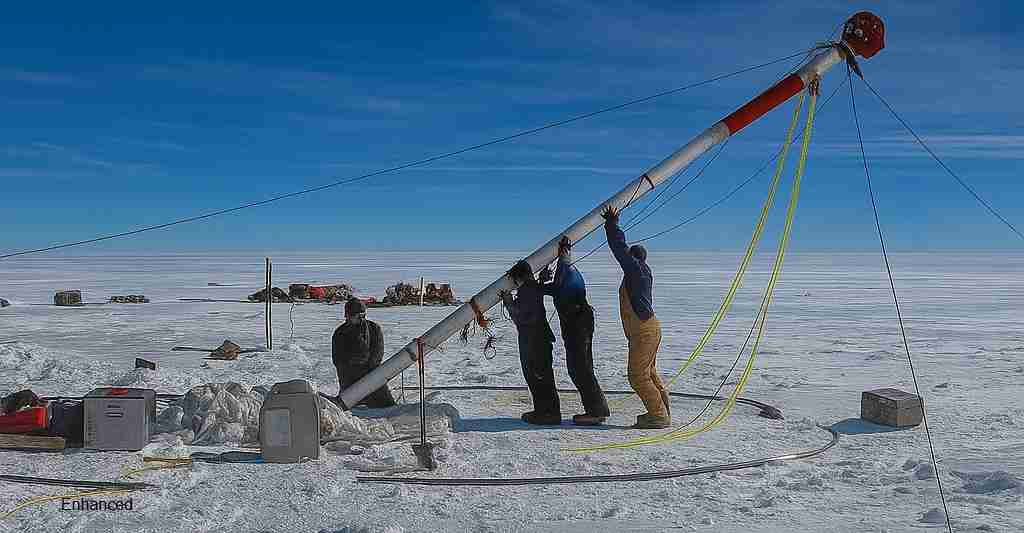
Six-million-year-old ice found in Allan Hills, Antarctica, contains ancient atmospheric air — a new “time machine” for climate science
Scientists have recovered approximately six million-year-old ice in Allan Hills, East Antarctica — the oldest directly dated ice and trapped-air sample yet — providing an unprecedented time-machine view of Earth’s warmer prehistoric atmospheres and long-term climate change.
- Oldest directly dated ice and air: Samples dated to ~6 million years provide the earliest direct snapshots of ancient atmospheres (WHOI; PNAS).
- Direct noble-gas dating: Argon isotope measurements in trapped bubbles give much firmer ages than indirect methods (University of Maine; WHOI).
- Climate context: Oxygen isotopes point to ~12°C (22°F) long-term cooling in the region over 6 million years, and trapped gases allow direct greenhouse-gas measurement (PNAS).
A rare window into deep time
Researchers describe the find as a literal time machine. Air bubbles trapped in Allan Hills blue ice act as sealed capsules of ancient atmospheres. By measuring gases and isotopes in those bubbles, scientists can reconstruct past temperatures, greenhouse-gas concentrations, and atmospheric chemistry directly — extending paleoclimate observations far beyond previously studied Antarctic cores (WHOI; PNAS).
How the ice was dated
Dating hinged on a novel, direct approach: measurements of a noble-gas isotope of argon trapped inside the air bubbles. Noble gases are chemically inert and preserve a reliable clock within the ice, producing much tighter age estimates than approaches that infer age from layer counting or model extrapolation (WHOI; University of Maine).
Scientific significance: cooling, greenhouse gases and context
Early oxygen-isotope results indicate a long-term cooling of roughly 12°C (22°F) in this part of Antarctica over the last 6 million years — consistent with geologic evidence of Earth’s transition from the warmer Pliocene/Miocene toward Pleistocene glaciations. Crucially, the trapped air permits direct measurement of greenhouse gases such as CO2 and CH4 from deep time, improving understanding of the climate system’s response to long-term forcings and helping to refine models used for future projections (PNAS; WHOI).
Why Allan Hills yields ancient ice
Allan Hills’ local topography — winds, ice flow patterns and exposed blue-ice areas — brings very old layers close to the surface. That accessibility enables recovery of ancient ice without the massive deep-drilling campaigns used at central Antarctic sites. The trade-off: Allan Hills provides discontinuous snapshots rather than continuous, year-by-year records, making its data complementary to longer, younger cores (University of Maine).
Research teams and methods
The Center for Oldest Ice Exploration (COLDEX), led by Oregon State University with 15 U.S. partner institutions, coordinated field sampling and laboratory analysis. The interdisciplinary program combined field extraction in Allan Hills with state-of-the-art isotope laboratories to measure noble gases and oxygen isotopes, cross-checking ages and atmospheric composition with independent methods to strengthen confidence (WHOI; PNAS).
Limitations and what this does not show
Scientists emphasize that Allan Hills samples are snapshots. They do not provide an unbroken, continuous timeline stretching back millions of years, and therefore cannot alone resolve short-term events or year-to-year greenhouse-gas variability. The samples are most valuable when combined with marine, terrestrial and younger ice-core records for cross-validation (PNAS; University of Maine).
Next steps: more drilling, broader analysis
Teams plan follow-up expeditions, with additional drilling and sampling slated between 2026 and 2031 to expand the number of snapshots and to search for even older ice. Laboratory campaigns will analyze greenhouse gases, trace elements and isotopes to reconstruct ancient ocean heat and atmospheric chemistry across multiple samples (WHOI).
Supplementary material and outreach
The project has released summaries and visual materials for public audiences, including short video explainers that show how teams sample blue ice and extract trapped air bubbles for analysis. Visuals aim to make technical work accessible to non-experts and policymakers (Project video).
Implications for Utah
Economic impact
- Research spin-offs: Utah-based companies and universities could partner on laboratory analysis, instrumentation and cryogenic technologies developed for Antarctic research, creating commercial applications in energy, mining and environmental monitoring.
- Funding and jobs: Federal and private grants may flow to state institutions with Earth-science capacity, creating high-skill research jobs and contracts for labs and contractors in Utah.
Political consequences
For policy audiences in Utah, direct measurements of ancient atmospheric air strengthen the scientific record on natural climate variability over millions of years. These data can inform state-level decisions on water management, infrastructure planning and long-term energy strategy without prescribing one-size-fits-all federal solutions.
Social effects
Local governments can use improved paleoclimate context to assess drought and wildfire risk and to prioritize practical measures — such as water-conservation infrastructure and emergency-response improvements — that align with local control and fiscal prudence.
Cultural relevance
Deep-time climate records underscore stewardship values many Utah communities hold. Framing the discovery in terms of local conservation and responsible resource use helps make the science culturally relevant and actionable.
Practical applications for residents
- Resource planning: Planners can refine assumptions about water-supply variability and design infrastructure for a broader range of historical conditions.
- Public safety: Emergency managers can prioritize wildfire mitigation, flood control and critical-infrastructure protection based on improved long-term climate context.
- Economic opportunity: Utah firms offering analytical services, remote sensing, cryogenic or lab equipment could win contracts as sampling and analysis expand.
Reporting sources and further reading
Primary reporting and scientific sources include:
- Woods Hole Oceanographic Institution (press release) — “Six million-year-old ice discovered in Antarctica offers unprecedented window into a warmer Earth.”
- Proceedings of the National Academy of Sciences (PNAS) paper — detailed peer-reviewed results and methods.
- University of Maine climate summary — “Ice core analysis reveals cooling period 6M years ago.”
- Project video — short visual explainer of field methods.
“This discovery provides an unprecedented window into Earth’s ancient atmosphere and will help refine our understanding of long-term climate dynamics.” — research teams reporting in WHOI and PNAS releases.