Scientists say Easter Island’s Moai “walked” — new study backs Rapa Nui oral tradition and solves archaeological mystery
New research combining 3D modeling, full-size replica experiments and physics analysis shows Easter Island’s Moai were moved upright in a rocking, pendulum-like motion — confirming Rapa Nui oral tradition and solving a long-standing archaeological mystery for generations.
Key takeaways
- Moai “walked” upright: Experimental archaeology and modeling show statues were pivoted forward in a controlled, rocking motion that resembles walking.
- Deliberate design: Many Moai have a forward tilt and D-shaped base that lower the center of mass and stabilize rocking movement.
- Small teams sufficient: Depending on size, teams as small as ~15 people could initiate movement and 5–25 could maintain it, reducing the need for large-scale logging.
- Oral tradition validated: The study provides scientific support for long-held Rapa Nui stories that the statues “walked” from the quarry.
How the research was done
Researchers combined high-resolution scanning and 3D modeling of 962 Moai with full-size replica construction and hands-on experiments. Teams tested rope placements, anchor points and coordinated pulls to recreate transport methods described in local tradition. The published summary is available via ScienceDaily.
The physics behind “walking”
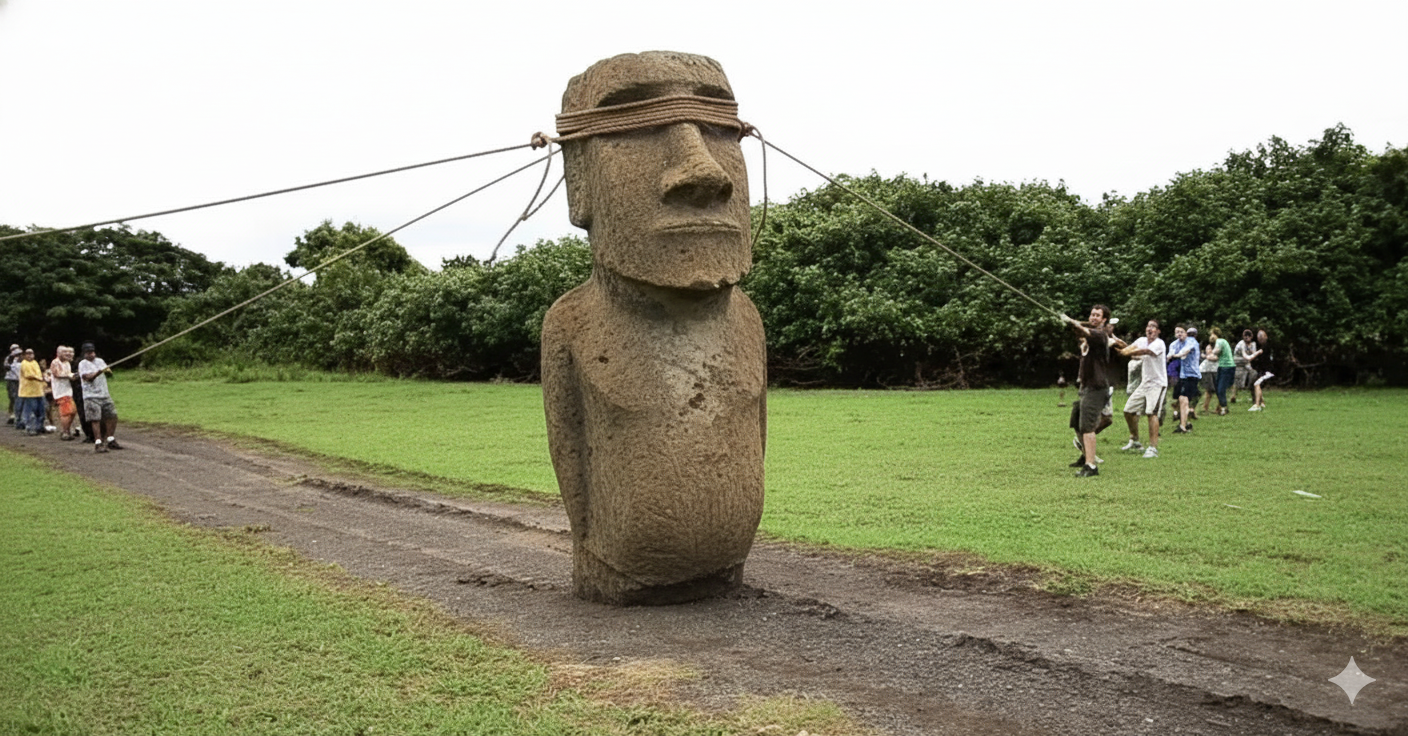
The method relies on simple mechanics: ropes on either side (and sometimes at the rear) tilt the statue slightly, then teams rock it side-to-side. Once rocking starts, pendulum dynamics assist forward pivoting so the base steps without tipping. Researchers liken it to moving a heavy appliance upright by shifting its contact points and rocking it forward.
Quote: “A rocking, pendulum-like motion can move the statues forward with surprising control and efficiency,” researchers write, reinforcing oral accounts of statues that ‘walked.’
Design features that made walking possible
The team found widespread intentional features: a subtle forward tilt and a D-shaped cross-section at the base. These design choices lowered the center of mass and increased stability during side-to-side rocking, suggesting carvers planned for transport at the quarry.
Labor and logistics: fewer people, less damage
Older theories required hundreds of people and extensive timber for sleds or rollers. This work shows much smaller crews could move the Moai: teams as small as 15 people could start movement and 5–25 maintain it. In physical trials, a replica moved 328 feet in 40 minutes with 18 people, challenging narratives that statue transport necessarily caused island-wide deforestation (LiveScience; Popular Mechanics).
Validation of Rapa Nui oral tradition
Rapa Nui elders have long recounted that the Moai “walked” from Rano Raraku quarry to ahu platforms. The new modeling and experiments align with those stories, offering a clear instance where indigenous knowledge and empirical science converge. The study is highlighted in reporting by ScienceDaily and local coverage (Local12).
Expert reaction and context
Outside archaeologists praised the study’s combination of statistical modeling and experiment. Many describe the work as ingenious and worthwhile, building on earlier proposals by scholars such as Carl Lipo and Terry Hunt. The research provides a larger dataset and more test runs, strengthening the walking hypothesis (LiveScience).
Why this matters now
Resolving how the Moai were moved answers a core question about human ingenuity: how islanders transported multi-ton statues across rugged terrain without modern machines. The findings emphasize planning, teamwork and simple tools, and they revise assumptions about environmental impact and resource use during the Moai-building era.
Implications for Utah
Though geographically distant, the study offers practical lessons for Utah communities in three areas:
- Tourism and cultural programming: Present indigenous stories with respect and scientific context — engage community voices and test claims carefully, as this study did.
- Engineering and education: Use the Moai example in classrooms and workforce programs to teach mechanics, modeling and low‑cost experimental methods.
- Conservation policy: Re-examine assumptions about cause and effect before enacting broad land-use changes; local knowledge may point to efficient, low-impact solutions.
Archaeological mystery solved — and what comes next
Many researchers now regard the walking hypothesis as persuasive, but archaeology remains iterative. Future work will refine details about community organization, pathway use and local collaboration. For now, the Journal of Archaeological Science study gives strong physical proof that the Easter Island Moai walked — a finding that both respects Rapa Nui oral tradition and reframes historical narratives about the island’s past.
Methods and sources
Key reporting and resources:
- LiveScience
- ScienceDaily (summary of the Journal of Archaeological Science paper)
- Local12
- Popular Mechanics
- Fox News
- University of Arizona researcher profile and publications