
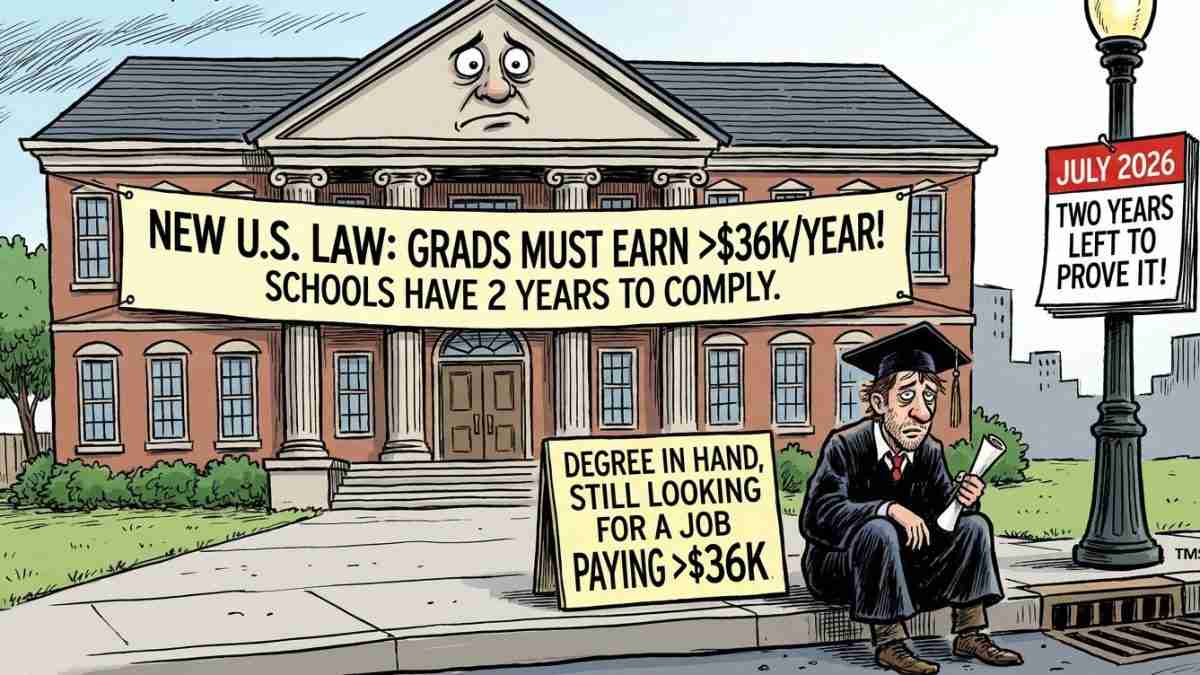
WASHINGTON, July 21 (DC Times Online) — The U.S. Department of Education has issued a final rule that could cut off federal student aid for college programs whose graduates do not earn enough after they finish school.
The new framework, called the Student Tuition and Transparency System, or STATS, and Earnings Accountability rule, applies to nearly all programs and sectors that participate in federal aid. In simple terms, the department says programs will now be judged on whether their graduates do better in the labor market than people with only a high school diploma or, for graduate programs, a bachelor’s degree.
What the rule does
Under the rule, undergraduate programs must show that their graduates earn more than the typical high school diploma holder. Graduate programs must show that their graduates earn more than the typical bachelor’s degree holder.
If a program fails that earnings test in two out of three consecutive award years, it loses eligibility for the federal Direct Loan program. If the failures continue for three years, the department says it can also end Title IV eligibility, including Pell Grants, for all of an institution’s low-earning outcome programs.
Title IV is the section of federal law that covers most federal student aid. Direct Loans are federal student loans. Pell Grants are need-based grants that do not have to be repaid.
How the department will measure programs
The department says schools will have to report program-level and some student-level data, including tuition, fees, and financial aid awards such as grants and scholarships. The regulations say the department will use earnings data from at least one federal agency, and that the earnings counts will include students who are working and not enrolled during the measurement year.
That matters because the rule is not based only on what a school charges. It is built around what graduates earn after leaving a program.
Who is covered
The department says the final rule creates one earnings-accountability framework for nearly all programs, regardless of tax status or credential level. It is meant to bring together the new earnings standard in the Working Families Tax Cuts Act with existing Financial Value Transparency and Gainful Employment rules.
That means the rule is not limited to one type of college or to one kind of degree. It reaches across the federal student-aid system.
Who gets special treatment
The department says some programs that prepare students for jobs where a majority of workers receive tipped income will have their consequences delayed. The reason, according to the department, is to allow the government to use earnings data from tax years when the No Tax on Tips policy is in effect, beginning with the 2026 tax year.
The rule also gives two blanket exemptions. An institution is not subject to automatic loss of Title IV eligibility if it has not participated in the Direct Loan program for the five most recently completed award years. The same exemption applies to institutions that exclusively serve people with documented disabilities.
Why the department says it is doing this
The department says the rule is meant to make federal aid more accountable by focusing on whether a program leaves students financially better off. The agency says the final rule will be published in the Federal Register and then used to help identify programs that do not clear the earnings standard.
The department has not named any specific college or program as a low-earning outcome program under the new rule yet.
For students and families, the practical effect is straightforward: a college program that does not lead to stronger earnings could lose access to federal loans, and eventually grants, making it harder for new students to pay for it with federal aid.
