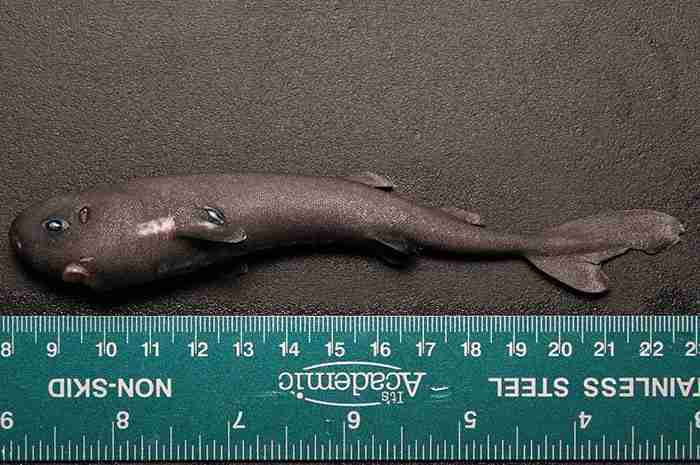
Scientists identify tiny “American pocket shark” in Gulf of Mexico — Mollisquama mississippiensis, a glowing deep-sea shark smaller than your hand
Scientists have identified Mollisquama mississippiensis, the American pocket shark, a glowing deep‑sea species about 14 centimeters long found in the Gulf of Mexico; this tiny bioluminescent shark sheds light on little‑known deep‑ocean diversity and highlights museum collections and modern imaging.
Key takeaways
- New species: Tulane University News documents Mollisquama mississippiensis, the American pocket shark.
- Tiny and bioluminescent: The specimen measures about 14 centimeters (5.5 inches) and bears photophores plus two pocket-like glands that may secrete luminous fluid.
- Extremely rare: Known from a single American specimen; only one other pocket shark species (Mollisquama parini) is known worldwide.
- Methods matter: External exams, X‑rays and high-resolution CT scans in museum collections enabled the species identification.
Main story
Discovery and identification
The lone American pocket shark was recovered from deep waters of the Gulf of Mexico in 2010 during work that included sampling sperm whale stomach contents. The preserved specimen was later incorporated into Tulane University’s Royal D. Suttkus Fish Collection and, after detailed study, was formally described as a new species in 2019.
Researchers relied on a combination of traditional taxonomy and modern imaging: careful external examination, X‑rays, and high-resolution CT scans were used to map bones, cartilage and soft tissue. These images revealed distinct differences in vertebrae, light organ placement and the size and shape of the characteristic pocket glands versus the Pacific species.
For detailed coverage see Tulane University News and the summary at Wikipedia.
Taxonomy and physical description
Mollisquama mississippiensis is a member of the family Dalatiidae (kitefin sharks), in the order Squaliformes. The shark has a bulbous head, a short cylindrical body, and a mouth located on the underside of the head. Coloration is generally grey with darker fins and cream-colored areas near the gills.
Teeth are arranged so that the lower jaw teeth overlap the upper teeth when the mouth is closed. Most notable are the skin’s photophores — light-producing organs — and the two small “pocket” glands adjacent to the gills that appear capable of storing and releasing a luminous fluid.
Bioluminescence and likely behavior
The shark’s light-producing anatomy suggests several possible ecological roles. In deep water, organisms often use light for counter-illumination (masking their silhouette against downwelling light), for attracting prey, or for communication. The pocket glands may function to release luminous fluid that could lure prey or disorient predators, but their exact role remains under study.
Coverage exploring these behaviors is available from The Archaeologist and specialist commentary such as Sophie Maycock / SharkSpeak.
Rarity and scientific value
Only two pocket shark species are known to science: the Pacific pocket shark (Mollisquama parini), found off Chile in 1979, and the American pocket shark (Mollisquama mississippiensis), known from a single Gulf of Mexico specimen. That rarity makes each specimen invaluable for understanding anatomy, evolution and deep‑sea diversity.
The discovery underscores how much of the deep ocean remains unexplored and how museum collections can contain undescribed biodiversity awaiting modern analysis.
Conservation, unknowns and next steps
With only one specimen available, the conservation status of Mollisquama mississippiensis cannot be determined. The species appears to inhabit deep waters that are difficult to sample with conventional gear. Researchers call for more targeted deep-sea surveys and improved access to preserved collections and imaging resources.
Key research needs include determining the species’ range, population size, diet and reproductive biology — data that are essential for any conservation assessment and for understanding Gulf of Mexico ecosystem dynamics that support fisheries and coastal economies.
Why this matters to scientists — and taxpayers
This case highlights the payoff from steady investment in basic science, museum curation and modern imaging tools. The specimen sat in a university collection for years before high-resolution imaging and expert analysis established it as a new species. As researchers note, such work often uses a combination of federal and academic resources to produce lasting scientific returns.
“A small but powerful reminder that scientific knowledge grows slowly, often through careful preservation, modern imaging and patient study.”
Implications for Utah
Economic impact: Although Utah is landlocked, state universities and private companies that specialize in imaging, remote sensors and data analysis can win federal research contracts related to marine science. The same advanced CT scanning and digital archiving technologies used in this identification also serve medical devices, industrial inspection and high-tech startups.
Political consequences: The discovery underscores the role of federal agencies and university collections in basic research. For Utah policymakers, the story supports targeted research funding, public‑private partnerships and grants that keep scientific capabilities within the U.S.
Social and cultural effects: The tiny glowing shark offers an accessible narrative to inspire students and families, bolstering STEM education efforts. Utah schools and outreach programs can use the story to promote careers in imaging, biology and engineering and to retain talent in-state.
Practical steps for residents: Encourage state institutions such as the University of Utah and Brigham Young University to pursue marine-imaging grants, internships with federal agencies like NOAA, and public engagement by federal researchers. These steps can attract federal dollars, high-tech jobs and student opportunities back to Utah.