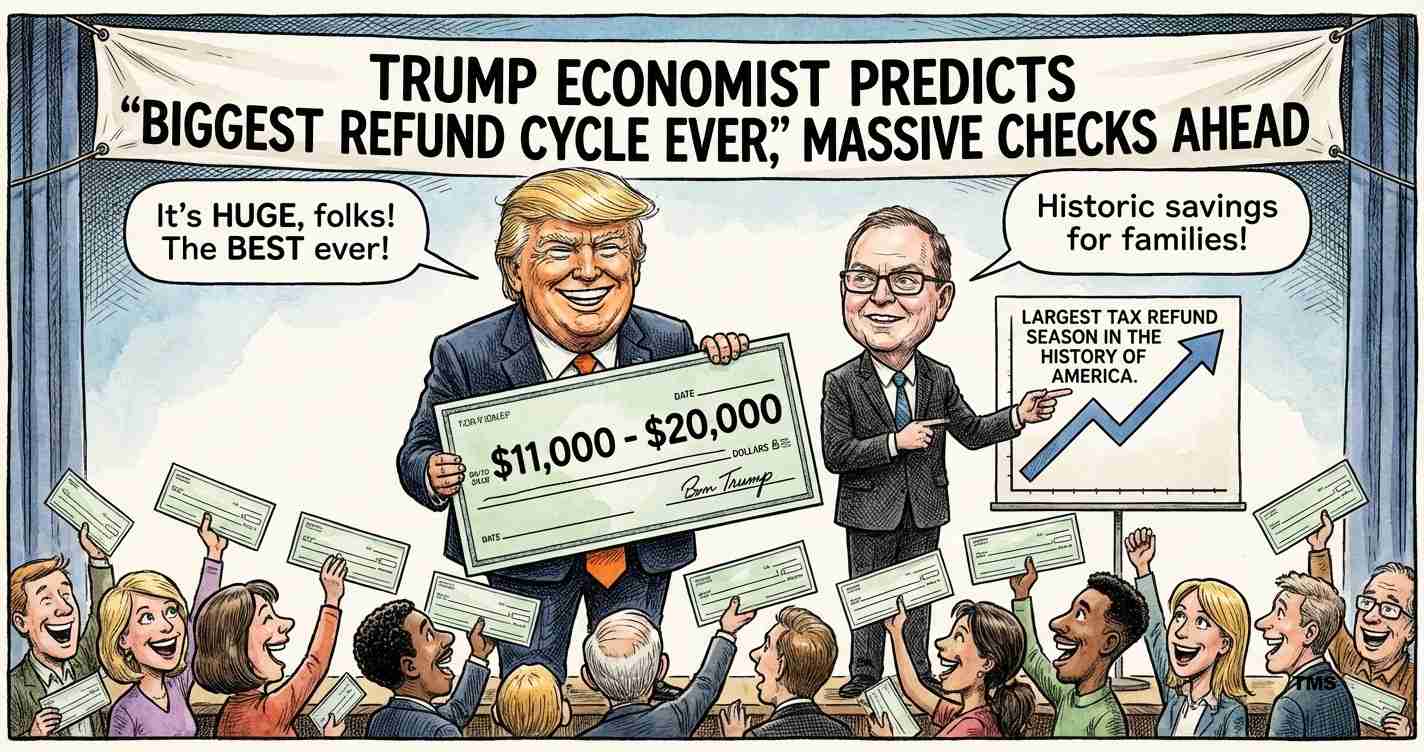
Trump economists say “Massive 2026 Tax Refunds” are coming after One Big Beautiful Bill Act — families could see $11K–$20K in savings, officials predict
American families could receive the “biggest refund cycle ever” in spring 2026 after the One Big Beautiful Bill Act, with officials projecting billions in refunds and an average household boost of about $1,000 driven by expanded deductions.
- Officials predict a large refund season: the White House calls 2026 the “largest tax refund season in American history,” driven by provisions in the One Big Beautiful Bill Act and late passage effects (CPA Practice Advisor).
- Average household gains: the administration projects roughly a $1,000 average boost per household, with some estimates of $1,000–$2,000 or higher in specific cases.
- Timing drives refunds: mid-2025 passage meant 2025 withholding didn’t reflect new rules, producing reconciliations and larger refunds in spring 2026.
What officials are saying
Kevin Hassett, director of the National Economic Council, told reporters the combination of late passage and the law’s design will produce unusually large refunds next spring; he called it the “biggest refund cycle ever” with “massive refund checks” and pointed to wage gains and low core inflation as evidence that workers are gaining ground (Fox Business).
President Trump framed potential household savings more dramatically, saying some families could see annual savings of $11,000 to $20,000. White House Press Secretary Karoline Leavitt and Treasury officials offered more measured averages — Leavitt cited about $1,000 more in refunds for households in 2026, while Treasury Secretary Scott Bessent suggested gains of $1,000–$2,000 in many cases (CPA Practice Advisor).
How the timing creates a refund spike
Tax experts and administration officials say the key driver is timing. Because many of the law’s changes applied to 2025 income but the bill did not pass until mid-summer 2025, withholding (W-4) and payroll calculations early in the year did not reflect larger standard deductions, an expanded child tax credit, or exemptions on tips and overtime. That mismatch means many filers will see larger refunds when their 2025 returns are reconciled in spring 2026 (Fox Business).
Specific provisions that boost refunds
Several provisions in the One Big Beautiful Bill Act are central to the predicted “Massive 2026 Tax Refunds.” Key elements include:
- Higher standard deductions for 2025: e.g., $31,500 for married filing jointly, $15,750 for single filers, and $23,625 for head of household, with inflation indexing (IRS; TurboTax/Intuit).
- Larger child tax credit: boosts refunds for families with children (TurboTax/Intuit).
- Restored or expanded qualified business income deductions: a 20% rate for eligible filers (TurboTax/Intuit).
- Higher SALT cap: a $40,000 state and local tax deduction cap for 2026–2029, adjusted annually (TurboTax/Intuit).
- Vehicle loan interest deduction: up to $10,000 for interest on certain vehicle loans with phaseouts for higher earners (TurboTax/Intuit).
- Tax exemptions: tips, overtime and certain Social Security income are treated in ways that can reduce federal tax liabilities (CPA Practice Advisor).
Administration numbers vs. public sentiment
Administration officials highlight wage growth (roughly 3.7%) and low core inflation (~1.6%) as signs of real wage gains, and they emphasize the projected $91 billion in additional refunds plus an estimated $30 billion from reduced withholding. But public polling shows unease: a recent Fox News Poll found 44% say they are falling behind financially and 74% view the economy as not so good or poor — a contrast the administration contests (Fox Business).
How refunds and withholding changes will play out
There are two main channels for the projected household boost:
- Refunds in spring 2026: filing 2025 returns will reconcile taxes owed under the new rules with taxes withheld under the old rules, producing larger refunds for many filers.
- Reduced withholding in 2026: updated Treasury guidance and W-4 instructions will lower payroll withholding, putting more money in paychecks throughout 2026 — officials estimate roughly $30 billion could flow to workers this way (CPA Practice Advisor).
What to watch for
Taxpayers should monitor updated IRS guidance and W-4 instructions in early 2026. Employers will receive details on withholding changes; tax preparers and software providers will update forms and calculators ahead of filing season.
Implications for Utah
Economic impact
Direct household relief: Utah families may benefit from larger refunds and higher take-home pay. The larger standard deduction and expanded child tax credit are likely to help middle-income households and families with children — an important demographic in many Utah counties (CPA Practice Advisor; TurboTax).
Local spending and small business lift: refund checks and higher paychecks could stimulate spending in retail, restaurants and services across Salt Lake City, Provo, St. George and other Utah communities, potentially boosting small-business revenue and seasonal hiring in tourism and construction.
Political consequences
Message for conservatives: the tax changes and promised family savings may reinforce tax-cut and pro-family messaging among Utah’s conservative voters.
Voter expectations and accountability: if refunds or withholding adjustments don’t match expectations, local officials and candidates may face pressure — clear communication on timing and amounts will be crucial given ongoing economic unease (see Fox Business polling references).
Social effects
Reduced short-term financial stress: for households living paycheck to paycheck, even an extra $1,000 or a larger refund can help with bills, medical costs or debt repayment — especially meaningful in rural Utah counties with limited credit access.
Targeted benefits for families: the enhanced child tax credit and other family-focused provisions are likely to aid households with children, a sizable demographic in Utah.
Practical guidance for Utah residents
- Update withholding: check IRS and employer guidance on W-4 updates in early 2026 to benefit from reduced withholding (IRS).
- Consult tax preparers: plan to use updated tax software or professional advice when filing 2026 returns to claim new deductions and credits correctly.
- Track refund timelines: the IRS will publish processing schedules — plan for timing variability if relying on refunds for major expenses.
Reporting and sources
This article draws on statements and reporting from multiple outlets and official summaries, including:
- Fox Business: “Trump economist predicts biggest refund cycle ever, massive checks ahead.”
- CPA Practice Advisor: “Here’s why Americans could see a $1,000 increase in tax refunds next year.”
- IRS: One Big Beautiful Bill Act provisions summary.
- TurboTax/Intuit: overview of tax law changes and provisions.
Readers in Utah should monitor IRS updates and consult local tax preparers as the 2026 filing season approaches to understand precisely how the One Big Beautiful Bill Act will affect individual refunds and paychecks.