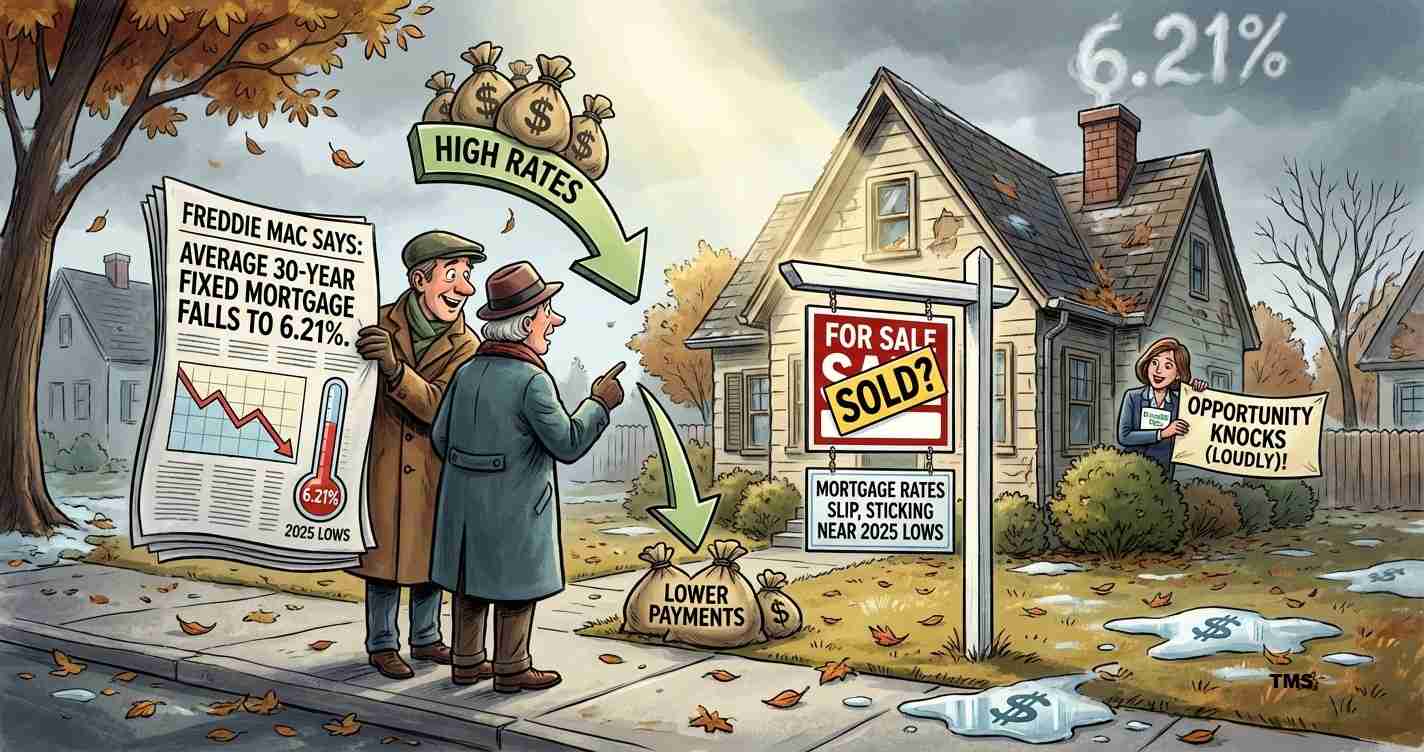
Mortgage rates slip near 2025 lows as 30-year fixed mortgage rate falls to 6.21%
The average 30-year fixed mortgage rate fell to 6.21% for the week ending Dec. 18, 2025, per Freddie Mac, keeping rates near 2025 lows after a recent Federal Reserve rate cut — potentially easing borrowing conditions for December homebuyers.
- Freddie Mac weekly survey: 30-year fixed at 6.21% for the week ending Dec. 18, 2025; data cited by Mortgage News Daily and Fox Business.
- Fed action: A 25-basis-point cut lowered the fed funds range to 4.25%–4.50%, a factor in recent easing though mortgages track longer-term yields (Fox Business).
- Benchmark to watch: Mortgage pricing follows the 10-year Treasury yield, which hovered near 4.12%, influencing lenders’ long-term pricing (Federal Reserve H.15).
- Local impact (Utah): Slightly lower rates can help buying power, but affordability remains constrained by high home prices and limited supply.
What the numbers show
Freddie Mac’s weekly measure placed the average 30-year fixed mortgage rate at 6.21% for the week ending Dec. 18, a small slip from the prior week that keeps rates near their lowest levels of 2025. Daily trackers show short-term movement: Mortgage News Daily reported 6.22% on Dec. 18 and 6.25% on Dec. 19, while The Mortgage Reports and partner networks indicated conventional 30-year offers around 6.25% in mid-December.
Why the Fed move matters — and why it does not move mortgages directly
The Federal Reserve cut its benchmark rate by 25 basis points last week, lowering the fed funds range to 4.25%–4.50%. That headline action signals modest easing of short-term policy, but conventional mortgage rates are set mostly by the bond market and lenders’ hedging rather than the Fed-controlled short-term rate (Fox Business).
When the Fed cuts, investor expectations about growth and inflation can change — sometimes pushing Treasury yields down. Because lenders price long-term loans off the 10-year Treasury yield, declines there often pull mortgage rates lower. In the current episode, the 10-year near 4.12% supported the slide to roughly 6.21% on the 30-year fixed (Federal Reserve H.15).
Market reactions and daily rate detail
Mortgage lenders and aggregators reported small daily moves after the Fed action. The Mortgage Reports listed conventional 30-year offers near 6.251% with modest declines across FHA, VA and shorter-term fixed programs on Dec. 20. Trackers such as Mortgage News Daily show short swings as trading in Treasuries and mortgage-backed securities changes pricing within hours.
For broader context, the FRED mortgage series and Mortgage Bankers Association surveys show current rates remain above the ultra-low era before 2022, even as they ease from recent peaks.
What this means for buyers, refinancers and lenders
Buyers: A move toward 6.2% can lower monthly payments compared with mid-6% figures earlier in the year, expanding affordability for some buyers. However, high home prices in many Utah markets keep overall affordability tight.
Refinancers: Homeowners who locked very high rates earlier may find a modest window to refinance, but savings must exceed fees and meet household plans. Lenders still require strong credit and stable income.
Lenders & the market: Declines in the 10-year yield can let lenders offer slightly better terms, but funding costs, reserves and investor demand also shape actual offers.
Local economic and policy context for Utah
Utah’s economy has experienced strong job growth and in-migration, sustaining housing demand and competitive markets. Even with mortgage rates drifting down, buyers in Utah face lower borrowing costs paired with limited supply in many cities — a dual dynamic that keeps affordability constrained.
Implications for Utah
Economic and housing effects:
- Market opportunity: Rate relief near 6.2% may bring some Utah buyers back into the market or increase purchasing power in counties such as Salt Lake and Utah County (Mortgage News Daily).
- Affordability challenge: High local prices mean many buyers still face tight budgets unless incomes rise or supply expands (The Mortgage Reports).
Political and policy consequences:
- State and local leaders may press for supply-side reforms — zoning changes and development incentives — to pair with modest financing improvements.
- Conservative households focused on fiscal caution may view current rates as an opportunity to lock favorable terms when refinancing or buying aligns with long-term plans.
Social and community impacts:
- First-time buyers: A modest rate decline can bring some younger families closer to ownership; counseling and down-payment assistance can amplify benefits.
- Rural and exurban opportunities: Lower rates may make outlying areas more attractive for families seeking larger homes at lower per-square-foot cost.
Practical steps for Utah homeowners and buyers
- Shop multiple lenders: Rates vary by lender, credit score and program; comparison can yield savings (The Mortgage Reports).
- Consider total costs: APR and fees matter; a lower rate with high fees can cost more than a slightly higher rate with low fees.
- Weigh timing: For long-term owners, locking a 30-year fixed rate near current levels can provide budget certainty; short-term plans may warrant adjustable options with professional advice.
Sources
- Mortgage News Daily: 30-Year Fixed Mortgage Rates
- Fox Business: Mortgage rates December 18, 2025
- The Mortgage Reports: 30-year mortgage rates
- Federal Reserve H.15 data (yield curves)
- FRED: 30-Year Fixed Rate Mortgage Average
Reporter: Times Media Service