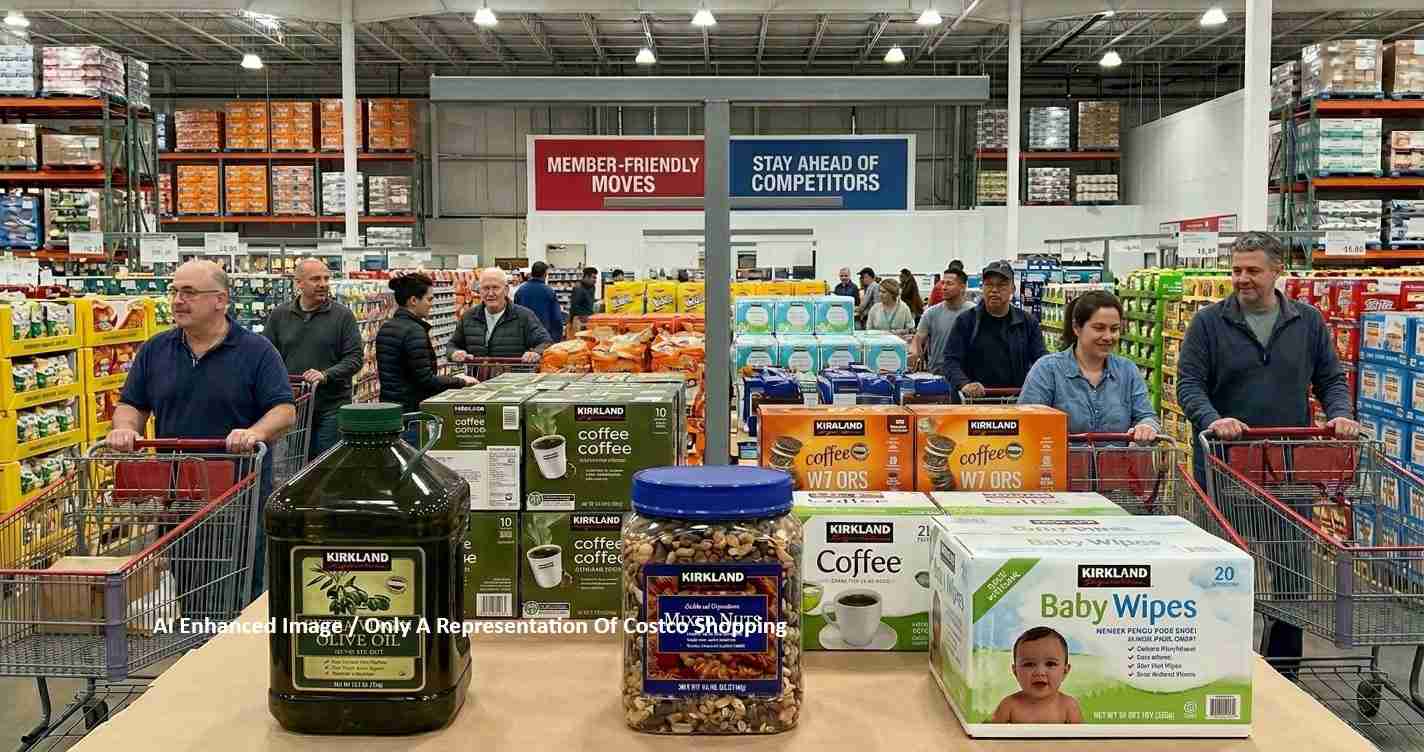
Costco quietly trims prices on Kirkland Signature items, offering relief for shoppers as company doubles down on value
Costco quietly cut prices on several Kirkland Signature items — from snacks to sheets and golf balls — saying the selective reductions reinforce its pledge to be “the first to lower prices and last to raise them,” benefiting members nationwide.
Key takeaways
- Selective price cuts: At least four Kirkland Signature items received targeted reductions, spanning food, home goods and sporting equipment.
- Company message: Executives framed the move as part of a broader pricing strategy to protect member value.
- Local impact: Utah households and bulk buyers may see modest savings; members should confirm local warehouse pricing and availability.
Main story
What Costco said and what it didn’t
On its May 28 earnings call, Costco executives described the price reductions as deliberate and strategic. CEO Ron Vachris emphasized value with the line:
“Our goal is to be the first to lower prices and last to raise them.”
CFO Gary Millerchip noted the company looks to lower prices “where we see opportunities to do so” and pointed to past examples where cuts boosted volume — for example, a reported 13% reduction in KS boneless chicken tenders that lifted pounds sold by about 21% (sales-impact context previously reported by industry coverage). Media coverage of the call and comments is summarized by Fox Business.
Which Kirkland items were affected
Media reporting identified at least four specific Kirkland Signature products with price reductions. Reported changes include:
- KS Crispy Wings — from $16.99 to $14.99 (source: Fox Business).
- KS Milk Chocolate Almonds — from $19.99 to $18.99 (source: Fox Business).
- KS Golf Balls — from $32.99 to $29.99 (source: Fox Business).
- KS King Size Sheets — from $89.99 to $79.99 (source: Fox Business).
These selective reductions — roughly $1 to $10 per item — reflect a pattern of targeted price management rather than a broad Kirkland-wide markdown.
Why shoppers noticed price creep
Shoppers used social platforms to call out price increases on certain Kirkland items, notably the chocolate-covered almonds, where posts tracked price swings and consumer frustration in the U.S. and Canada. For bulk-buying households, even small unit-price moves are highly visible and can strain budgets.
A record of periodic price cuts
This is not the first time Costco has trimmed Kirkland prices. In 2024 the company cut prices on several items, presented as part of the same effort to protect member value. Reported prior reductions include:
- KS macadamia nuts — $18.99 to $13.99
- Spanish olive oil (3-liter) — $38.99 to $34.99
- Standard foil — $31.99 to $29.99
- Laundry packs — $19.99 to $18.99
- Baguette two-pack — $5.99 to $4.99
Coverage of prior moves and their sales effects is summarized by LiveNOW from Fox and other industry trackers.
Supply chain and sourcing shifts as a factor
Industry analysts have noted that Costco increasingly moves Kirkland sourcing closer to the regions where products are sold to cut shipping costs and reduce tariff exposure. Although Costco did not cite logistics on the May 28 call, public reporting links regional sourcing and supply-chain adjustments to prior price moves and to the company’s ability to hold lower prices (context in analyses by MoneyTalksNews).
How the moves play into competition
Costco’s private-label strategy is designed to undercut national brands and keep members returning. The “first to lower, last to raise” message seeks to make price stability a competitive advantage, putting pressure on smaller retailers that cannot match Costco’s scale.
What shoppers can expect
Practical guidance: The cuts are limited and selective. Members should:
- Check local warehouse signage and online listings for exact pricing and availability.
- Be aware of quantity limits, regional assortment differences and staggered rollouts.
- Consider stocking up when a favored Kirkland item shows a confirmed, permanent reduction.
Implications for Utah
Economic impact: Utah has many bulk-shopping households; small per-item savings can add up for large families, nonprofits and small businesses that buy in volume.
Political consequences: In conservative-leaning communities, messages about private-sector price relief and household stewardship resonate; policymakers may cite such moves as market-driven easing of cost pressures.
Social and cultural effects: Larger household sizes and active outdoor lifestyles in Utah make bulk price changes meaningful — even lower-cost sporting goods like golf balls can matter to recreational budgets and community programs.
Practical applications for Utah shoppers: Watch local warehouses and online listings; small per-unit savings on staples can free up household dollars for other local spending.
Questions for local leaders and retailers
- How do high-value retailers like Costco shape local retail competition and household budgets?
- Should local grocers adjust promotions or emphasize unique offerings to compete with bulk prices?
- How can city officials leverage the presence of strong-value retailers for economic stability messaging?
Sources and further reading
Full reporting and context are available from the following sources:
- Fox Business reporting on the May 28 call and the recent price cuts
- LiveNOW from Fox review of prior Kirkland price cuts and sales impacts
- MoneyTalksNews roundup of Costco items that have gotten cheaper and sourcing moves
Note: Members should confirm local pricing and availability, as quantity limits, regional assortment differences and rollout timing can affect whether a given warehouse reflects these reductions.