Iceberg A-23A nears final disintegration as rapid melt accelerates in the South Atlantic
Iceberg A-23A, a colossal tabular iceberg that calved from the Filchner–Ronne Ice Shelf in 1986, is now nearing complete disintegration in the South Atlantic as it rapidly melts between South America and South Georgia Island.
Key takeaways
- Name and origin: Iceberg A-23A calved from the Filchner–Ronne Ice Shelf in 1986 and became grounded for over 30 years.
- Size decline: From ~4,000 km² at calving to roughly 1,100–1,200 km² in early 2026 per the NASA Earth Observatory and the U.S. National Ice Center.
- Dynamics: After floating free around 2020, the berg experienced grounding, a Taylor column trap, northward drift and major fragmentation in 2025.
- Scientific value: A-23A provides a rare, real-world dataset on megaberg melt mechanics, ecology and ocean interactions.
Overview and current status
Iceberg A-23A — sometimes written A23a — originated when a tabular portion of the Filchner–Ronne Ice Shelf broke away in 1986. At calving it measured about 4,000 km² (~1,544 sq mi), nearly twice the size of Rhode Island. After decades grounded in the southern Weddell Sea it refloated around 2020 and began a lengthy northward journey into the South Atlantic.
Agencies now estimate the berg’s area at roughly 1,100–1,200 km² in early 2026, a dramatic reduction from its peak but still larger than many major cities. These figures come from the NASA Earth Observatory analysis and the U.S. National Ice Center public products.
How A-23A formed and stayed grounded
After calving in 1986, A-23A became grounded on shallow seafloor in the Weddell Sea. That long grounding kept the iceberg from following typical drift patterns, allowing slow basal thinning over decades. The grounding and subsequent release are documented by the British Antarctic Survey and referenced in the Wikipedia — A23a entry.
Renewed motion and trapping in a Taylor column
Around 2020 A-23A regained buoyancy and began drifting north. During late 2023 and 2024 the berg interacted with complex oceanographic features, including becoming trapped over Pirie Bank in a rotating water column known as a Taylor column. That interaction caused the iceberg to spin in place for months instead of making steady northward progress, as described in a EUMETSAT case study.
Breaking free and heading toward South Georgia
By December 2024 A-23A exited the Taylor column and rejoined the Antarctic Circumpolar Current, moving toward the warmer South Atlantic and South Georgia Island. Approaching shallower zones near the island, it partially grounded again, raising concerns for local ecology and navigation (see British Antarctic Survey and Wikipedia).
Major fragmentation in 2025
Upon entering warmer waters in 2025 the berg began to fracture extensively. Satellite imagery and monitoring showed large pieces breaking away through mid-to-late 2025, some fragments hundreds of square kilometers in area — hazards for shipping in busy Southern Ocean lanes. The fragmentation led to the steep area decline documented by public tracking products.
Signs of rapid surface melt and structural failure
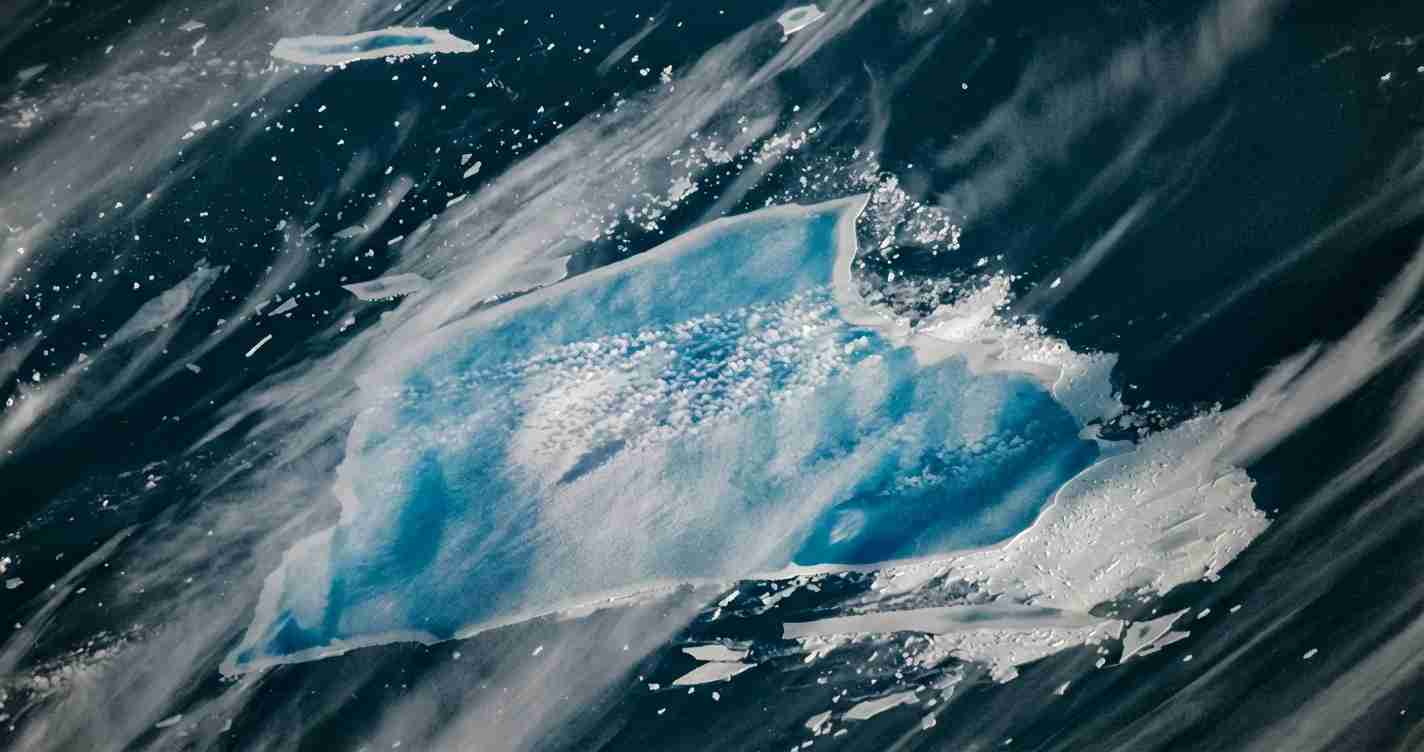
Recent photos from the NASA Earth Observatory and astronaut imagery show extensive bright blue melt ponds and water-filled crevasses on A-23A’s surface. These ponds concentrate solar heat, promote hydrofracture and can force cracks open. Scientists describe features such as “blue mush” and rampart–moat structures that often precede complete breakup.
“The berg is likely days to weeks from complete disintegration as it moves into warmer waters during the austral summer,” researchers including Ted Scambos and Chris Shuman have said in recent analyses.
Measured sizes and tracking data
Estimates vary by method and date. NASA cited U.S. National Ice Center area estimates near 1,182 km² in early January 2026 after major 2025 calvings. The NIC iceberg table listed dimensions translating to roughly 1,035–1,100 km² on 9 January 2026; while methods vary, all tracking agrees the mass has shrunk dramatically from 1986.
Why scientists are closely watching the disintegration
A-23A is a singular natural experiment: grounding, long-term persistence, Taylor column trapping and final breakup offer insights into megaberg lifecycles. Researchers collected water and ecological samples near the berg in 2023 using the research vessel RRS Sir David Attenborough; those data help interpret nutrient, phytoplankton and broader ocean-chemistry responses (see British Antarctic Survey and EUMETSAT).
Implications for Utah
Though Utah is landlocked, A-23A’s break-up has several indirect effects worth noting:
- Economic impact: Southern Ocean shipping disruptions and re-routing caused by large ice fragments can raise global freight costs, potentially affecting import prices in Utah.
- Fisheries and markets: Changes to Southern Ocean ecosystems from iceberg melt may alter seafood supply chains and prices, which reach consumers nationwide.
- Political and funding consequences: The event underscores the need for robust federal satellite monitoring, research funding and maritime surveillance — considerations for Utah’s congressional delegation and policy debates.
- Public engagement and education: The story is a powerful case study for Utah schools and universities on remote sensing, oceanography and supply-chain literacy.
Practical steps for Utah residents and organizations
Recommended actions include: monitor federal advisories from agencies like NOAA NESDIS and the U.S. National Ice Center; support STEM education that leverages satellite and oceanographic datasets; and use the A-23A story to teach supply-chain and environmental stewardship lessons in communities.
Sources and further reading
Reporting compiled from Times Media Service staff research and the sources below:
- NASA Earth Observatory — “Meltwater turns iceberg A-23A blue”
- British Antarctic Survey — “World’s largest iceberg grounds near South Georgia”
- Wikipedia — A23a
- NOAA NESDIS — “Tracking A23A, the world’s largest iceberg”
- EUMETSAT — Iceberg A‑23A through the decades
- U.S. National Ice Center iceberg products
Reporting compiled from Times Media Service staff research and the sources above.