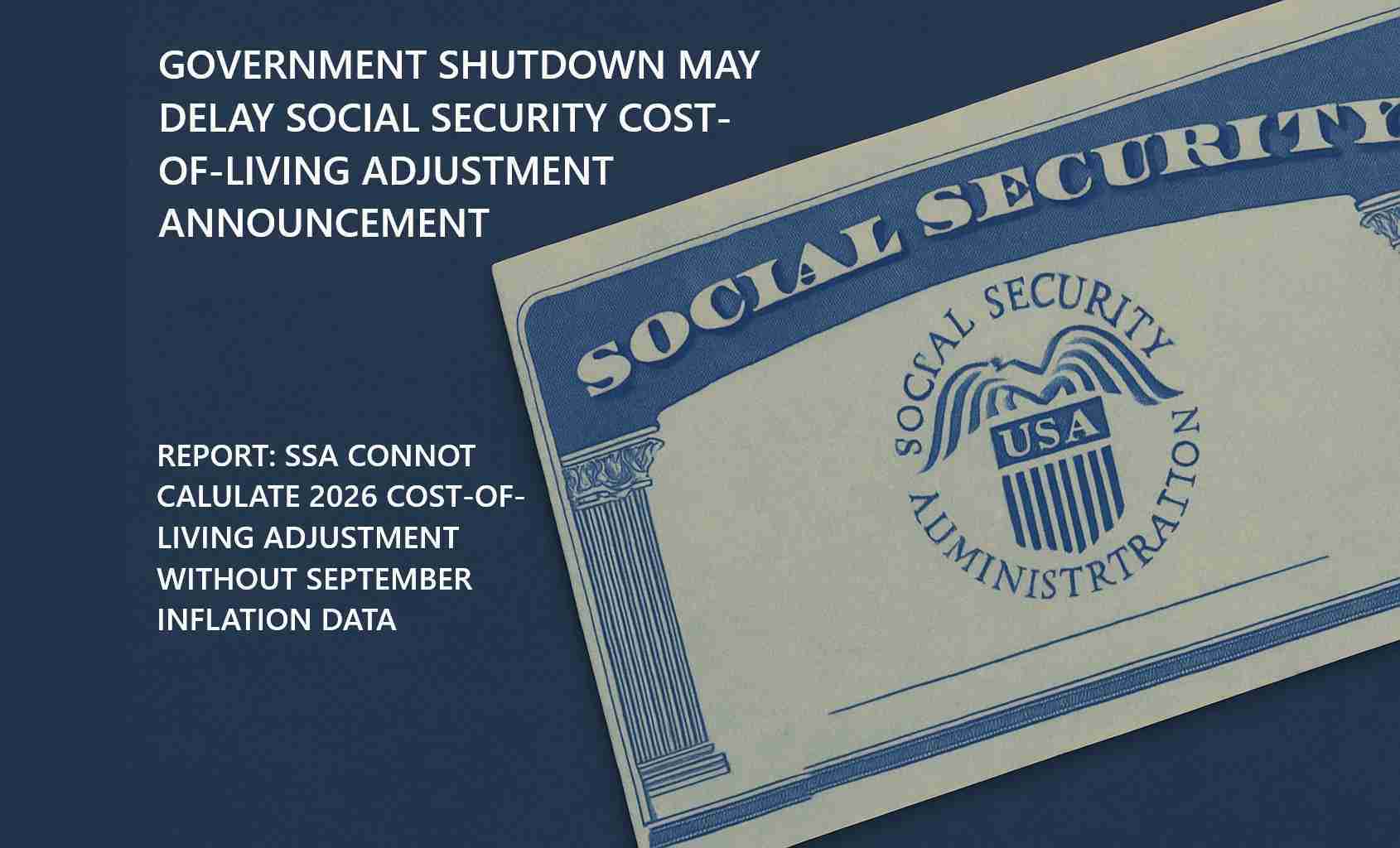
Government shutdown could trigger 2026 Social Security COLA delay, though payments would continue
A potential government shutdown in October 2025 threatens to delay the announcement of the 2026 Social Security COLA by postponing September inflation data. Benefits should continue, but the official COLA timing could be pushed back.
- Announcement risk: The SSA’s Oct. 15, 2025 announcement could be delayed if the BLS cannot publish the September CPI‑W on time (Fox Business).
- Payments protected: Social Security checks are expected to continue because the program is not subject to annual appropriations (AARP; Fox Business).
- Estimated impact: Independent forecasts put the likely 2026 COLA near 2.7%, roughly a $54 monthly increase on the average benefit (Globe Charter; Nasdaq).
- Local effects: Utah residents and service providers may face compressed planning time and increased demand for guidance if the announcement is delayed.
Why the 2026 Social Security COLA announcement could be delayed
The Social Security COLA is calculated from the Consumer Price Index for Urban Wage Earners and Clerical Workers (CPI‑W) for July, August and September. The Bureau of Labor Statistics normally publishes the September CPI‑W report in October. If a government shutdown in October 2025 leads to furloughs of BLS staff, the September CPI‑W may not be published on schedule, preventing the SSA from completing and legally publishing the COLA on its planned date. Reporting explains this timing link (Fox Business; AARP).
What a delayed COLA announcement would mean for beneficiaries
Important: A delayed announcement does not mean Social Security payments stop. Because benefits are funded outside annual appropriations, monthly checks are expected to continue even during a shutdown (AARP; Fox Business).
However, a delayed COLA creates uncertainty for retirees and fixed‑income households who use the annual increase to plan budgets, withdrawals, taxes and health‑care decisions. A late announcement could compress the time available to adjust before any January 2026 payment reflecting the new COLA begins.
How the COLA is calculated and the role of CPI‑W
The COLA compares the CPI‑W for July–September of the prior year with the same quarter in the previous year. The SSA needs the September CPI‑W figure to finish the calculation and legally publish the COLA amount on the scheduled date. Consumer and retirement observers offer detailed explainers on the mechanics and legal timing (AARP; Globe Charter).
Financial projections for the 2026 COLA
Independent analysts currently project a 2026 COLA near 2.7%, up from 2.5% in 2025. That estimate would increase the average monthly benefit by roughly $54 (moving an average payment from about $2,008 to about $2,062), based on inflation trends through August and forecasts for September (Globe Charter; Nasdaq).
If a delay is short, many analysts note that September data are often already collected before a shutdown begins and the published report can follow soon after federal workers return—minimizing practical disruption (Fox Business).
Historical precedent
A similar delay occurred during the 2013 shutdown: the COLA announcement was postponed until the BLS resumed operations and published the required CPI‑W data. Once the government reopened, the SSA issued the COLA and adjusted payments accordingly—showing that delays are possible but temporary (Fox Business).
Policy and practical considerations
Policy observers note that the September CPI‑W is often already collected when a shutdown begins, which can limit delays. Still, the process requires BLS staff to process and publish the data; a prolonged shutdown raises the chance of a multi‑week delay. Some analysts warn of a “lose‑lose” scenario where political brinkmanship both disrupts reporting and imposes economic and political costs (Nasdaq).
Expert commentary and sources
Experts emphasize that payments are protected but that transparency and timing are at risk if BLS releases are delayed. Summaries and reporting are available from AARP, Fox Business, Globe Charter and Nasdaq. A short video summary is also available (short video summary).
Implications for Utah
Economic impact
- Retirees and fixed‑income households in Utah rely on predictable benefits for rent, utilities and medical bills; a delayed COLA could compress planning time and increase demand for local guidance.
- Rural and conservative communities that emphasize certainty in retirement planning may respond to even short delays by cutting discretionary spending or seeking one‑time credit solutions.
Political consequences
- A shutdown that disrupts routine releases like the CPI‑W can become a local political issue. Constituents may pressure Utah’s congressional delegation to avoid brinkmanship that risks delaying benefits or announcements.
- Lawmakers could face scrutiny from voters seeking timely appropriations and stable government operations.
Social effects
- Nonprofits and faith‑based groups may need to scale outreach and reassure seniors that payments continue even if the COLA announcement is late.
- Local volunteer programs and county offices assisting with benefits should communicate clearly that monthly Social Security payments are expected to continue.
Cultural relevance
Utah’s civic culture, which values self‑reliance and community support, may push local leaders to urge swift legislative fixes to avoid future disruptions. Constituents could view delays as avoidable and tied to political gridlock.
Practical applications for Utah residents
- Plan conservatively: Don’t assume the 2.7% increase until officially announced; review budgets and delay nonessential expenses where possible.
- Confirm payments: Beneficiaries with direct deposit should monitor statements but can be reassured monthly Social Security payments are expected to continue (AARP).
- Seek local help: County aging services, financial counselors and nonprofits can provide short‑term budgeting assistance.
- Contact representatives: Utahns concerned about shutdown ripple effects can contact congressional offices to press for timely funding and stable operations.
Sources and further reading
- Fox Business: Government shutdown may delay Social Security cost‑of‑living adjustment announcement for 2026
- AARP: Will a shutdown affect the COLA announcement?
- Globe Charter: Social Security’s 2026 COLA is forecast
- Nasdaq: Dreaded lose‑lose scenario near certainty for Social Security’s 2026 COLA
- Short video summary
Reporting by Times Media Service