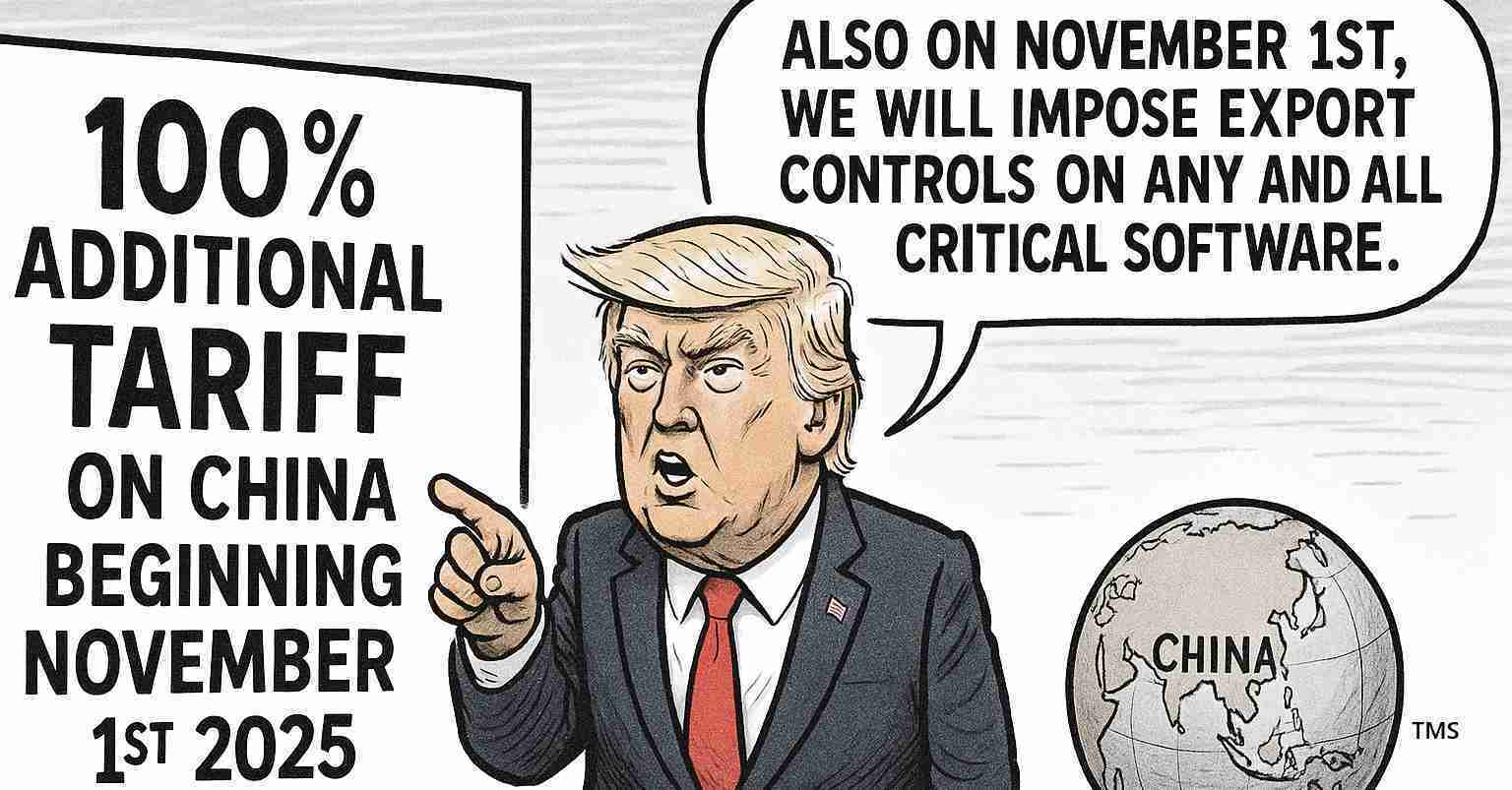
Trump announces 100% additional tariff on China after Beijing expands rare earth export controls
Former President Donald Trump ordered a 100% additional tariff on all Chinese imports, effective November 1, 2025, in response to Beijing’s expanded rare earth export controls — a major escalation in the US-China trade dispute.
Key takeaways
- 100% additional tariff on all Chinese imports to begin November 1, 2025 (or sooner if China escalates).
- Response to rare earth controls: Beijing added five elements to restricted lists, tightening export permissions for strategic materials.
- Broader U.S. measures: Export controls on critical software announced alongside tariffs; unilateral action expected.
What the new U.S. move says
According to reporting from CBS News and The Economic Times, Donald Trump announced a 100% additional tariff on all goods imported from China.
The tariff is intended to be added on top of existing duties — some categories already face roughly 30% — meaning affected goods could face combined duties approaching ~130%.
Trump framed the move as a direct response to China’s expansion of rare earth export controls, calling Beijing’s steps “extraordinarily aggressive” and a “moral disgrace.” He warned that U.S. retaliation could grow if China escalates further (CBS News; The Economic Times).
What Beijing did: rare earth export controls
China expanded its export-control rules by adding five elements — holmium, erbium, thulium, europium, and ytterbium — bringing the controlled list to 12 of the 17 rare earths, per reporting in The Economic Times and CBS News.
The new policy requires special permission to export products containing even trace amounts of those rare earths and can apply to goods produced outside China or by non-Chinese firms if they contain controlled inputs. Controls also cover production technologies and their overseas applications — meaning China can limit both raw materials and the tools/processes used in advanced chips, magnets, and other critical parts (CBS News; The Economic Times).
Why rare earths matter
Rare earth elements are essential inputs for semiconductors, electric vehicle motors, jet engines, defense systems, and other advanced technologies. China controls a dominant share of global production for some materials and nearly all production of certain rare earth magnets — reports cite up to 95% of the world’s rare earth magnets produced in China (CBS News).
U.S. countermeasures beyond tariffs
In addition to the 100% additional tariff, the announcement included export controls on “any and all critical software” starting in November, described as a national security measure to limit technology transfer that could bolster China’s military or high-tech industries (CBS News; The Economic Times).
Officials signaled a unilateral approach rather than waiting for an international coalition — designed to deliver a swift response to what they call a strategic chokehold on critical materials (The Economic Times).
Economic and strategic consequences
Analysts warn that a 100% additional tariff on all Chinese imports could raise costs for U.S. businesses and consumers. Firms that rely on parts, components, or finished goods from China would face sharply higher import bills and could pass many costs to households (CBS News; The Economic Times).
The tariffs would increase pressure on global supply chains: companies may scramble to find alternate suppliers, relocate production, or accelerate onshore/allied-country investment — all expensive and time-consuming transitions. For technology and defense sectors, the measures are intended to blunt China’s ability to weaponize control of critical inputs (CBS News).
Political signaling and risks
The step deepens the US-China trade war and raises geopolitical tensions. Trump framed the action as defending American interests and national security, and suggested diplomatic talks could be suspended if China continues to escalate (TheJournal.ie; CBS News).
Other countries affected by China’s export controls are weighing options, but U.S. officials emphasized they would not wait for a global coalition before acting (The Economic Times).
Implications for Utah
Economic impact
Higher import costs could push prices up across Utah — electronics, appliances, and many goods with China-sourced components may become more expensive. Local manufacturers and tech firms that depend on Chinese inputs could see squeezed margins or be forced to seek new suppliers.
Political consequences
Utah leaders focused on national defense and domestic industry may support the tariffs as a response to rare earth controls. The policy could become a local political issue, prompting state officials to seek federal aid or incentives for supply-chain adjustments.
Social effects
Workers in manufacturing and logistics could face shifting demand: some sectors may expand domestic sourcing and create jobs, while others may slow hiring due to rising costs. Household budgets may be strained if price increases are broad and sustained, increasing demand for assistance.
Practical applications for residents
- Defense and aerospace contractors near Hill Air Force Base should review supplier chains and inventory strategies now.
- Utah businesses should consider alternative suppliers and explore federal programs funding domestic critical-mineral and high-tech production.
- Consumers may need to budget for higher prices on certain goods in the months ahead.
Timeline and escalatory risks
The tariffs are scheduled to begin November 1, 2025, but U.S. officials warned they could take effect earlier if Beijing acts further. Export controls on critical software were signaled to align with the tariff start. Businesses and state leaders face a narrow window to prepare.
Sources and further reading
- CBS News: Trump announces 100% tariff on China in response to rare-earth export controls.
- CBS News: Coverage on rare-earth elements and strategic implications.
- The Economic Times: Reporting on tariffs and China export controls.
- TheJournal.ie: Coverage of Trump remarks and trade escalation.
- Additional video briefings and related coverage: video (1), video (2).
“If China escalates, our response will grow — we will defend American security and industry,” the announcement warned, underscoring the national-security framing of the measures (CBS News).
For businesses and policymakers: act now. Review supplier chains, identify alternatives, and consider inventory and procurement adjustments to mitigate near-term disruption. For readers seeking the original reports, see the links above for on-the-record coverage and official statements.