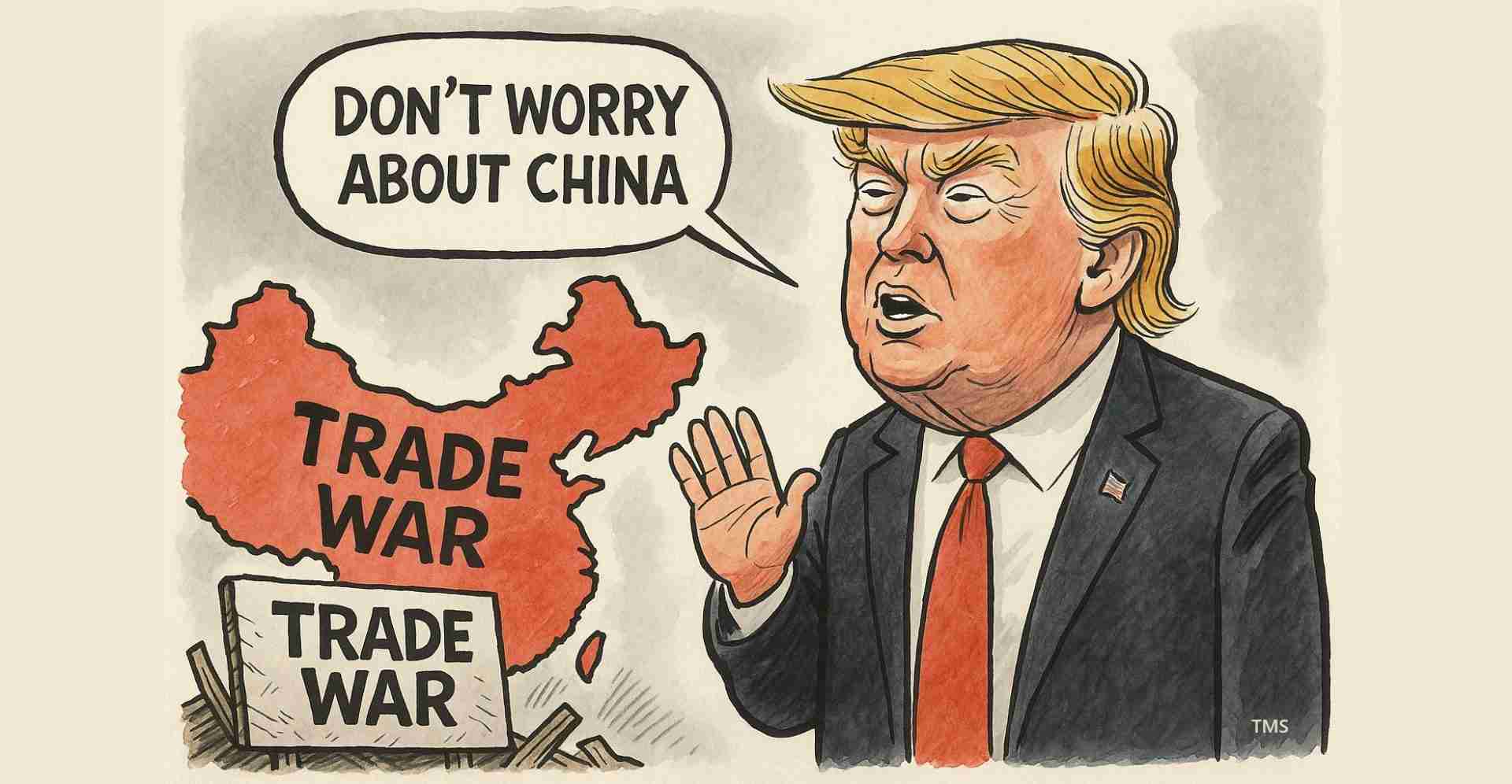
Trump urges calm after Beijing warns over proposed 100% tariffs as rare earths row deepens
President Donald Trump sought to calm markets on October 12, 2025, after proposing 100% tariffs on Chinese imports in response to Beijing’s rare‑earth export limits, while China warned it would take “corresponding measures” if the U.S. proceeds.
- Tariff shock: Trump proposed sweeping 100% tariffs on Chinese imports in reaction to Beijing’s rare earth limits (Fox Business).
- Sharp increase: The proposal would jump well above the current average U.S. levy on Chinese goods, roughly 55% (Fox Business).
- China warns of retaliation: Beijing said it would take “corresponding measures” and insisted it “does not want a tariff war” but is “not afraid of one” (Fox Business).
- Strategic stakes: The dispute centers on rare earth minerals, where China controls about 70% of mining and nearly 90% of processing capacity (Fox Business).
Trump moves to calm fears amid sharp rhetoric
President Trump posted on Truth Social to downplay the chances of a trade war after his 100% tariff proposal sparked alarm. He described the moment as “a bad moment” for China and wrote, “it will all be fine,” stressing the U.S. did not seek to break China’s economy. The post aimed to reassure markets and allies that Washington hopes to manage the dispute without a full-scale economic clash.
Trump’s proposal represents a dramatic escalation beyond current tariff levels — roughly a 55% average — that already affect many imports from China. Such a jump would raise costs for U.S. businesses reliant on Chinese-made parts and finished goods, potentially forcing companies to rethink sourcing or inventories (Fox Business).
China’s defiant reply
Hours after the tariff proposal, China’s Commerce Ministry issued a robust rebuttal, warning Washington against “threats” and saying Beijing would take “corresponding measures” if the United States pushed ahead. Officials said they do not want a tariff war but emphasized they are “not afraid of one,” urging dialogue and negotiation as a better path to resolve disputes (Fox Business).
Beijing also signaled it would continue to allow exports of rare earths for legitimate civilian uses while reserving the right to act if the U.S. “obstinately insists” on punitive measures — a mix of openness and warning that keeps necessary supply lines available but defends strategic interests (Fox Business).
Why rare earth minerals matter
Rare earth elements are critical to advanced manufacturing — from electric vehicles and wind turbines to semiconductors and defense systems. China’s dominance is substantial: roughly 70% of global mining and nearly 90% of processing capacity, according to industry estimates cited by analysts, giving Beijing considerable leverage in this flashpoint (Fox Business).
“This is the definition of a national emergency,” Vice President JD Vance said on Fox News’ Sunday Morning Futures, urging accountability while noting the administration believes it “has far more cards than the People’s Republic of China.” (Fox Business)
Potential fallout and the Nov. 1 deadline
The administration set a Nov. 1 timeline tied to the possible imposition of 100% tariffs. That deadline complicates diplomatic planning — including a tentative Trump‑Xi meeting later in 2025 — and increases uncertainty for businesses evaluating stockpiling, supply‑chain shifts, or accelerated domestic production (Fox Business).
Analysts warn a broad 100% tariff would raise consumer prices, squeeze manufacturers that rely on Chinese components, and disrupt integrated global supply chains. Even discussion of such tariffs can prompt companies to change sourcing and invest to reduce dependence on China, while some Republican lawmakers and administration officials argue strong measures are needed for national security and industrial protection.
What the administration says and what it signals
The administration frames the stance as protecting American manufacturing, jobs, and national defense. By spotlighting rare earths and critical supply chains, the White House signals a focus on strategic vulnerabilities as well as trade fairness. The 100% tariff threat functions as both leverage and a public warning: a tool to force negotiations and a message that the U.S. will act if Beijing restricts access to vital materials (Fox Business).
Public reassurances that the administration does not want to “break” China’s economy appear crafted to reduce panic and market shocks while maintaining pressure. Officials say the objective remains to restore predictable trade behavior and supply‑chain openness.
Implications for Utah
Economic impact
Utah’s economy — with manufacturing, tech firms, defense contractors, and a growing mining sector — could feel direct effects. Higher tariffs or rare earth disruptions may increase costs for Utah companies using advanced materials, create delays, and slow job‑creating investments as firms pause amid uncertainty (Fox Business).
Political consequences
For Utah’s conservative voters, a tough posture on China may be popular. Local Republican leaders are likely to welcome moves to protect strategic materials, while the business community will closely monitor policies that could raise costs or complicate trade with Asian markets (Fox Business).
Social effects
Rising prices for consumer goods could affect Utah households managing tight budgets. If manufacturers pass on higher costs, shoppers may see steeper prices for electronics, appliances, and vehicles that use rare earth components; workers tied to global supply chains may worry about job stability.
Cultural relevance
Utah communities value self‑reliance and local industry growth. The episode amplifies debates about reshoring and building domestic supply chains — themes likely to resonate with voters supportive of American manufacturing and Mountain West development.
Practical applications for Utah residents
- Businesses: Review supply chains and create contingency plans; consider alternative suppliers and inventory strategies (Fox Business).
- Policymakers: Consider incentives to attract domestic processing and recycling of critical minerals via grants or tax incentives.
- Consumers: Expect possible price shifts on electronics and vehicles; retailers and shoppers may seek to lock in prices or secure inventory as a buffer.
Sources and reporting
This report draws on statements, official responses and analysis reported by Full reporting on the developments is available at Fox Business.