Democrats Shift From Impeachment to Article II Legal Challenges as Portland National Guard Deployment Tests Presidential Authority
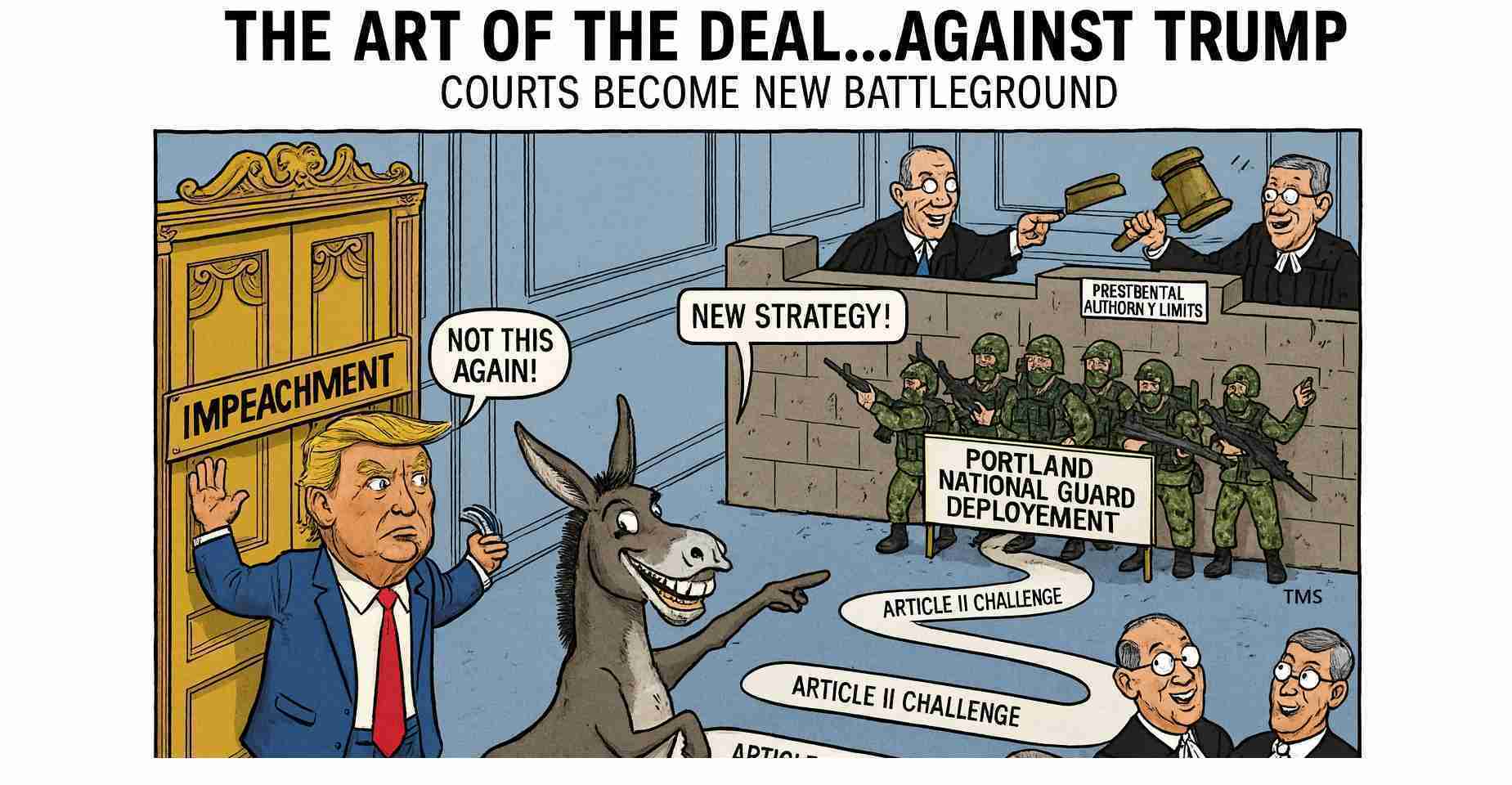
Democrats are shifting from impeachment toward Article II legal challenges, relying on federal and state courts to test and limit President Trump’s use of federal forces — notably the Portland National Guard deployment — to define presidential authority.
Key takeaways
- Litigation over impeachment: Many Democrats now favor Article II legal challenges, Article II legal challenges in federal and state courts to block or constrain presidential action.
- Portland as a test case: The Portland National Guard deployment has become a high-profile legal battleground over federal intervention and state control.
- Fast-moving precedents: Courts nationwide, including appeals and the Supreme Court, are weighing whether recent directives exceed constitutional limits under Article II (SCOTUSblog).
- Local stakes — Utah: Changes in presidential authority could affect state Guard availability, emergency response, and prompt Utah officials to seek legal and legislative protections.
Main story
Overview. Across the country, Democrats and allied groups have increasingly turned away from impeachment as the primary tool to check the president, instead mounting lawsuits that press constitutional and statutory limits on executive power. Courts — not Congress — are now the forum where many key questions about presidential authority are being determined.
Key information
- Litigation strategy: Democrats and allied groups are using Article II legal challenges, Article II legal challenges in federal and state courts instead of pursuing impeachment to block or constrain President Trump’s actions.
- Portland case: The Portland National Guard deployment has become a focal test of whether the president can direct federal forces in ways that override state decisions.
- Courts weighing limits: Courts across the country are examining whether presidential directives exceed constitutional or statutory limits under Article II.
- Rising caseload: A growing number of rulings and lawsuits — including more than 100 cases and numerous restraining orders — are shaping precedent on presidential authority (University of Chicago News, Just Security).
- Scholarly concerns: Legal scholars warn that broad readings of Article II could reduce congressional oversight and weaken the separation of powers (The Regulatory Review, Brookings Institution).
Legal battleground: Portland National Guard
The deployment of the Portland National Guard has emerged as one of the clearest tests of presidential authority this term. Lawsuits filed by civil rights groups and state officials contend the White House ordered federal troops and Guard units into the city in ways that bypassed local control and raised civil liberties concerns (The Regulatory Review).
Judges are now asked to decide whether the president can deploy federal forces domestically when state priorities differ. Courts are examining statutes, historical practice, and the text of Article II to determine whether the president’s orders exceed constitutional powers (SCOTUSblog).
Shift from impeachment to courts
Many Democrats have stepped back from impeachment as the primary strategy. Instead, they are investing in litigation that raises legal questions about executive action. The lawsuits target a range of presidential moves, but deployments of federal forces — including the Portland case — are among the most urgent issues (Just Security).
This approach is partly practical: court cases can produce injunctions that halt executive actions quickly and create a legal record that constrains future behavior. For critics of the administration, litigation offers a way to force judges to define limits on presidential power without relying on politically fraught impeachment trials (The Regulatory Review).
Expansion of presidential authority
Recent high-court decisions have moved legal interpretation toward a broader reading of Article II, with some rulings emphasizing that the president holds “the entirety of the executive power.” Supporters say this grants decisive control over executive officers and agencies; critics warn it could hollow out congressional checks and agency independence (The Regulatory Review, Brookings Institution).
Voices in the debate: Some legal scholars argue a strong executive is necessary for national security and public order. Others, including Peter M. Shane, call for “genuinely rigorous oversight without deference to the President’s party affiliation,” urging courts to preserve Congress’s role and protect agency autonomy (The Regulatory Review, Brookings Institution).
Litigation as the primary check
The trend toward lawsuits is measurable: recent counts identified at least 150 judicial decisions involving Trump-era executive orders and more than 100 lawsuits tied to presidential actions. Many suits seek restraining orders or injunctions to stop or limit executive moves while courts resolve legal issues (University of Chicago News, Just Security).
Types of challenges include:
- Suit over deployment and use of federal forces, such as the Portland National Guard disputes.
- Challenges to the removal of agency officials and the scope of presidential hiring and firing power (Just Security).
- Lawsuits over attempts to defund or reshape federal agencies without express congressional action (The Regulatory Review).
Courts are setting fast-moving precedents; some judges have issued temporary blocks on deployments or orders, and higher courts, including the Supreme Court, are being asked to weigh in (SCOTUSblog).
What the legal record could mean
If courts uphold a broad Article II, the president could gain significant leeway to direct federal personnel and National Guard units in domestic matters — potentially centralizing power and reducing congressional oversight. If courts narrow Article II, Congress and state governments would retain stronger checks on presidential moves (The Regulatory Review, Brookings Institution).
Many pending cases, notably the Portland litigation, will shape how presidents deploy forces during civil unrest and how much authority state leaders retain over their Guard units (The Regulatory Review).
Implications for Utah
Economic impact. Federal deployments can shift resources: if the president can order Guard units across states more freely, Utah’s Guard could be sent farther from home during crises, affecting local disaster response, training schedules and raising costs for the state and families of Guard members.
Political consequences. Utah leaders value state control. Wider presidential authority over Guard deployments would reduce governors’ power to manage their forces and could prompt the Utah Legislature and governor to pursue clearer state laws or formal agreements to protect state control.
Social effects. Utah communities rely on the National Guard for wildfire fighting, floods and search-and-rescue. If units are tapped for federal actions elsewhere, local capacity could shrink and families and first responders could see delays or gaps in emergency help during peak seasons.
Cultural relevance. Utah tends to favor local control and limited federal intrusion. The idea of federalizing state Guard units for law-enforcement purposes can prompt strong reactions; Utahns who prioritize state sovereignty may back legal efforts to preserve governor authority over the Guard.
Practical applications for residents. Utahns should watch court rulings closely — changes to presidential authority could affect timing of local emergencies, Guard availability for community assistance, and coordination between state and federal agencies. State officials may prepare contingency plans such as mutual-aid agreements, reserve staffing plans, or legislative protections.
Legal and political follow-up in Utah. Utah’s judicial and political leaders may be asked to weigh in or file amicus briefs in national cases that affect the Guard; local law firms and advocacy groups could be drawn into litigation shaping the Guard’s future use in federal operations.
Source references
- The Regulatory Review: Spotlight — The uncertain future of the separation of powers
- Just Security — Tracker of litigation challenging the Trump administration
- SCOTUSblog — The Trump docket
- University of Chicago News — Trump’s executive orders
- Brookings Institution — Is the growth of executive power a threat to constitutional democracy?
Bottom line: Ongoing litigation nationwide — especially the Portland National Guard cases — will continue to shape how presidential authority is defined and checked, with direct effects on state Guard control, domestic deployment speed, and separation-of-powers balance (The Regulatory Review, SCOTUSblog).