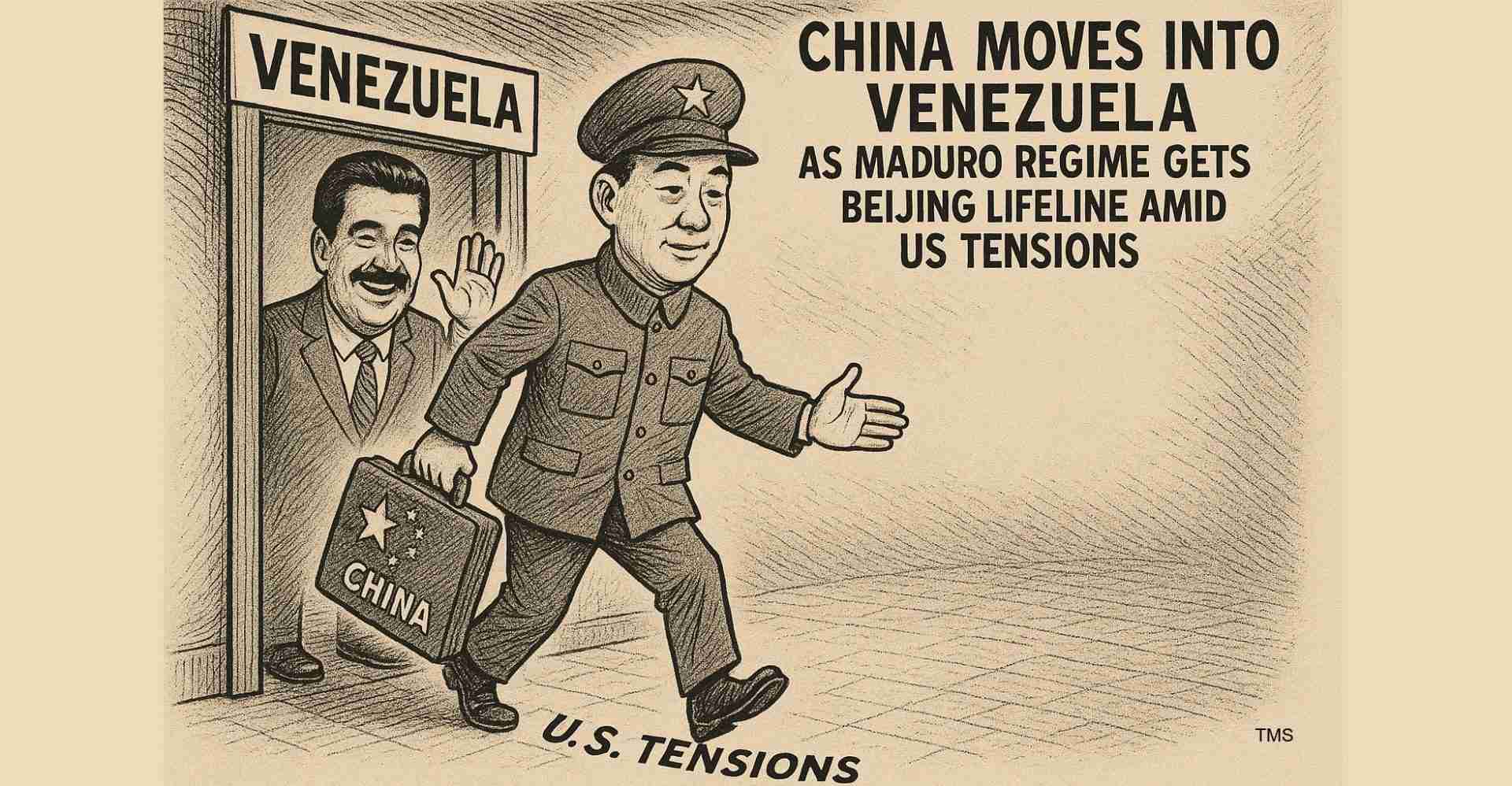
China moves into Venezuela as Beijing offers Maduro lifeline amid US tensions; critics warn of growing influence
China and Venezuela have deepened ties into an “all-weather strategic partnership,” shifting Beijing’s approach toward targeted investment, trade and Special Economic Zones that bolster Nicolás Maduro’s government while reshaping regional influence amid heightened U.S. tensions.
- Beijing’s 2025 strategy: favors trade, productive investment and Special Economic Zones over large oil-backed loans.
- Legal cover: a China‑Venezuela bilateral investment treaty (BIT) entered into force in April 2025, boosting protections for Chinese firms.
- Trade imbalance: Chinese exports to Venezuela have surged, while Venezuelan exports to China remain concentrated in oil and raw materials.
- Geopolitics: the partnership raises U.S. concerns about expanding Chinese influence in the Western Hemisphere.
Key information and agreements
China and Venezuela elevated ties to an “all‑weather strategic partnership” in 2023 and announced more than 600 bilateral deals planned or announced for 2025 spanning trade, technology, agriculture and investment. Reporting and official statements have documented the shift toward productive deals rather than fresh oil‑backed lending. See Chinese government announcements, ministry releases and coverage of the investment shift in El País.
Beijing’s new playbook: investment, SEZs and legal cover
The relationship has evolved from the 2010s model of large state loans—often repaid in oil shipments—to a targeted strategy emphasizing:
- Special Economic Zones (SEZs): zones that provide regulatory stability, tax incentives and operational frameworks favorable to foreign firms.
- Productive investment: direct project investments and contracts that limit Beijing’s credit exposure.
- Legal protections: the April 2025 bilateral investment treaty (BIT) that extends investor protections to Chinese firms.
SEZs, in particular, offer China lower currency and credit risk, clearer rules and the chance to operate with greater autonomy—advantages Chinese investors find attractive after past disputes and unpaid debts involving oil‑for‑loan arrangements. This is a deliberate shift to secure commercial footholds without repeating heavy-credit exposure.
Trade and asymmetry: China sells more than it buys
Trade data show a sharp rise in Chinese exports to Venezuela—motorcycles, tires and electronics among them. Chinese exports to Venezuela reached $3.45 billion in 2023 and have been growing rapidly; Venezuelan exports to China remain concentrated in oil and raw materials and are smaller in comparison. See bilateral trade data at OEC World.
While oil remains politically and economically important, Chinese state firms are cautious about new large energy deals after past disputes; some service firms continue operations, sometimes via less transparent channels. Meanwhile China pursues other regional energy opportunities such as in Guyana.
Political alignment and geopolitical optics
Beyond commerce, Beijing and Caracas emphasize shared opposition to U.S. sanctions and advocacy for a multipolar world. Official Chinese statements have praised Venezuela’s sovereignty and framed the partnership as a model for expanding influence in Latin America. Chinese and Venezuelan ruling party officials have engaged in inter‑party exchanges and governance training, signaling intent to embed long‑term influence in Caracas. See official releases: CIDCA announcement and foreign ministry release.
Diverging views on a “takeover”
Commentators differ on whether China is aiming to “take over” Venezuela’s economy. Critics such as Gordon Chang warn of potential complete economic domination, highlighting strategic risks to U.S. influence. See critical coverage at Fox News.
“These moves really look like China is going to completely take over the Venezuelan economy.” — cited by critics in U.S. commentary.
Other analysts urge caution: China’s current strategy appears cautious—using contracts, SEZ rules and legal instruments rather than blanket ownership of national assets, with an emphasis on limiting financial exposure.
U.S. tensions and regional context
China’s deepening engagement with Venezuela occurs amid U.S. sanctions and pressure on the Maduro government. Washington views Beijing’s presence as a strategic challenge in the Western Hemisphere and worries about erosion of U.S. influence. For broader analysis of China’s role in Latin America, see the CFR backgrounder.
Notable 2025 developments
- Over 600 bilateral deals announced or planned for 2025 across sectors from agriculture to tech (coverage: El País).
- A reported “zero‑tariff” agreement unveiled at the 2025 Shanghai Expo to boost Chinese imports from Venezuela (Fox News).
- The China‑Venezuela BIT entered into force in April 2025, strengthening legal protections for Chinese investors (FIETTA Law).
Implications for Utah, United States
Economic and energy considerations: Utah policymakers and businesses should monitor effects on global energy markets and supply chains; shifts in Chinese‑backed trade may indirectly affect manufacturers and logistics firms in Western states.
Security and geopolitical risk: deeper China‑Venezuela ties could expand Chinese influence in the hemisphere. Utah’s congressional delegation might press for federal measures—export controls, investment screening and programs strengthening U.S.–Latin America trade alternatives.
Migration and regional stability: changes in Venezuela’s political and economic stability could affect migration patterns; state officials and communities should track potential humanitarian and migration impacts.
Academic and research ties: Utah universities should vet partnerships with foreign entities to protect research integrity while considering legitimate collaborations tied to Latin America and China. See official Chinese outreach description: CIDCA announcement.
Practical steps for Utah leaders: monitor federal policy responses; urge targeted export controls and investment screening; support U.S. trade ties to Latin America; and raise awareness about how SEZs and BITs can shift regional power dynamics. For BIT analysis see FIETTA Law and reporting in El País.
Sources and further reading
- Chinese government announcements and ministry releases (CIDCA)
- Ministry of Foreign Affairs release
- Coverage of China‑Venezuela partnership and investment shift (El País)
- Trade data and bilateral profiles (OEC World)
- Analysis of China’s role in Latin America (CFR)
- Bilateral investment treaty notes (FIETTA Law)
- Commentary on U.S.–China strategic rivalry (CounterPunch)
- Recent reporting on Beijing’s lifeline to Maduro (Fox News)
Reporting compiled from international sources and official statements.