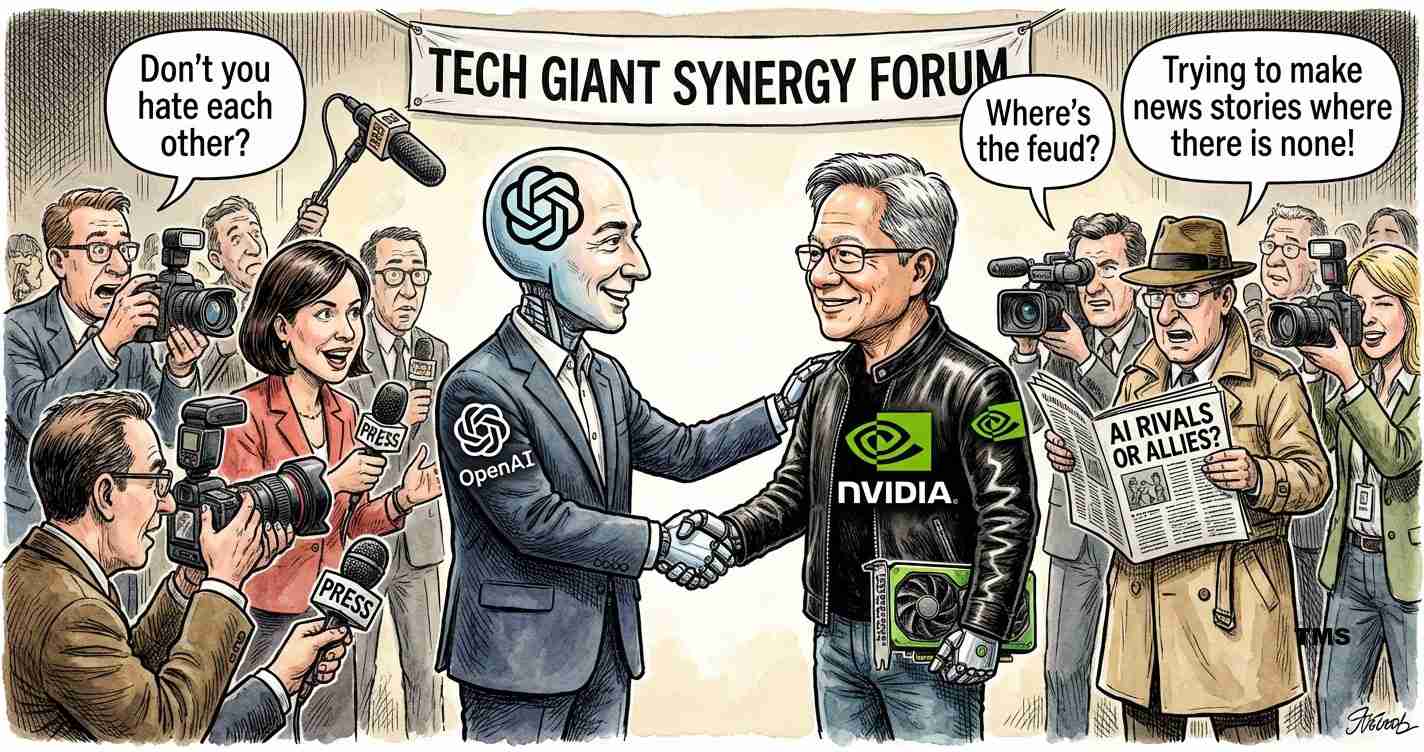
Nvidia’s Jensen Huang Denies Stalled $100 Billion OpenAI Investment, Calls Commitment “Huge” as Questions Persist over AI Infrastructure Deal
In Taipei on Jan. 31, 2026, Nvidia CEO Jensen Huang denied reports that a planned $100 billion investment in OpenAI had stalled, calling such claims “nonsense” and reaffirming Nvidia’s “huge” commitment to the partnership and pledging continued support.
Key takeaways
- Huang rejected reports that Nvidia’s planned $100 billion investment had stalled, calling suggestions he was unhappy with OpenAI “nonsense.”
- Strategic partnership: Nvidia announced a deal tying investment to deployment of 10 gigawatts of systems; see the investor release.
- Media reporting: The Wall Street Journal and summaries on TechCrunch described internal doubts and reported pauses in negotiations; see the reported summary.
- OpenAI response: OpenAI said the companies are “actively working through the details” and described Nvidia as central to scaling plans.
Background on the announced partnership
In September 2025, Nvidia and OpenAI unveiled a strategic partnership linking investment up to $100 billion to the progressive deployment of 10 gigawatts of Nvidia systems for OpenAI’s compute needs. Nvidia described itself as OpenAI’s preferred compute and networking partner and said the first phase of systems would come online in the second half of 2026 using the Vera Rubin platform. See the investor release for full details and forward-looking cautions.
What the Wall Street Journal report said, and internal doubts
On Jan. 30, The Wall Street Journal reported internal friction over the size and terms of Nvidia’s planned involvement, suggesting executives questioned whether the $100 billion headline figure was realistic. TechCrunch summarized that some insiders viewed the number as non-binding and flagged concerns about OpenAI’s business discipline and competition from Google and Anthropic. Other outlets reported negotiations had been paused while terms were reviewed; see additional coverage noting paused talks in the coverage of paused negotiations.
Those accounts said some Nvidia executives preferred a smaller equity commitment tied more closely to deployed systems rather than a fixed pledge. The reporting raised broader questions about how large tech firms balance strategic bets with financial discipline and whether infrastructure deals can cement market power as rivals develop custom chips and models.
Huang’s response in Taipei: denial and reaffirmation
Speaking to reporters in Taipei on Jan. 31, Nvidia CEO Jensen Huang pushed back strongly. He dismissed suggestions he was unhappy with OpenAI as “nonsense” and said Nvidia would “definitely participate” in OpenAI’s latest funding round, calling the opportunity “such a good investment.” Huang added, “We will invest a great deal of money. I believe in OpenAI. The work that they do is incredible. They’re one of the most consequential companies of our time.” He declined to specify a firm amount and directed questions about precise sums to OpenAI CEO Sam Altman. See TechCrunch’s reporting on Huang’s remarks for context: TechCrunch reporting.
“Nonsense,” Huang said when asked if he was unhappy with OpenAI. “We will invest a great deal of money. I believe in OpenAI.”
OpenAI’s response
OpenAI said the companies are “actively working through the details” and described Nvidia as central to OpenAI’s plans to scale compute. For reporting that synthesizes both sides, see the TechCrunch account: TechCrunch reporting.
Broader funding context and competition
OpenAI is reportedly seeking roughly $100 billion in new funding, with interest from Nvidia, Amazon, Microsoft and SoftBank. The company now serves hundreds of millions of users weekly, requiring vast compute resources. Nvidia’s chips and networking gear power many leading AI models and are widely used across cloud providers and AI labs; see the Nvidia investor release for the partners’ framing.
Competition is intensifying: Google’s AI efforts and independent labs like Anthropic are building rival models and infrastructure. Such pressures were cited in reporting as reasons for calls to tie investment more closely to concrete infrastructure milestones rather than a headline number.
Implications for Utah, United States
Economic impact
Utah’s growing data center and cloud hub could see increased demand for space, power and networking if Nvidia ties investment to actual gigawatt deployments. Local providers and real-estate developers may benefit from leasing and construction; universities and training programs could see upskilling needs for system engineers and HPC technicians.
Political consequences
State officials may evaluate incentives and require clear job and tax commitments before offering support. Concerns about concentration of AI compute and supply chain resilience could drive oversight and regulatory interest at state and federal levels.
Social effects
Local businesses may gain from enhanced cloud services, while automation risks could shift some job types. Community colleges and technical programs will likely need to adapt to provide reskilling opportunities.
Cultural relevance
Utah communities value stewardship and self-reliance; residents may welcome jobs while demanding safeguards for privacy, employment protections and community benefits. The state’s startup ecosystem—“Silicon Slopes”—could gain new opportunities if access and costs remain fair.
Practical applications for residents
- Jobs: More openings in cloud operations, AI DevOps and systems engineering.
- Training: Increased demand for courses in AI infrastructure, networking and power management.
- Energy: Utilities will need to plan for higher loads and ensure reliability.
What Utah officials and businesses should watch
- Contract terms: Review job commitments, timelines and cost obligations before offering incentives.
- Local access: Negotiate fair access for universities and startups to advanced compute.
- Workforce programs: Expand technical training and certification for data-center roles.
Ongoing questions investigators are tracking
- Will Nvidia convert the non-binding letter of intent into firm, binding commitments as deployments proceed?
- How closely will investment dollars be tied to actual gigawatt deployment milestones?
- Will competition from Google, Anthropic and others change the scale or structure of the investment?
- How will regulators and policymakers respond to concentration of compute power?
Reporting notes and sources
This article draws on reporting from TechCrunch, Nvidia company releases, and coverage of paused negotiations. Key sources include: TechCrunch reporting on Huang’s remarks and the WSJ report; the Nvidia investor press release announcing the partnership; and coverage noting paused negotiations at reported paused negotiations.
Bottom line: For Utah, the Nvidia–OpenAI arrangement is more than a headline number — it could reshape local jobs, energy demand and the region’s role in AI infrastructure. State and local leaders should insist on clear terms, local benefits and fair access as details are finalized.