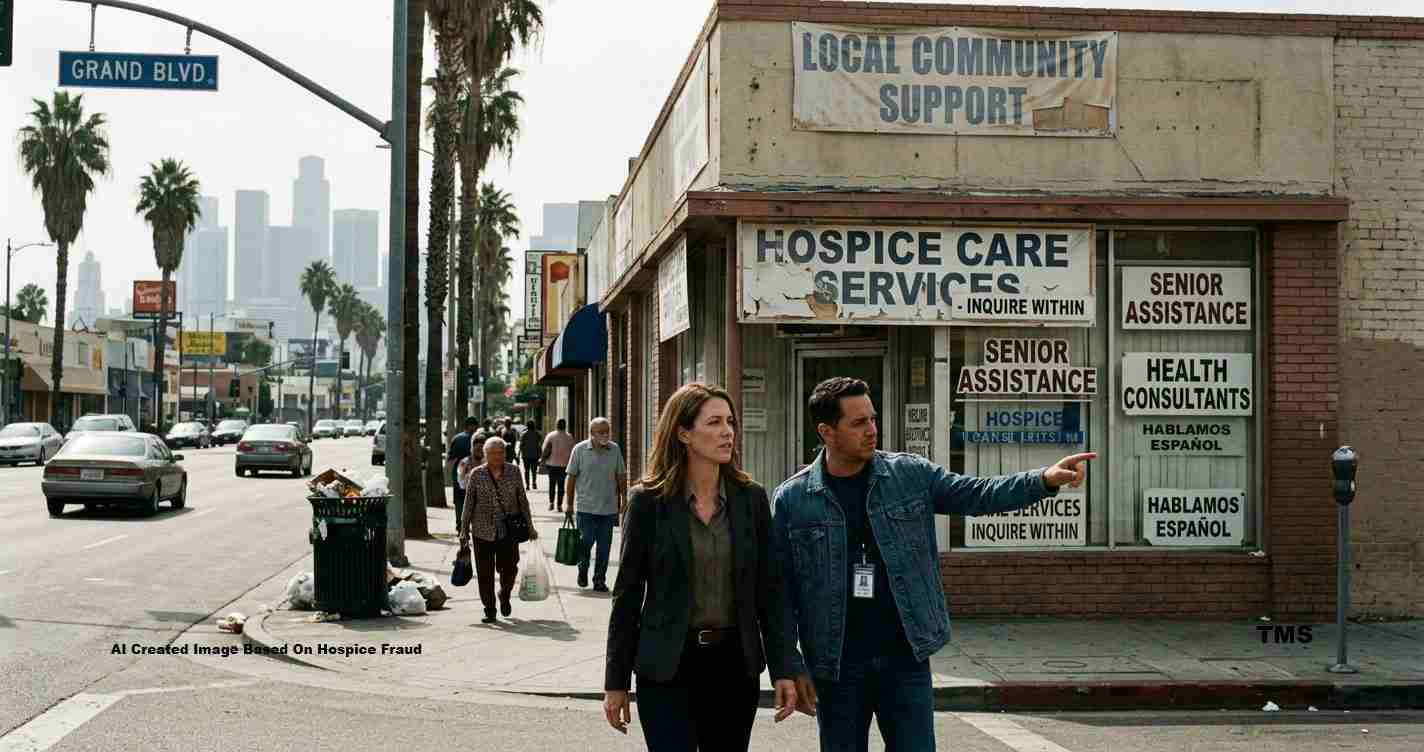
New Investigation Lifts Lid on Massive Medicare Hospice Fraud Centered on Van Nuys Boulevard
A CBS News investigation and state audits uncovered widespread Medicare hospice fraud across Los Angeles County — an estimated $105 million in overbilling in 2019 — with dense suspicious clusters along Van Nuys Boulevard prompting aggressive federal and state enforcement.
- Auditors estimate Los Angeles County hospices overbilled Medicare by about $105 million in one year. CBS News project
- More than 700 of roughly 1,800 county hospices triggered multiple state-defined fraud red flags. House Energy & Commerce post
- Van Nuys cluster: 137 hospices on Van Nuys Boulevard and nearly 500 in a ~3-mile radius; 89 companies registered to a single building. CBS News project
Key information
Auditors and investigators have documented patterns that point to organized abuse. Below are the facts, preserved from reporting and official releases:
Audit estimates and scope
Estimated overbilling: Auditors estimate Los Angeles County hospices overbilled Medicare by about $105 million in one year. See the CBS News project for reporting and audit references.
Provider counts: Of roughly 1,800 hospices in the county, more than 700 triggered multiple state-defined fraud red flags, according to state and congressional reporting. House Energy & Commerce post
Van Nuys Boulevard cluster: dense registrations, empty offices
A roughly 3-mile stretch around Van Nuys Boulevard contained an extraordinary concentration: 137 hospices listed along the boulevard and nearly 500 within that small radius. Regulators found 89 companies registered to a single building and repeated deficiencies in inspected suites from 2021–2025. When visited, many offices were empty with mail piled up. (See reporting: CBS News project and CBS News video.)
Investigators observed shared personnel across nearly 40 companies, empty storefronts, and addresses that matched auto parts shops or locations that appear not to exist — classic markers of sham providers.
How the fraud works
Common tactics identified by prosecutors and auditors:
- Billing Medicare for services never provided or for patients enrolled without proper consent.
- “Flipping” licenses after patient enrollment to hide real ownership, and using straw owners or foreign nationals to mask control. See a government case example: DOJ release on sentencing.
- Co-locating many agencies at a single address while providing little or no on-the-ground care.
Scale of the national problem
Hospice fraud extends beyond Los Angeles. The HHS Office of Inspector General reported suspected hospice fraud of $198.1 million in FY2023, and CMS recently referred billions in questionable billing. In 2025, CMS referred $3.4 billion in potentially fraudulent billing and revoked thousands of provider enrollments nationwide. Los Angeles County accounted for a disproportionate share, including a seven-fold increase in hospice billing at one point. (House Energy & Commerce post; Hospice News on CMS/DOJ enforcement).
Recent prosecutions and government action
Federal prosecutors have pursued multi-million-dollar cases tied to sham hospices. In November 2025, four California residents were sentenced in a $16 million scheme that used fake owners and shell companies to launder proceeds; assets seized included homes and cash. DOJ release.
CMS has restricted new enrollments in high-risk areas and cut payments to suspicious operations; the HHS-OIG signaled audits and oversight of new hospice enrollments in FY2026. Multiple House committees have demanded briefings and documents from HHS and CMS about Los Angeles County activity. (Hospice News)
California state responses
Since Governor Gavin Newsom’s 2022 provider ban, state agencies have revoked more than 280 hospice licenses. California’s Department of Health Care Services has used fraud-detection tools to halt payments and has worked with the state DOJ’s Medi‑Cal Fraud unit on hundreds of actions since 2019. State steps have tightened enforcement, but Medicare is federal — analysts say state moves cannot fully solve the problem without sustained federal action. (California governor’s office; Hospice News)
Voices from the field
Sheila Clark, president and CEO of the California Hospice and Palliative Care Association:
“You can’t throw a rock without hitting a hospice.”
Dr. Ira Byock, national palliative care leader, told The California Post that the speed and scale of alleged fraud have overwhelmed regulators; California has more than 2,800 hospices compared with 91 in Florida and 39 in New York, underscoring how outsized the provider market has become. (CBS News project)
Investigative gaps and continuing risks
Auditors and reporters note that red flags persist despite reforms and prosecutions. Hotspots have also emerged in Arizona, Nevada and Texas, indicating the tactics can migrate. Investigators warn sham hospice growth wastes taxpayer dollars and can deliver poor end‑of‑life care to vulnerable patients. (Hospice News; CBS News video)
Implications for Utah
Economic impact
Medicare overbilling and fraud in large markets like Los Angeles cost taxpayers millions, driving federal pressure to cut payments, increase audits, and tighten enrollment rules nationwide. Utah could face stricter oversight that slows legitimate payments, raises administrative burdens for local providers, and increases pressure for tighter budgets. (House Energy & Commerce post)
Political consequences
For Utah’s conservative voters and leaders, the story reinforces priorities of protecting seniors and stopping wasteful spending. Lawmakers may press state agencies to review local hospice enrollments, vet license transfers more closely, and demand better data sharing with federal investigators. Utah’s congressional delegation could push for tougher federal enforcement and faster penalties.
Social effects
Fraud schemes often target vulnerable seniors. Utah families should be alert when a hospice or home health agency appears only on paper. Ensuring trusted end‑of‑life care is a community priority; local providers who follow rules should be supported.
Cultural relevance
Utah communities value family care and responsibility. Stories of sham hospices exploiting seniors and taxpayers conflict with those values. Local faith and community leaders can help raise awareness and guide families to reputable providers.
Practical applications for residents
- Check licenses and complaints — verify a hospice’s license and complaint history via state health department resources and Medicare’s provider lookup tools.
- Verify in person — ask for references, visit offices, confirm staff identities; empty offices, piled mail or multiple agencies at one address are red flags. (CBS News project)
- Demand accountability — push state regulators and Utah’s congressional representatives to demand transparency and stricter enrollment checks from CMS and HHS. (House Energy & Commerce post)