LaGuardia Air Canada crash kills both pilots after regional jet collides with Port Authority fire truck; NTSB opens full probe
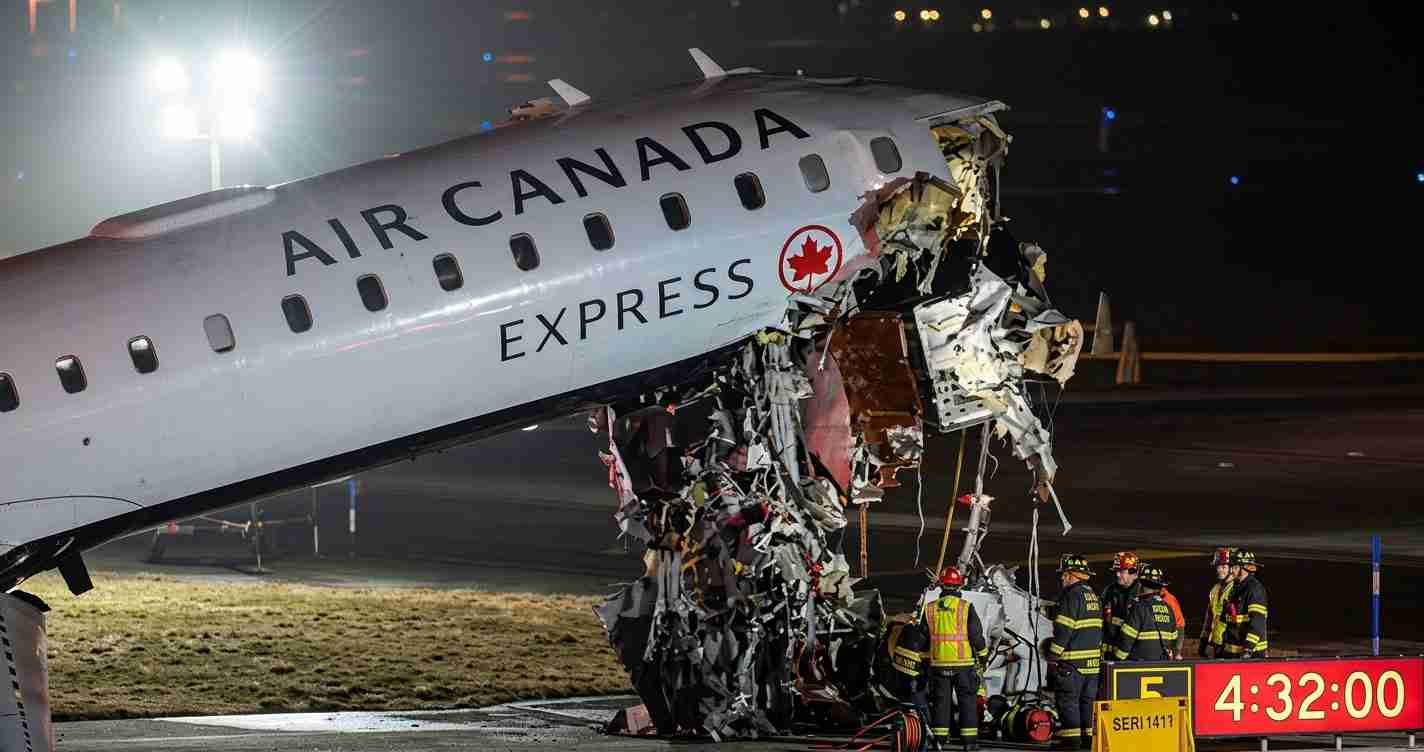
Two pilots were killed and dozens injured after an Air Canada Express CRJ-900, Flight AC8646 from Montreal, collided with a Port Authority fire truck while landing on Runway 4 at LaGuardia Airport on March 22, 2026.
Key takeaways
- Air Canada Express CRJ-900 (Flight AC8646) arrived from Montreal and was operated by Jazz Aviation.
- Runway 4 at LaGuardia Airport was the site of the impact late night on March 22; the airport briefly closed.
- Both pilots — the captain and first officer — were killed; dozens of passengers, crew and first responders were injured.
- 72 passengers and 4 crew members were aboard according to Jazz Aviation and federal sources.
- NTSB is leading the investigation with the FAA and Canadian authorities; the CVR and FDR were recovered and sent to NTSB labs.
Crash details and sequence
Eyewitness accounts, air traffic control audio and preliminary agency statements describe a chaotic scene. The CRJ-900 was landing on Runway 4 when it struck a Port Authority fire truck that had been responding to a separate incident — a United Airlines plane reporting an odor. Controllers can be heard urgently shouting, “Stop truck one. Stop!” as they managed multiple emergencies on the field; controllers’ exchanges were captured in recordings and are part of the probe.
The impact was violent. The aircraft was estimated to be traveling between 93 and 105 mph when it struck the truck, ripping off the nose and scattering debris across runway and taxiway areas. Investigators documented a wide, complex crash scene before wreckage removal; officials emphasize careful evidence collection as part of the NTSB-led work (preliminary agency statements and surveillance review).
Casualties, survivors and first responders
Port Authority Executive Director Kathryn Garcia said more than 39 passengers and crew members were hospitalized, along with two Port Authority officers who were aboard the fire truck. At least 32 of the hospitalized have since been released, though some sustained serious injuries (updates on releases and triage).
The two officers on the fire truck suffered broken bones but were expected to survive. All passengers were accounted for; an unaccompanied minor was quickly reunited with family. Officials continue to provide medical and family support services at the scene and through coordination with carriers and Port Authority personnel.
Flight crew details
Federal and carrier statements confirmed the aircraft had four crew members — the captain, first officer and two flight attendants — and that the captain and first officer were killed in the impact. U.S. Secretary of Transportation Sean Duffy’s office and carrier statements provided crew makeup details as part of early briefings (official briefings).
Investigation status: recorders recovered, analysis underway
The NTSB is leading the investigation with FAA and Canadian authorities because the aircraft was operated by a Canadian carrier. Investigators recovered both the cockpit voice recorder (CVR) and flight data recorder (FDR) after cutting an access hole in the damaged fuselage. NTSB Chair Jennifer Homendy said the CVR “was not damaged” and it was transported to the agency’s lab in Washington, D.C., where analysis has begun; work on the FDR followed the next day (NTSB statements and lab processing).
“We will determine the exact positions of both the aircraft and the fire truck in the seconds before the collision,” NTSB Chair Jennifer Homendy said, noting CVR, FDR, surveillance and surface radar data will be central to the probe.
Investigators are reviewing surveillance video, air traffic control recordings and airport surface detection system replays. The crash scene remains extensive; recovery teams are documenting wreckage and evidence before removing major pieces, a process that could take days as precise positions and sequences are reconstructed.
Airport operations and safety questions
The FAA implemented a ground stop and LaGuardia closed for several hours before reopening Monday at 2 p.m. after debris and wreckage were cleared. This is the airport’s first fatal crash in three decades and has renewed scrutiny of airport operations, emergency vehicle procedures and tower staffing levels (agency reviews and procedural concerns).
Key review areas include communications between controllers and ground vehicles, standard crossing authorization procedures, and whether additional safeguards or rule changes are needed to prevent runway incursions during emergency responses. Investigators will examine whether multiple simultaneous incidents strained tower resources at the time of collision.
Support for victims and families
Air Canada established a family helpline: 1-800-961-7099. Airlines, Port Authority officials and federal agencies coordinated medical assistance and family services as passengers were triaged and reunited with relatives. Travelers and families were directed to carrier assistance pages and airport support centers for updates (carrier coordination and helpline).
Accountability and public questions
Conservative concerns about accountability and safety center on whether standard procedures were followed for authorizing runway crossings, whether tower staffing levels contributed to the error, and what oversight exists for emergency vehicle movement on active airfields. The NTSB will seek answers via CVR/FDR downloads, radar and surveillance replays, and interviews with controllers and vehicle crews (live coverage and accountability questions).
Implications for Utah
Economic: Heightened inspections, revised safety rules or FAA directives could affect routes and operations connecting Utah to the Northeast, with potential short-term delays or schedule changes (regional travel impacts).
Political and social: Utah lawmakers may press for stronger FAA and Port Authority oversight, including reviews of staffing models at busy towers. Families who travel frequently to the East Coast may follow the investigation closely; local agencies may review runway crossing procedures and emergency drills (procedural review considerations).
Practical advice:
- Expect potential travel advisories and schedule adjustments on routes between Utah and the Northeast.
- Local airport authorities and emergency services should review runway crossing procedures and conduct multi-incident drills (recommended reviews).
- Travelers should monitor airline notifications and keep emergency contact information available; Air Canada’s helpline is 1-800-961-7099 (airline assistance).
Sources and further reading
Investigators continue to piece together data from recorders, radar, surveillance video and radio transmissions as they work to determine exactly what happened in the moments before the crash. The NTSB has said it expects to have key findings as analysis proceeds at its Washington, D.C. labs (ongoing NTSB analysis).