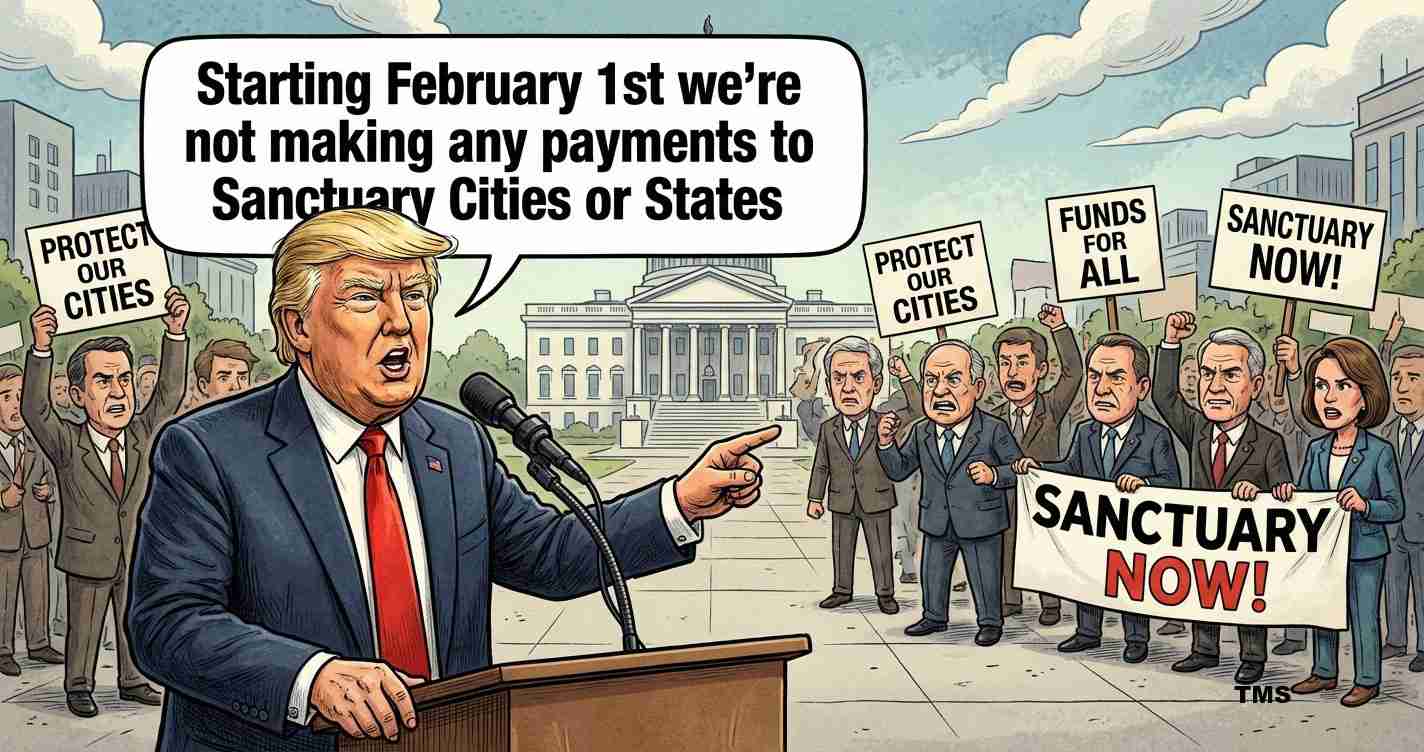
Trump halts sanctuary city payments, threatens wider cuts as he singles out Minnesota and Gov. Walz
WASHINGTON (Times Media Service) — President Trump announced his administration will halt federal payments to jurisdictions it labels “sanctuary” beginning Feb. 1, singled out Minnesota and Gov. Tim Walz, and said some payments tied to suspected fraud have been suspended.
- Federal payments to “sanctuary” jurisdictions will be stopped starting Feb. 1; announcement reported by KRCRTV.
- Trump framed the action as preventing crime and fraud, saying sanctuary policies “do everything possible to protect criminals at the expense of American citizens”; see KRCRTV.
- The president singled out Minnesota and Gov. Tim Walz, claiming payments tied to suspected scammers were suspended; coverage at Fox News.
- A federal judge temporarily blocked the administration’s pause on certain child-care and social services payments to Minnesota on Jan. 9, preserving those funds while courts weigh arguments — see WTOV9.
Policy announcement and Trump’s rationale
At the Detroit Economic Club, the president described the move as a law-and-order and fiscal-protection measure, arguing that jurisdictions with sanctuary policies “breed fraud and crime and all the other problems that come.” Trump said the federal government will withhold payments from any entity that supports sanctuary practices. Coverage of his remarks is available from KRCRTV.
The administration tied the policy to broader immigration enforcement goals, pressing local and state governments to comply with federal requests to identify or hold suspected undocumented immigrants. DHS previously published a list of more than 500 jurisdictions it says do not comply with federal immigration law — a list cited by the White House and DOJ when targeting payments and litigation (KRCRTV).
Minnesota specific actions and legal pushback
Trump specifically accused Minnesota of widespread fraud and claimed the administration had “suspended payments tied to suspected scammers in Minnesota, of which there are many.” He attacked Gov. Tim Walz by name, alleging the governor either missed the problem or was complicit. Reporting on those accusations and the administration’s statements appears at Fox News.
The administration has moved to block federal funds for several programs in five states, including Minnesota, citing alleged misuse tied to fraud. Programs named by officials include the Child Care and Development Fund, Temporary Assistance for Needy Families (TANF), and the Social Services Block Grant. Those actions met immediate legal resistance: a federal judge on Jan. 9 temporarily enjoined the administration from pausing some child-care funding to Minnesota, preserving the status quo while legal issues are argued (WTOV9; Fox News).
Legal history and litigation risk
This is not the first administration to try conditioning federal funding on immigration cooperation. Courts have previously rebuffed similar efforts: attempts during Trump’s first term to withhold federal dollars from sanctuary jurisdictions were struck down by judges, demonstrating limits on the federal government’s authority to impose such conditions (ABC7).
The Justice Department under the current administration has been active in suing sanctuary cities and states — naming municipalities such as Los Angeles, Chicago, Newark and Hoboken, and states including Illinois, Colorado and New York — signaling an aggressive, litigation-forward strategy to force compliance (KRCRTV).
What it could mean for federal programs
The announcement raises immediate questions about which programs might be affected and how cuts would be implemented across jurisdictions on the DHS noncompliance list. Prior actions named childcare assistance, TANF and Social Services Block Grants — programs that fund services for low-income families, child care providers and local social-service delivery. If payments are halted in whole or part, local governments could face immediate budget gaps and program disruptions (Fox News).
Administration officials argue the pressure is necessary to prevent federal dollars from supporting jurisdictions that they say shield criminal activity or harbor fraud. Legal experts and municipal officials counter that cutting social-service funding would harm vulnerable residents and may be unlawful if used to force policy changes — with past court rulings suggesting significant hurdles for the administration’s plan (ABC7).
Sources and government lists
The Department of Homeland Security’s list of jurisdictions it says are not complying with federal immigration law has been central to the administration’s enforcement decisions. That list has been cited by the White House and DOJ as the basis for targeting payments and litigation (KRCRTV).
Implications for Utah
While Utah has not been widely identified on the DHS noncompliance list as a major sanctuary jurisdiction, a broad move to withhold federal funds could ripple through state and local budgets that rely on child-care programs, TANF-linked work programs and social-services grants. Counties and cities depending on federal grants for early childhood education and social services could face budget gaps or pressure to reallocate limited funds (KRCRTV).
Economic impact
Local leaders in Utah who prioritize fiscal responsibility may confront hard choices: cut programs, raise local taxes, or reallocate funds to cover gaps left by federal reductions. Rural counties with small budgets could be particularly vulnerable if federal funds are curtailed and immediate state backfill is unavailable (KRCRTV).
Political consequences
For conservative Utah voters who emphasize law and order, the president’s move may reinforce federal authority and bolster support for state policies aligned with federal immigration priorities. At the same time, Republican state leaders focused on stable budgets could face pressure from municipalities and constituents to resist actions that risk funding for essential services (Fox News).
Social effects
Any disruption to child-care assistance or social services would disproportionately affect low-income families and providers across Utah. Rural counties and smaller jurisdictions may face acute strains if federal funds are paused and no immediate replacement is available, forcing local governments to prioritize or cut services (WTOV9).
Cultural relevance and messaging
The president’s rhetoric — framing sanctuary policies as enabling crime and fraud — resonates with Utah’s conservative base that favors stronger immigration enforcement. Republican leaders can emphasize public safety and fiscal stewardship while reassuring residents that vital services will continue. Messaging tying enforcement to protecting taxpayers and vulnerable neighbors may appeal to local conservatives seeking effective government without waste (KRCRTV).
Practical steps for local officials
County and city leaders should immediately review federal funding streams tied to child care, TANF and social-service grants to assess vulnerability. Legal teams and state officials may need to coordinate with the Justice Department or prepare legal challenges if they believe cuts would be unlawful or harmful. Officials seeking to avoid federal penalties could consider administrative steps to demonstrate cooperation with federal immigration requests where legally and practically appropriate (ABC7).
Ongoing questions and watch points
Key uncertainties remain about how the administration will define “sanctuary,” which programs will be targeted, and the mechanics of suspending payments across hundreds of jurisdictions. Past legal precedent favored local governments in similar disputes, and recent injunctions — such as the Jan. 9 order protecting Minnesota’s childcare funds — suggest courts will play a decisive role. Observers in Utah and nationwide will watch legal filings and any formal guidance from the White House, DHS and DOJ (WTOV9; Fox News).
Quote: “They do everything possible to protect criminals at the expense of American citizens,” the president said, framing the funding halt as a defense of taxpayers and public safety (KRCRTV).