Meloni Vows Firm Action After Violent Turin Protest Leaves More Than 100 Security Personnel Hurt
Violent clashes erupted in Turin on Saturday night, Feb. 1, 2026, after a march supporting the evicted Askatasuna social center turned violent, leaving 108 security personnel injured as masked protesters attacked police with stones, bottles and incendiary devices.
Key takeaways
- Scale of injuries: Authorities report 108 security personnel hurt — including 96 police officers, seven Guardia di Finanza and five carabinieri.
- Assault tactics: Masked groups used bottles, stones, Molotov-style devices, smoke bombs and improvised weapons during sustained attacks.
- Government reaction: Prime Minister Giorgia Meloni condemned the violence and convened an urgent meeting to consider new security measures and tougher legal tools.
- Context: The clashes followed the eviction of the Askatasuna social center and raise concerns about organized anarchist and far-left networks across Europe.
What happened
A national march drew tens of thousands to central Turin on Saturday. Organizers included grassroots unions, social center activists and public figures; eyewitnesses and footage show the daytime event was largely peaceful. After dark, groups police identified as black-clad anarchists and far-left militants broke off and moved into the Vanchiglia neighborhood, where violent confrontations began.
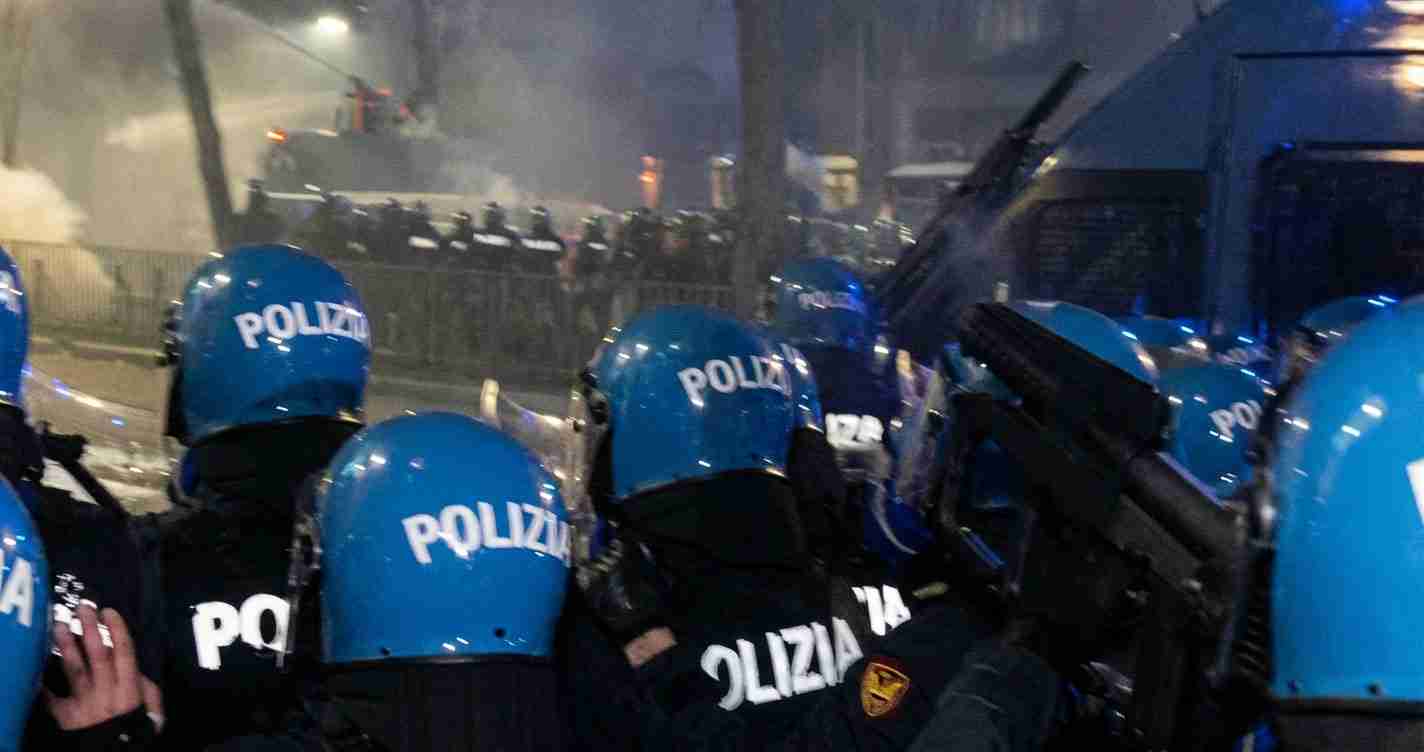
Video and photo sequences captured masked demonstrators forcing police lines back, throwing objects and engaging in sustained attacks. A Reuters photo series widely distributed showed riot police amid red smoke, burning bins and damaged police vehicles; online clips also documented smoke bombs and projectiles hitting security forces.
Violence, injuries and weapons used
Authorities and footage indicate protesters hurled bottles, stones, homemade incendiary devices, smoke bombs and fireworks. Rubbish bins and a police armored vehicle were set on fire; street furniture and uprooted lampposts were used as weapons. One officer was reportedly beaten with kicks, punches and an object described as a hammer.
Police responded with tear gas, water cannon and baton charges; clashes lasted more than an hour before order was restored. Some protesters were reported injured, though officials did not issue a consolidated total.
Government and political response
Prime Minister Giorgia Meloni denounced the events as “attempted murder” by “organized criminals” and called the violence an attack on the state. She visited injured officers at Le Molinette hospital and said judiciary and security forces must act firmly; the government convened an urgent meeting to discuss a security decree that could include preventive detention measures.
“These were attacks on institutions and on those who protect our democracy,” Meloni wrote and posted images of wounded officers on X.
Interior Minister Matteo Piantedosi described those involved as a “danger to democracy,” Deputy Prime Minister Matteo Salvini labeled attackers “terrorists” who must be arrested and removed from occupied spaces, and Carabinieri commander Lt. Gen. Salvatore Luongo called the events an “attack on the state.”
Arrests and investigations
Authorities reported at least three arrests, including one linked to the officer allegedly attacked with a hammer. Prosecutors are reviewing footage and witness statements to identify suspects and determine whether the violence was planned, with investigators focused on organized groups that have used similar tactics in past demonstrations.
Background — Askatasuna social center and networks
Askatasuna was a self-managed social center in Turin occupied by far-left activists for nearly 30 years; its eviction in recent weeks preceded the march and clashes. Analysts describe Turin as a hub for hardline anarchist and communist groups and warn of links to broader European protest networks, including elements that have intersected with pro‑Palestinian demonstrations elsewhere.
Competing narratives
Conservative leaders emphasize law and order, defending public servants and institutions and demanding firm action. Activist and left‑leaning outlets frame the clashes as a response to state actions and the criminalization of protest, criticizing what they call heavy-handed policing. Both narratives shape public debate and political messaging in Italy and beyond.
Implications for Utah
Though geographically distant, the Turin events have potential resonance in Utah in several ways:
- Public safety and policing debates: Conservative policymakers in Utah may point to Turin when arguing for stronger tools to protect officers and public safety.
- Extremist networks and vigilance: Warnings about organized far-left networks suggest state and local law enforcement should remain alert to coordinated tactics at large demonstrations or on campuses.
- Campus and protest policies: Administrators may re-examine permitting and enforcement plans to balance free speech and safety.
- Political messaging: Officials may adopt firm rhetoric similar to Prime Minister Meloni’s visit to wounded officers as a model for supporting police and pressing for tougher measures.
- Travel and institutional guidance: Utah residents and institutions with European ties should monitor travel advisories and embassy guidance when unrest occurs abroad.
Sources and video
- Anadolu Agency — detailed tally and official statements
- Fox News — coverage with quotes and footage context
- YouTube reporting — on-the-ground video and background about Askatasuna
- Peoples Dispatch — activist perspective and critique of state response
Conclusion
Investigating authorities continue to review footage and pursue suspects. The Turin clashes have prompted swift political action in Rome and renewed debate about how democracies protect public order while respecting the right to protest — a debate that will influence policymakers and law enforcement at home and abroad.