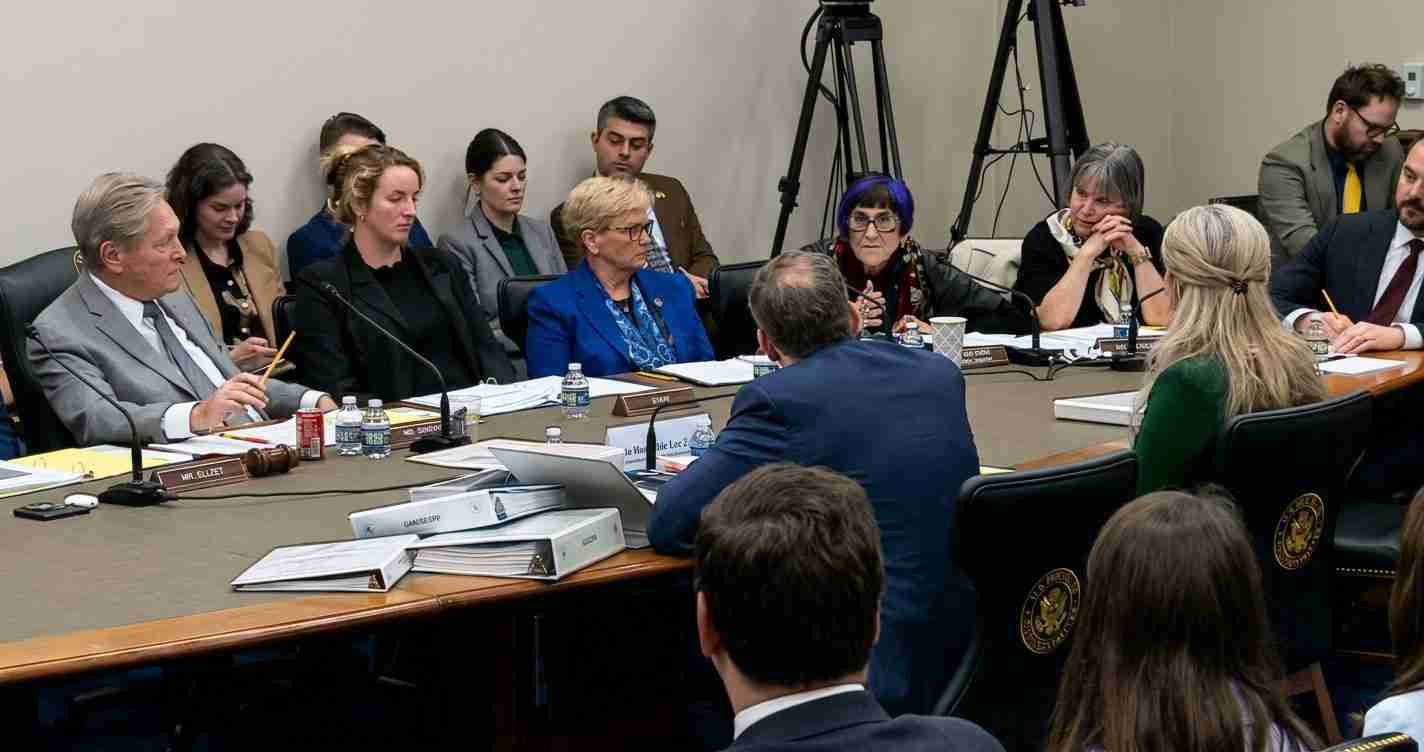
Zeldin, DeLauro Clash Over EPA Authority as 2027 Budget Seeks 52% Cut; Loper Bright Supreme Court Ruling at Center of Hearing
Rep. Rosa DeLauro and EPA Administrator Lee Zeldin engaged in a heated House Appropriations Committee hearing over the EPA’s proposed 2027 budget, a fight that spotlighted Supreme Court precedents like Loper Bright and a proposed roughly 52% funding reduction.
- Budget cut: The administration’s 2027 request proposes about $4.2 billion, down from $8.82 billion in FY2026 — roughly a 52% reduction.
- Legal limits: Zeldin cited the Loper Bright decision and other recent Supreme Court rulings to argue the EPA’s regulatory reach is constrained by court precedent.
- Sharp exchange: DeLauro called the budget a “climate change denier’s manifesto”; Zeldin retorted that members of Congress should understand the controlling case law.
- Political fallout: Clips circulated widely online, drawing praise from conservative commentators and criticism from Democrats warning of public-health impacts.
What happened at the hearing
The clash unfolded during the House Appropriations Committee’s review of the EPA’s 2027 budget request. Rep. Rosa DeLauro (D-Conn.) pressed Administrator Lee Zeldin over language in the budget document that she said downplayed or dismissed climate change impacts, arguing the agency was abandoning duties to protect Americans from air and water threats.
“When climate change is flooding our streets, poisoning our air, driving up health care, how can the EPA justify abandoning that duty to protect Americans, to appease polluters under the false flag of economic growth?” DeLauro asked, according to video of the hearing.
Zeldin pushed back, arguing the agency’s actions must conform to law as interpreted by the courts. He referenced major Supreme Court rulings and told DeLauro,
“You’re upset that you don’t know what Loper Bright is… You’re a member of Congress. You should know.”
He offered to explain “the two biggest Supreme Court cases of the last few years” relevant to agency authority.
DeLauro continued to press the point, at one point saying,
“I don’t have to listen to this BS.”
Short clips of the exchange were widely shared online and triggered a rapid reaction from commentators and social media users.
Legal backdrop: Loper Bright and the shifting scope of agency power
Zeldin’s invocation of Loper Bright referred to a 2024 Supreme Court decision that reshaped how courts treat agency interpretations of statutes. Administration officials cited Loper Bright as a constraint on the EPA’s ability to adopt expansive regulatory interpretations absent clear congressional authorization.
Observers noted Loper Bright sits alongside other recent rulings — including Michigan v. EPA and West Virginia v. EPA — that narrowed agency discretion and favored stricter judicial review. Zeldin argued the EPA must operate within clearer statutory limits and cannot “get creative” with Clean Air Act provisions such as Section 202 without express congressional direction.
The EPA budget proposal and the administration’s rationale
The administration’s 2027 budget request asks Congress to approve about $4.2 billion for the EPA, a roughly 52% reduction from the $8.82 billion allocated in fiscal 2026. Zeldin defended the proposal as both a response to judicial limits on agency action and a reallocation of priorities away from what the administration views as costly or legally dubious regulatory schemes.
Democrats on the Appropriations panel warned that shrinking the agency’s budget by more than half would curtail grants to states, reduce enforcement of pollution standards, and hamper activities from toxic cleanup to drinking-water monitoring. DeLauro framed the cuts as harmful to public health and as a capitulation to polluters under the guise of economic growth.
Public reaction and political fallout
Video clips of the Zeldin–DeLauro exchange were widely shared across social media and conservative outlets. Conservative commentators praised Zeldin for emphasizing Supreme Court precedent and criticized DeLauro’s grasp of recent legal changes. Democratic critics called the exchange a spectacle that obscured the real-world impacts of the proposed budget reductions on enforcement and public-health programs.
Implications for Utah
The proposed EPA budget cuts and the legal debate around agency authority carry concrete implications for Utah across several dimensions:
Economic impact
Utah’s economy—anchored in energy production, mining, outdoor recreation, and agriculture—could feel both relief and strain. Reduced federal regulatory pressure may ease permitting for energy and mining projects, potentially benefiting businesses and workers. At the same time, cuts to EPA grants and cooperative programs could mean fewer funds for drinking-water upgrades, hazardous-site cleanup, and state environmental programs.
Political consequences
Utah’s conservative leaders tend to favor limited federal regulation and expanded state control; the administration’s legal arguments invoking cases like Loper Bright may resonate politically. State officials could use the moment to press for clearer federal-state roles and greater flexibility in implementing environmental programs without aggressive federal rulemaking.
Social effects
Cuts to EPA funding may reduce federal monitoring and enforcement, affecting rural areas and tribal communities that rely on federal support. Utah’s seasonal air pollution challenges—such as those on the Wasatch Front—could see reduced federal monitoring or technical assistance, even as state and local governments continue mitigation efforts.
Cultural relevance
Utah’s cultural mix emphasizes stewardship of public lands, outdoor recreation, and self-reliance. The debate over EPA authority and funding underscores tensions between desires for economic growth and the protection of air, water, and public lands that are central to the state’s identity.
Practical applications for residents
- Permitting and development: Constrained federal oversight could shift permitting responsibility to state agencies, potentially speeding approvals but increasing state-level legal and administrative burdens.
- Grants and infrastructure: Local governments and water districts that rely on federal grants may confront tighter funding pools, requiring more state or local investment.
- Air and health monitoring: Reduced federal support could mean fewer EPA-led monitoring or enforcement actions, elevating the role of state agencies in tracking pollution and responding to incidents.
Sources for coverage and video
- Fox News reporting on the hearing
- Full hearing video (YouTube)
- Short clip of exchange (YouTube Shorts)
Note: All facts, quotes, and URLs in this article are preserved from original hearing coverage and video sources listed above.