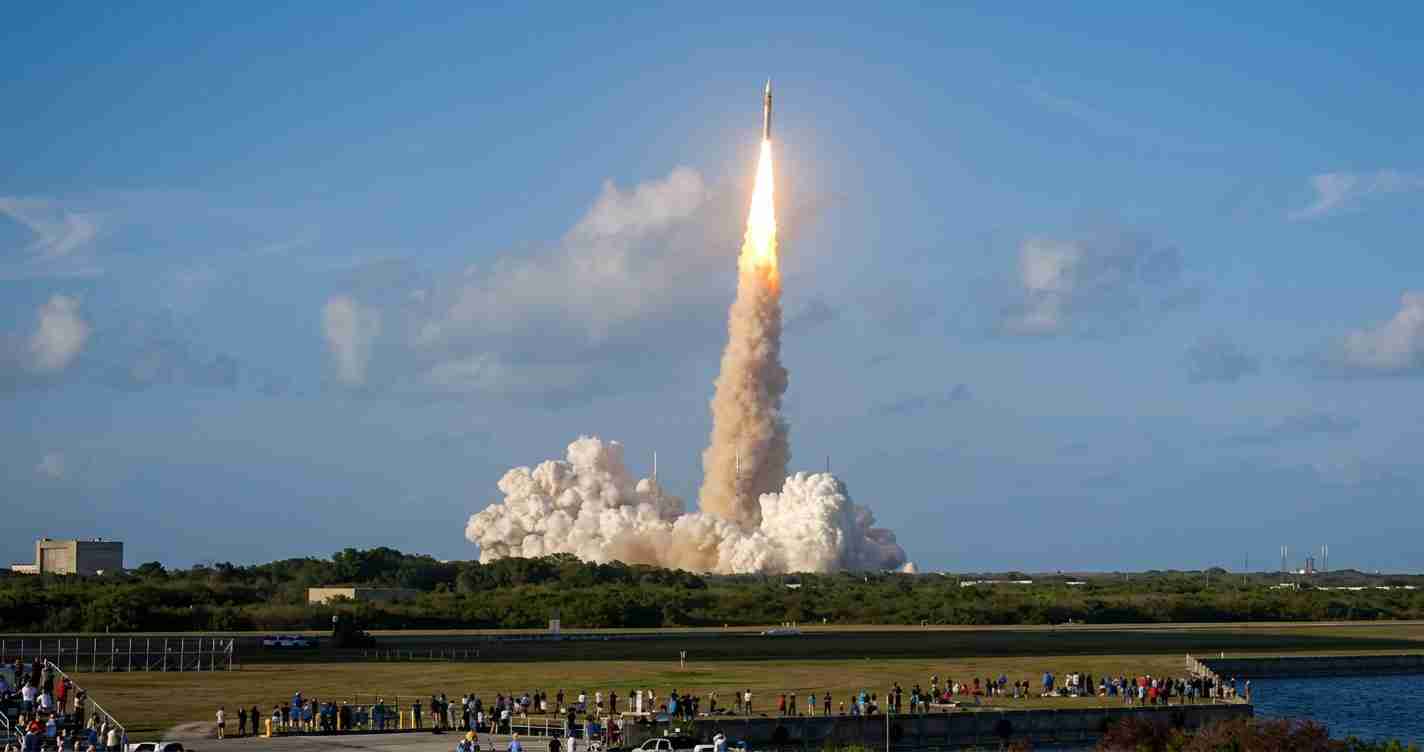
Artemis II mission launch returns humans to deep space — 4 astronauts on 10-day lunar flyby to test systems for future moon landings
NASA’s Artemis II mission launched April 1, 2026, from Kennedy Space Center, Florida, sending four astronauts on a 10-day free-return lunar flyby aboard Orion to test deep-space systems and validate hardware for future Artemis lunar landings.
Key takeaways
- Launch: 6:35 p.m. EDT from Launch Complex 39B at Kennedy Space Center — see the Kennedy Space Center event page.
- Crew: Commander Reid Wiseman; Pilot Victor Glover; Mission Specialists Christina Koch and Jeremy Hansen on Artemis II.
- Mission: A 10-day free-return lunar flyby to test the SLS rocket and Orion deep-space systems — details in NASA’s launch-day updates.
Main story
Launch and early flight: what happened and why investigators watched closely
At 6:35 p.m. EDT on April 1, 2026, the Space Launch System — NASA’s heavy-lift rocket — lifted off from Launch Complex 39B. About eight minutes after liftoff the vehicle reached supersonic speed and the main engines detached and fell away as designed. The interim cryogenic propulsion stage then injected the Orion spacecraft into a high Earth orbit where the crew will spend roughly one day performing system checks before departing for the Moon.
Official reporting and live updates from NASA confirmed the timeline and the successful early checks; follow NASA’s launch-day updates for telemetry and briefing archives.
Trajectory, distance and notable milestones
Artemis II follows a free-return trajectory, a conservative path that automatically brings Orion back toward Earth if a key engine burn is not performed. Mission planners expect the crew to travel farther from Earth than any humans in more than five decades — exceeding roughly 400,000 kilometers from Earth — and to approach a close lunar pass at about 8,000 kilometers from the surface around day six of the flight.
On that close pass the geometry could create a solar eclipse visible to the crew if the Moon blocks the Sun from Orion’s vantage point. Background on mission profile is summarized on the Artemis II reference page.
Testing SLS and Orion: the core mission goal
Artemis II is primarily an integrated systems test. The mission must validate the Space Launch System (SLS), Orion’s life-support and navigation systems, solar array deployment, and deep-space communications under crewed conditions before NASA authorizes lunar landings on Artemis IV and V.
An early milestone came when Orion’s solar array wings deployed and locked after launch, providing power for transit — a confirmation engineers needed to proceed with in-flight checkouts. For live telemetry and official rundowns, see NASA’s mission updates and the Kennedy Space Center event page.
Delays, fixes and scrutiny before liftoff
Final prelaunch testing revealed hydrogen fuel leaks and a helium flow anomaly to the rocket’s upper stage. Engineers worked through the winter on hardware and procedural fixes; a Flight Readiness Review on March 12 cleared Artemis II for the April window. The rocket’s rollout to Pad 39B shifted by one day due to high winds during the planned move from the Vehicle Assembly Building.
Those slips prompted extra oversight from Congress, watchdogs and aerospace partners. Independent reporting and analysis — such as the summary from the Planetary Society — highlight the balance between careful engineering checks and program timelines tied to subsequent lunar landings.
Who’s on board and what their flight means
Commander Reid Wiseman, Pilot Victor Glover, and Mission Specialists Christina Koch and Jeremy Hansen (Canadian Space Agency) make up the four-person crew. Commander Wiseman described the moment after launch as “a beautiful moonrise.”
Notable firsts: the flight carries astronauts beyond low Earth orbit, marking expanded diversity of crew experience on deep-space missions. The mission also underscores international cooperation via the Canadian Space Agency’s participation. For crew details, see the Artemis II entry.
“The crew seem to have really bonded into a spectacular team … where everyone is bringing their expertise and elevating the entire game for everyone.” — Lindy Elkins-Tanton, planetary scientist
How the public can follow the mission
NASA provides near-real-time public tracking via the Artemis Real-time Orbit Website and the NASA mobile app, plus live telemetry and public briefings at key mission milestones. Official status and archives are posted in NASA’s launch-day updates.
Investigative perspective: risks, costs and program accountability
Artemis II functions both as a technical test and a political statement. Success will validate engineering milestones that justify funding and scheduling for Artemis IV and V. The SLS rocket and Orion spacecraft have long faced budgetary and technical scrutiny; any anomalies on Artemis II would likely sharpen congressional debates about program direction and contracts.
From an investigative vantage point, the mission’s outcome defines how quickly and cost-effectively the program can advance, and how well NASA demonstrates stewardship of taxpayer dollars. Read analysis and expectations at the Planetary Society page and Kennedy Space Center briefings on the Kennedy Space Center event page.
Implications for Utah
Economic opportunities: Utah aerospace, defense and tech suppliers could see contract opportunities tied to follow-on Artemis missions. Firms supplying materials, electronics, software and testing services stand to benefit if procurement opens to broader suppliers.
Workforce and education: The mission creates a visible boost for STEM outreach in Utah. Universities and community colleges can leverage public interest to expand aerospace curricula, apprenticeships and recruitment programs that prepare students for deep-space systems work. NASA mission information and procurement notices provide primary leads — see NASA’s mission updates and the Kennedy Space Center event page for announcements.
Political and budgetary implications: Utah’s elected leaders can cite Artemis II milestones to press for continued federal investment in NASA-related programs, emphasizing clear cost controls and performance metrics for future contracts.
Community and cultural effects: The flight may spur public interest across Utah through viewing events, university talks and school programs — translating national achievement into local engagement that supports long-term workforce pipelines.
Additional resources and reporting
- NASA launch-day updates: NASA launch-day updates
- Kennedy Space Center event page: Kennedy Space Center event page
- Technical background and expectations: Planetary Society: Artemis II — what to expect
- Reference summary: Artemis II (Wikipedia)
Reporting from Kennedy Space Center, Florida (Times Media Service).