After 177 years, Schlitz beer discontinued as Wisconsin Brewing Company brews the “last Schlitz” on May 23
Wisconsin Brewing Company in Verona brewed the final Schlitz batch on May 23, ending a 177-year run of the historic American lager; Pabst calls it a ‘hiatus,’ but the small, limited release is being treated as a discontinuation.
- Final brew: Wisconsin Brewing Company produced a limited “Last Schlitz” batch on May 23, with cans and bottles due in late June.
- Reason: Pabst cites rising storage and shipping costs and portfolio rationalization as the reason for pausing the low-volume legacy brand.
- Legacy: Schlitz, founded in 1849, helped make Milwaukee a brewing capital but declined after mid-century recipe and process changes.
- Local impact: In Utah the effect will be minimal — mostly a collectible farewell and marginal shelf space for other lagers or craft beers.
What’s happening now
Wisconsin Brewing Company said it would brew “the last Schlitz” on May 23, producing a small, limited-release batch to be sold in late June. Pabst Brewing Co. labels the move a temporary “hiatus,” but the brewer and many observers are treating the run as the end of regular Schlitz production after 177 years.
Why now: logistics and portfolio math
Zac Nadile, Pabst’s head of brand strategy, told reporters that rising logistics — notably storage and shipping — make low-volume legacy labels costly to maintain. In short, portfolio decisions in a crowded, low-margin beer market force companies to prioritize titles that justify shelf space and warehousing.
A short history: how Schlitz became an American staple
Founded in 1849 when August Krug opened a small Milwaukee brewery, the brand took the Schlitz name under bookkeeper-turned-owner Joseph Schlitz and expanded rapidly — notably shipping to Chicago after the Great Chicago Fire of 1871, which helped the company grow across the Midwest.
By the mid-20th century, Schlitz was one of the nation’s most popular beers; its slogan, “the beer that made Milwaukee famous,” and heavy advertising made it a household name.
The “Schlitz mistake”: when cost-cutting changed the beer
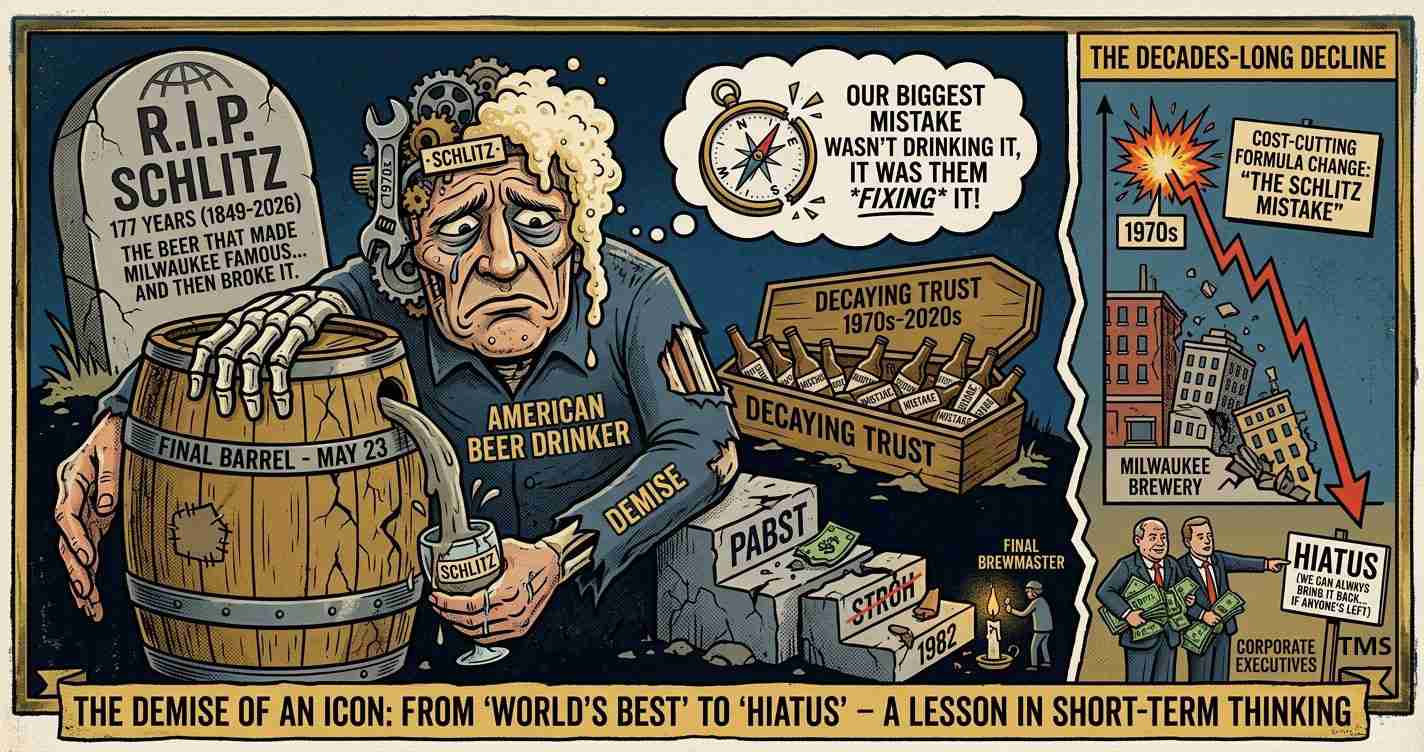
In the 1960s–70s management sped production and cut costs by altering processes and ingredients. Historians call that period the “Schlitz mistake,” when recipe and process changes harmed taste and clarity — a turning point that many longtime drinkers still cite as the start of the brand’s decline.
“Real Schlitz definitely had its own taste. Original formula was decent. Then it became swill.” — sampled social media reaction
Competition and ownership changes
As rivals such as Budweiser and Miller invested in marketing and distribution, Schlitz’s market share slipped. The brand moved through several owners — sold to Stroh Brewing in 1982 and acquired by Pabst Brewing Company in 1999 — becoming a heritage label valued for nostalgia but not high-volume sales.
Wisconsin Brewing Company’s role and the Last Schlitz batch
Wisconsin Brewing Company in Verona acted as contract brewer for Pabst and announced it would brew the farewell Schlitz batch on May 23. The small run, slated for late-June distribution, is being treated as a symbolic close to a brand that began in Milwaukee.
Online reaction and cultural memory
Reaction online mixed fond memories — family gatherings, college days and local bars — with blunt criticism recalling the recipe changes that led many to dismiss later Schlitz as inferior. The debate highlights how brands can be both beloved and criticized, depending on which era people recall.
Physical and brand legacy
The original Joseph Schlitz Brewing Company property in Milwaukee has been redeveloped as Schlitz Park, a historic mixed-use complex. The brand’s legacy is twofold: it helped make Milwaukee a brewing capital and serves as a cautionary tale about cost-cutting that can damage long-term reputation.
Implications for Utah
Economic
Schlitz’s retirement is unlikely to move Utah’s market significantly. As a low-volume nostalgia label, its absence will mostly free up marginal shelf and tap space for other value lagers or local craft options.
Political and regulatory
Utah’s unique alcohol laws and taxes already shape offerings; this brand decision underscores how supply-chain and storage costs — not regulation — often determine which legacy beers remain available.
Social and cultural
For readers with Midwestern ties, Schlitz’s end will be more a cultural note than an economic shock. The story illustrates how long-standing American institutions can fade when business choices prioritize short-term savings over product identity.
Local business impact and craft opportunity
Utah’s craft-beer scene may find marginal upside: distributors and bars can expand local offerings, and Utah breweries may gain small increases in shelf or tap presence previously given to legacy or nostalgic labels.
Practical effect on consumers
For most Utah consumers the Last Schlitz batch will be a collectible curiosity rather than a daily purchase; those with sentimental ties may seek the limited release, while casual drinkers will notice little change.
Sources and further reading
- Milwaukee Magazine reporting and interview with Zac Nadile
- Encyclopedia of Milwaukee, Joseph Schlitz Brewing Company
- Wisconsin Brewing Company
- Pabst Brewing Company
- Fox Business coverage
- The Independent coverage
- AmericanCraftBeer.com (history and “Schlitz mistake” context)
Reporting compiled from Times Media Service reporting and coverage by Milwaukee Magazine, Encyclopedia of Milwaukee, Wisconsin Brewing Company, Pabst Brewing Co., Fox Business, The Independent, and beer-industry history sources.