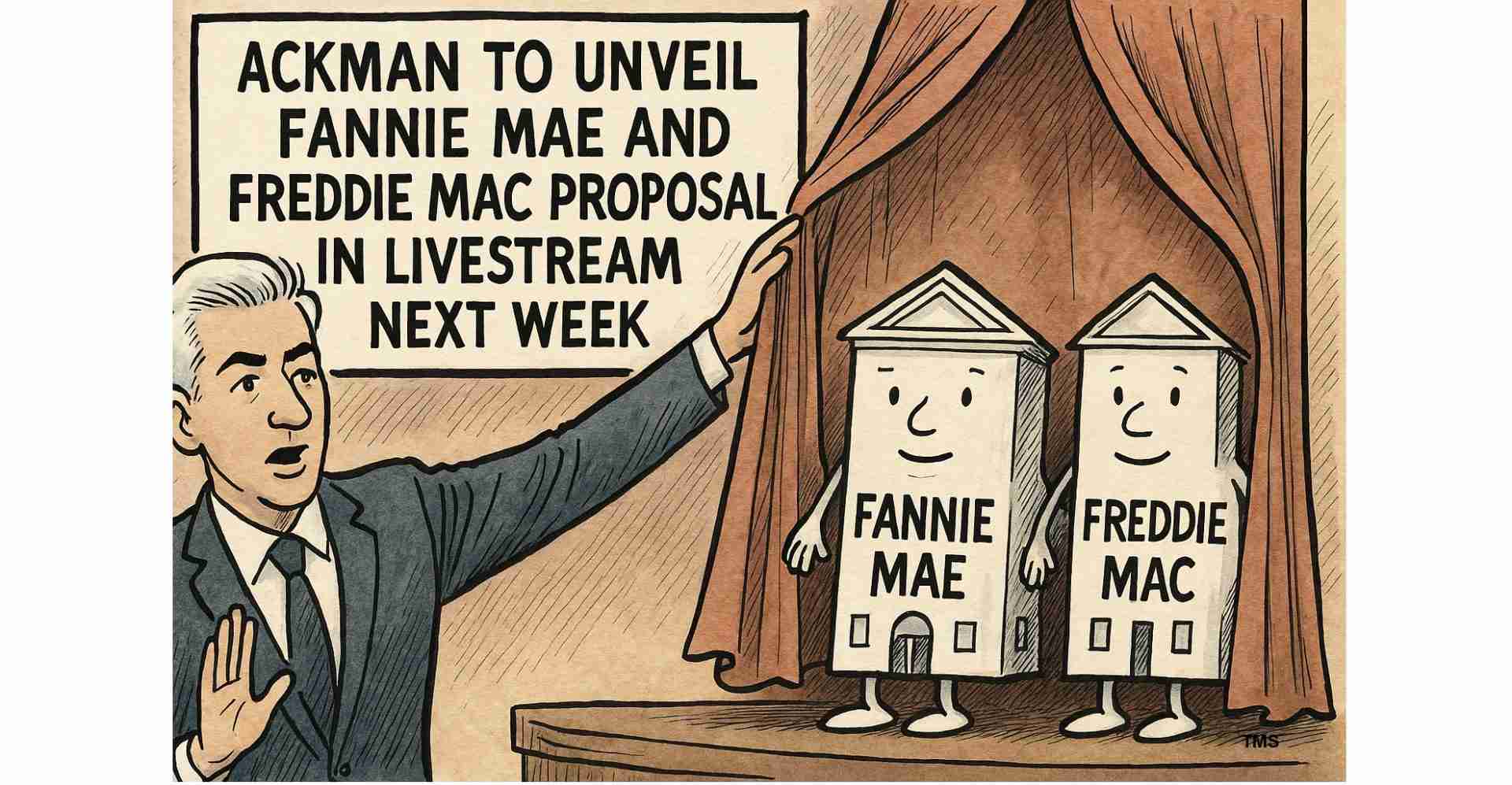
Bill Ackman to unveil plan to merge Fannie Mae and Freddie Mac, pitching privatization to lower mortgage rates
Billionaire hedge fund manager Bill Ackman will livestream a proposal to merge Fannie Mae and Freddie Mac into a single, privatized company, arguing consolidation would cut costs, streamline oversight and could lower mortgage rates for American homebuyers.
Key takeaways
- Ackman to present merger proposal: He will unveil details in a public livestream next week — Fox Business, Benzinga.
- Proposed effects: Merge aims to reduce duplicate operations and oversight costs with the goal of passing savings to borrowers; Fannie and Freddie currently back roughly 70% of U.S. residential mortgages (Friedman Vartolo, GuruFocus).
- Risks and debate: Critics warn transition risks, potential cost increases without safeguards, and the complexity of unwinding conservatorship-era structures (Friedman Vartolo).
What Ackman is proposing
Ackman argues the two government-sponsored enterprises should be combined into a single, streamlined institution. He says a merger would cut duplicate operations, simplify oversight under the Federal Housing Finance Agency (FHFA), and produce cost savings that could be passed to borrowers through lower mortgage rates.
Supporters frame the consolidation as both a business and policy reform: ending redundant staff, systems, and processes across the agencies to create a more efficient housing finance system and reduce government-backed risk on the books. (Source: Friedman Vartolo; Fox Business)
Privatization and IPO plans tied to the proposal
Ackman’s merger idea is set against broader privatization talks. Prior outlines have included selling up to 15% of shares in an initial public offering — potentially raising as much as $30 billion. His plan appears intended to mesh with those privatization concepts by presenting a path to a single, investor-owned company. (Source: Friedman Vartolo)
How the plan could affect mortgage rates
Ackman predicts operational savings from a merger could be translated into lower fees and tighter spreads in the mortgage market. Because Fannie Mae and Freddie Mac back about 70% of mortgages, any structural change could meaningfully affect rates nationwide. Analysts will watch whether savings are realized and passed on to consumers or retained by investors and servicers. (Sources: Friedman Vartolo; GuruFocus)
Concerns and criticism
Not all observers are convinced consolidation or privatization will benefit homeowners. Critics warn of possible market instability during any transition and the risk that privatization could raise mortgage costs for some borrowers if competition and regulation are not structured properly.
Some estimates suggest privatizing without robust safeguards could raise annual mortgage expenses for homeowners by roughly $1,800 to $2,800 — figures that remain debated and depend on final policy design. (Source: Friedman Vartolo)
Experts also highlight the complexity of unwinding or retooling companies that have been under conservatorship since 2008. Transition plans must address capital rules, guarantees, lending standards, and the federal role in times of stress. Consolidation could simplify oversight for some, but may also concentrate risk in a single entity unless carefully managed. (Source: Friedman Vartolo)
What to expect from the livestream
Ackman will use a public livestream next week to present details on his proposed Fannie–Freddie merger and the path to privatization. The presentation is expected to outline consolidation mechanics, projected savings, timelines, and how an IPO or partial privatization might be structured. Market participants, regulators and lawmakers will likely scrutinize the proposal closely after the announcement. (Sources: Fox Business; Benzinga)
Historical background
Fannie Mae and Freddie Mac were placed into federal conservatorship during the 2008 financial crisis to stabilize the housing market. Since then, reform has been debated for more than a decade — from full privatization to breaking up government roles among insurers, guarantors and private capital. Ackman’s merger-centered approach adds another consolidation option to that long-running debate. (Source: Friedman Vartolo)
Implications for Utah
Economic impact
Mortgage rates impact: Utah’s housing market is sensitive to national mortgage rates. If Ackman’s plan leads to meaningful savings passed to borrowers, Utah homebuyers could see modest rate relief and lower monthly payments — aiding affordability in Salt Lake City and fast-growing counties. (Sources: Friedman Vartolo; GuruFocus.)
Local lenders and banks: Regional banks and mortgage lenders that work with secondary market buyers could see changes to pricing, product availability, and underwriting standards if a merged Fannie–Freddie adopts new rules, affecting loan flow and servicing in Utah.
Political consequences
Utah’s conservative leadership often favors market-based solutions and limited federal intrusion. Ackman’s privatization-friendly plan may appeal to lawmakers who want to reduce federal exposure in housing finance and could prompt members of Utah’s congressional delegation to voice support or call for strict guardrails. Any major change would require federal rulemaking or legislation, where Utah representatives could play a role. (Source: Friedman Vartolo)
Social effects
If mortgage rates fall, more Utah families could become homeowners; conversely, if privatization raises costs or constrains credit, first-time buyers could face higher barriers. Observers emphasize monitoring product availability for lower-income buyers across Utah’s diverse communities. (Source: Friedman Vartolo)
Cultural relevance
Utah places high value on family stability and homeownership. A proposal framed as lowering government exposure while boosting private-sector efficiency may resonate with conservative audiences who favor stewardship of taxpayer dollars and private-market solutions.
Practical applications for residents
What homeowners should watch: Utah homeowners and buyers should monitor Ackman’s livestream and regulatory reaction. Changes to guarantees, down-payment rules, and mortgage product pricing could affect refinancing and new mortgage costs. (Sources: Fox Business; Benzinga)
Reporting note
This is a developing story. Full details on Ackman’s proposed mechanics, projected savings and regulatory responses will become clearer after his livestream presentation and follow-up analysis from market and government sources. (Sources: Fox Business; Benzinga; Friedman Vartolo).