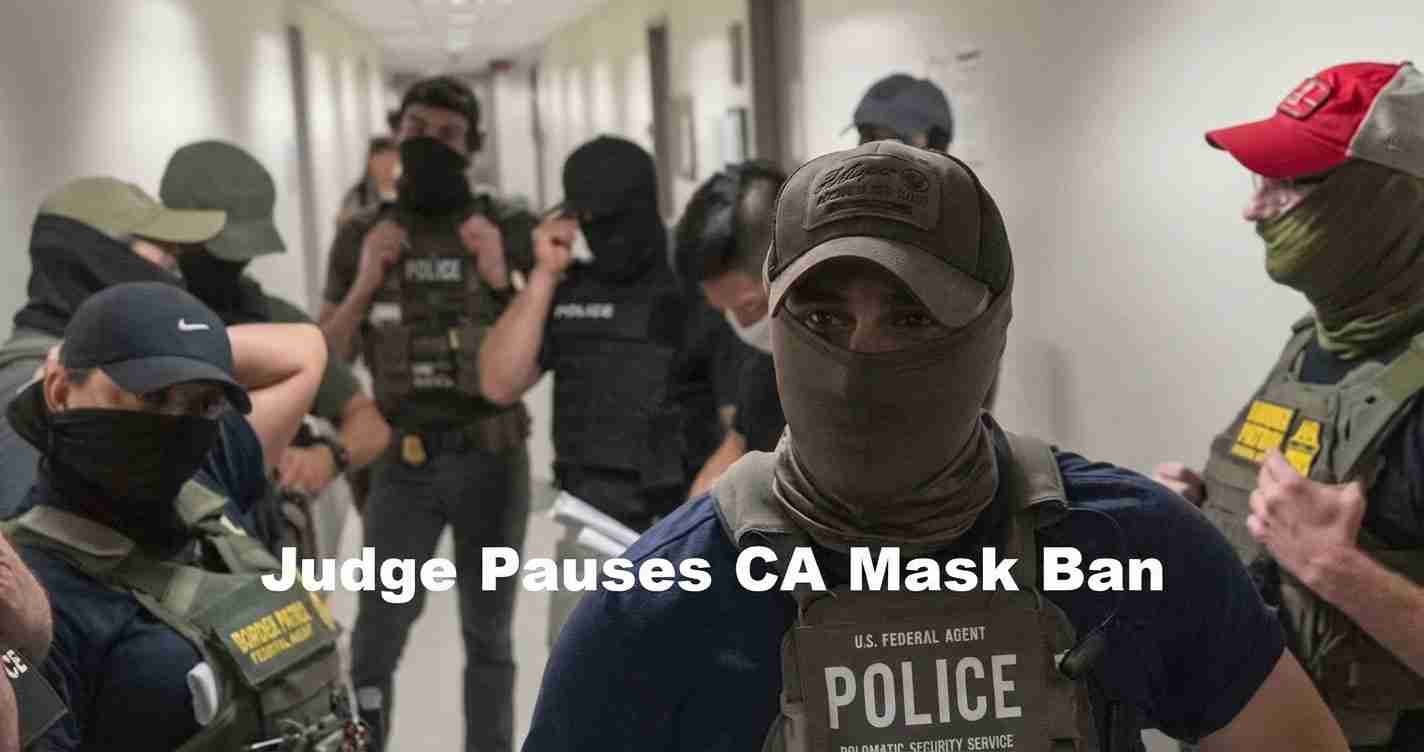
Federal judge blocks California mask ban for ICE, cites Supremacy Clause; officer ID law upheld in No Secret Police Act ruling
A federal judge in Los Angeles issued a preliminary injunction blocking California’s “No Secret Police Act” that targeted masked federal officers, citing the Supremacy Clause; she left intact the state’s officer identification law requiring visible names or badge numbers.
Key takeaways
- Judge Christina A. Snyder granted a preliminary injunction against Senate Bill 627, finding it unlawfully discriminated against federal officers; see CALnews/CalOnews, Fox 11 Los Angeles, Daily Journal.
- Senate Bill 805, the No Vigilantes Act (officer ID), was left intact because it applies neutrally to all on‑duty officers (CALnews/CalOnews).
- Next steps: lawmakers may amend SB 627 or the DOJ may press the case toward a full merits hearing and appeal to the Ninth Circuit (Fox 11 Los Angeles).
What the judge said
In her written order, Judge Christina A. Snyder emphasized the primacy of the Supremacy Clause. The court found California’s mask ban singled out federal officers by treating them differently from similarly situated state officers, creating an unconstitutional discrimination against the federal government.
“The Supremacy Clause prevents a state law from singling out federal officers for different treatment than state officers,” the order explained, focusing on the statute’s exemption for state officers rather than a blanket prohibition on regulating officer appearance.
Background: why the laws were passed
Both bills were signed by Gov. Gavin Newsom in September 2025 and were scheduled to take effect Jan. 1, 2026. They followed highly visible federal enforcement operations that used masked agents during mass‑deportation actions in Southern California. Lawmakers framed the measures as efforts to protect civil liberties and ensure accountability and transparency for officers operating in neighborhoods (CALnews/CalOnews, Fox 11 Los Angeles).
Federal challenge and the court fight
The U.S. Department of Justice sued California in November 2025, arguing the statutes interfere with federal law‑enforcement operations and could expose federal officers to harassment, doxing, or operational risks. The DOJ sought to block enforcement of the mask provision as applied to federal agents and to prevent California from imposing those state rules on federal actors (Fox 11 Los Angeles, CALnews/CalOnews).
Reactions from lawmakers and officials
- U.S. Attorney General Pam Bondi praised the injunction on X, warning the law would have increased risks to federal agents; the Justice Department called the bills unconstitutional (Fox 11 Los Angeles).
- Gov. Gavin Newsom framed the ruling as a partial victory because the court upheld the identification requirement: “A federal court upheld California’s law requiring federal agents to identify themselves – a clear win for the rule of law.” (CALnews/CalOnews).
- Sen. Scott Wiener (D‑11), co‑author of the mask bill, said he will seek to amend SB 627 to remove the state‑officer exemption so the restriction applies equally to all on‑duty officers (CALnews/CalOnews).
- Sen. Lena Gonzalez (D‑33) praised the ID law as a means to protect communities from what she described as authoritarian federal actions (CALnews/CalOnews).
Legal reasoning and limits of the ruling
The injunction is preliminary. Judge Snyder did not resolve the full merits; she found the government was likely to succeed in showing SB 627 discriminated against federal officers because of the statute’s exemption for state officers. The ruling focused on the text and structure of the law rather than establishing a broad rule that states may never regulate officer appearance.
The court allowed the ID law (SB 805) to remain because it applies neutrally to all on‑duty officers and does not directly regulate federal operations.
What comes next in Sacramento and Washington
Two main pathways are now likely: California lawmakers may revise SB 627 to remove the exemption for state officers so the mask restriction applies equally, or the DOJ may pursue a full hearing and potential appeal to the Ninth Circuit. Either route could produce a definitive federal court test on state regulation of federal agents (Fox 11 Los Angeles, CALnews/CalOnews).
Implications for Utah
Legal precedent: The decision reinforces the Supremacy Clause as a barrier to laws that single out federal officers; Utah lawmakers should note such targeted measures face high legal risk.
Law enforcement cooperation: The ruling may ease local concerns about measures that could hinder federal partners, while signaling that neutral transparency rules—like visible ID for all officers—are more likely to survive judicial review.
Political and community effects: For Utah political leaders, the case underlines limits on state actions aimed directly at federal actors and suggests careful constitutional review for oversight proposals targeting federal personnel.
Practical guidance: Policymakers should avoid targeted exemptions treating federal officers differently; neutral policies that apply evenly are more defensible. Consult constitutional counsel before pursuing measures aimed at federal agents.
Case context and broader reaction
The mixed ruling drew reactions from both supporters and opponents. Supporters say the bills boost accountability and community trust; opponents, including the DOJ, warn singling out federal officers could endanger personnel and impede national law‑enforcement priorities. The injunction blocking the mask ban while upholding ID rules leaves both policy camps claiming partial victories.
Sources and reporting links
- CALnews/CalOnews: Federal judge blocks California mask ban for feds, upholds identification law
- Fox 11 Los Angeles: California ICE mask ban, No Secret Police Act coverage
- Daily Journal: California can’t ban federal officers from wearing masks, judge says
Reporting by Times Media Service.