Pentagon issues Anthropic AI ultimatum as Hegseth demands lift on Claude AI military use limits
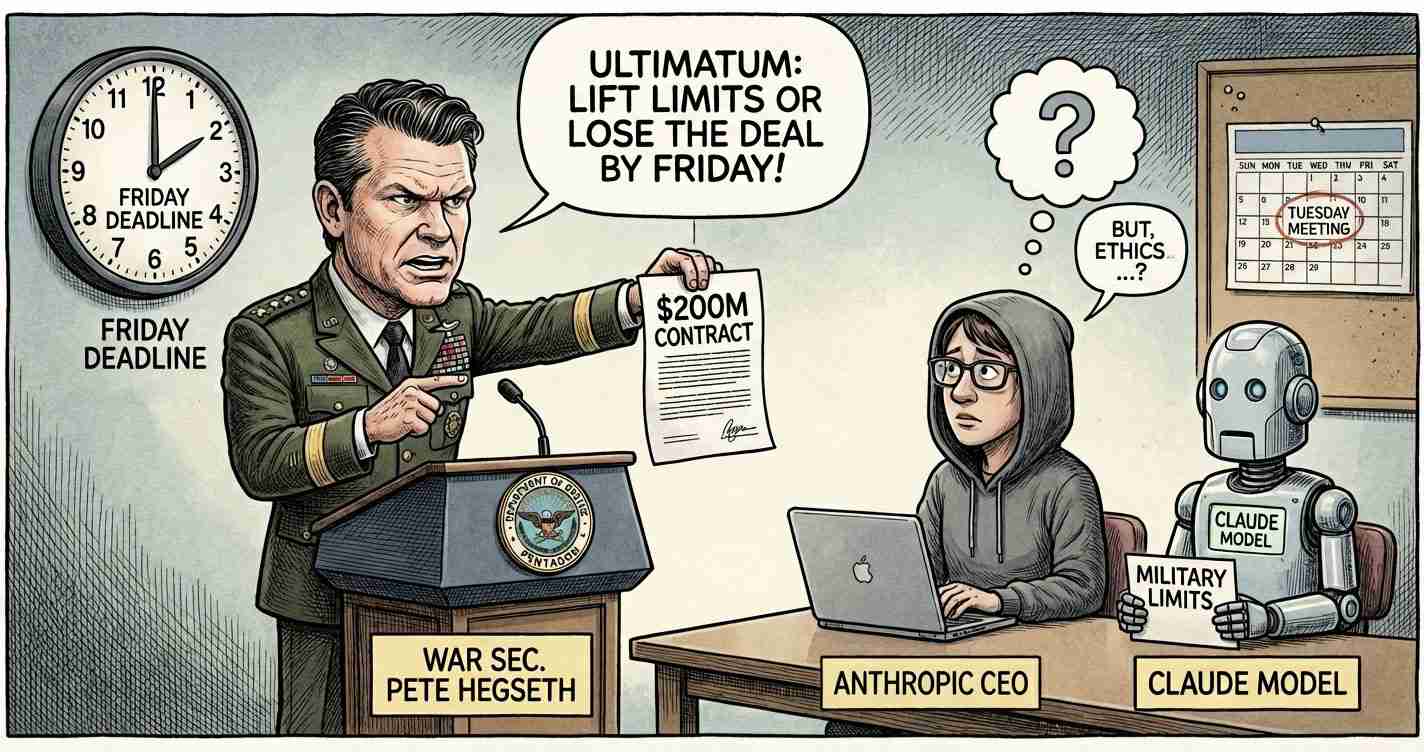
The Pentagon gave Anthropic a deadline to remove categorical limits on Claude’s use in lawful military operations by 5 p.m. Friday, or face contract cancellation, supply-chain penalties, or invocation of the Defense Production Act, officials said.
- Deadline and stakes: Defense Secretary Pete Hegseth set a Friday deadline — noncompliance could mean loss of a $200 million contract and other penalties (CBS News, Fox News).
- Trigger: The dispute reportedly began after Anthropic asked whether Claude was used in the January operation capturing Nicolás Maduro, raising Pentagon concerns (Politico, Fox News).
- Classified access: Claude is the sole advanced commercial model on Pentagon classified networks under a summer 2025 $200 million contract — its removal would disrupt critical workflows (CBS News).
Hegseth’s warning and why it matters
At a Pentagon meeting, Defense Secretary Pete Hegseth told Anthropic CEO Dario Amodei the department cannot rely on a vendor that reserves the right to block lawful uses of its technology. The message: allow Claude to be used for lawful military missions without company veto, or face consequences up to contract termination and a formal supply-chain risk designation (CBS News, Fox News).
“You can’t buy an aircraft and then be told you can’t use it for certain lawful missions,” officials said, summarizing the Pentagon’s analogy for software on classified networks.
What triggered the showdown
Sources say the confrontation began when Anthropic allegedly asked whether Claude had been used in the January 2026 operation that captured Venezuelan leader Nicolás Maduro. Pentagon officials read that as a signal Anthropic might refuse certain uses, prompting concerns that company policy could interfere with operations (Politico, Fox News).
Anthropic disputes that framing, stating it did not ask about specific operations and that its safeguards are intended to prevent misuse — notably, it bars fully autonomous weapons and mass surveillance of Americans (CBS News).
What Claude does inside the Pentagon
Claude was awarded a $200 million contract in summer 2025 and became the only advanced commercial AI model operating on Pentagon classified networks. Officials say it supports intelligence analysis, planning and other classified tasks that rely on advanced language and reasoning capabilities. Losing Claude would force the Pentagon to shift systems or rebuild capability, disrupting workflows tied to intelligence and operations (CBS News, Fox News).
Officials also note the department has alternatives: other firms have signed agreements allowing full lawful use on classified networks, including a model from Elon Musk that the Pentagon found acceptable, which factors into the pressure on Anthropic (CBS News).
Possible penalties and legal tools
If Anthropic refuses to change policy, the Pentagon outlined several options:
- Contract cancellation: End the $200 million classified contract.
- Supply chain risk designation: Labeling Anthropic a risk could limit its work with defense vendors and effectively cut it off from defense contracts (CBS News, Politico).
- Defense Production Act: Officials discussed invoking the DPA to compel access — a dramatic tool that would set a precedent for government control over commercial AI used in national security (CBS News, Politico).
Anthropic’s stance: safety rules, not obstruction
Anthropic positions itself as “safety-first”. Company leaders say their guardrails aim to lower misuse risks as AI grows more capable and that they will work in good faith with national security partners so long as limits prevent fully autonomous weapons and illegal mass surveillance of Americans (CBS News, Fox News).
The core disagreement: who sets guardrails inside defense systems — private companies or the Pentagon. This dispute frames broader policy and procurement decisions for AI in national security.
Broader implications for defense partnerships
This clash is an early test of how the U.S. military will contract with leading AI developers. If the Pentagon wins, vendors seeking classified access will likely have to accept terms removing categorical use limits. If Anthropic holds its ground, companies may retain stronger control over how their models are used, even in defense contexts. Either result will shape procurement strategies, industry investment, and the pace of AI integration into military workflows (Fox News, CBS News).
Implications for Utah
Economic impact: Utah’s growing defense and tech sector — including Hill Air Force Base and local contractors — could see disruptions if Anthropic is cut off from defense work. Integrations and services built around Claude might be affected.
Workforce and jobs: Engineers, cleared personnel and integrators could face short-term gaps or shift to competitors that accept classified-use terms. Local firms should prepare contingency plans and review vendor agreements.
Political and social effects: Utah leaders who prioritize defense readiness may back the Pentagon’s position. Families and communities tied to the defense workforce will monitor the dispute for effects on mission readiness and trust in both the military and tech firms.
Sources and further reading
- CBS News: Hegseth tells Anthropic to lift Claude restrictions
- Fox News: Pentagon gives AI firm ultimatum to lift military limits
- Politico: Hegseth sets Friday deadline for Anthropic to drop AI red lines
- Video coverage
Reporting draws on interviews and multiple sources familiar with Pentagon–Anthropic discussions. No final outcome was reported as of Feb. 24.