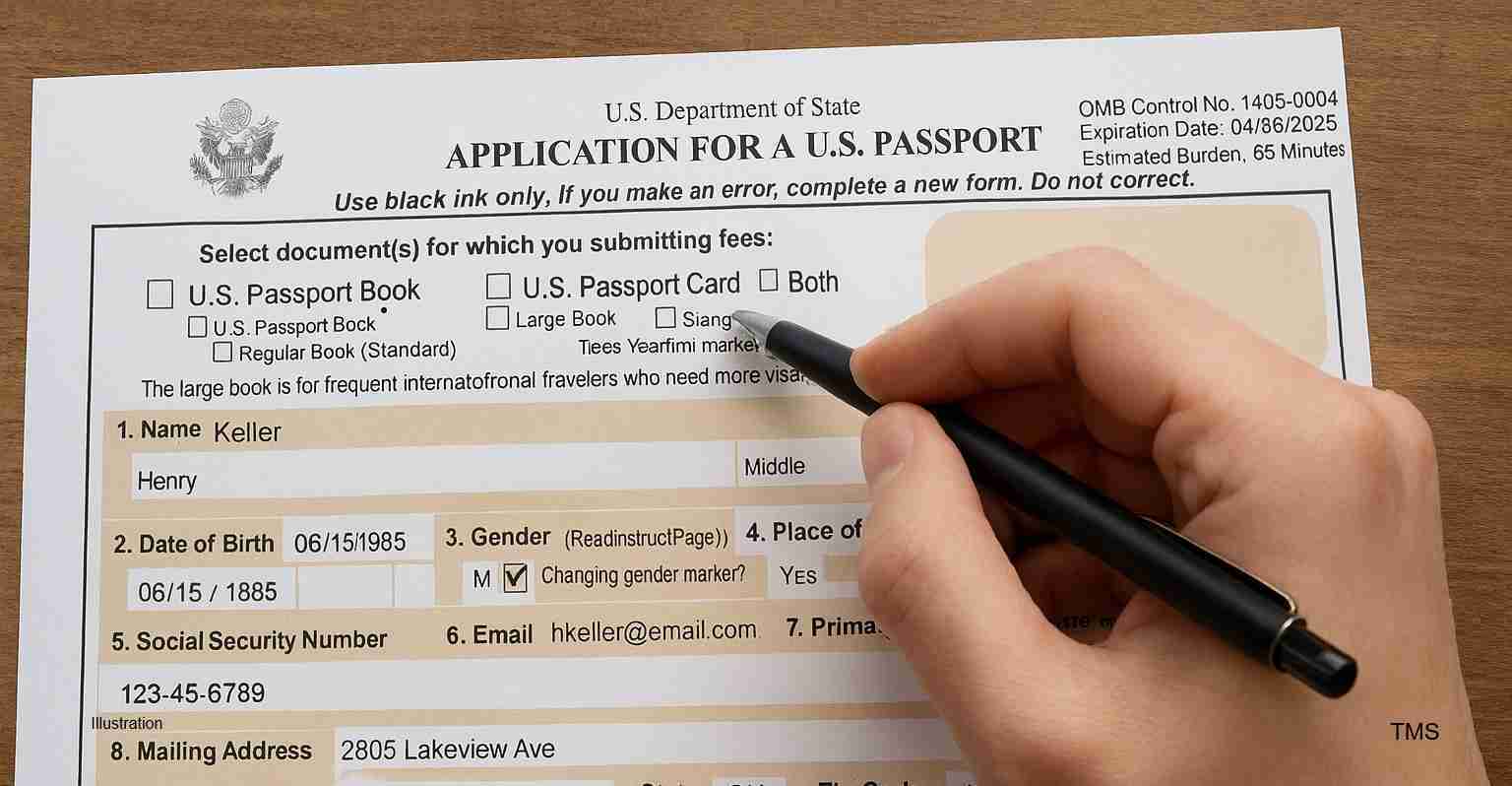
Supreme Court Allows Trump Administration to Reinstate Birth-Assigned Sex Markers on Passports
The U.S. Supreme Court on Nov. 6, 2025 allowed the Trump administration to reinstate passports listing birth-assigned sex nationwide, pausing lower-court orders that had permitted self‑identified markers including X, affecting transgender and nonbinary travelers immediately.
Key takeaways
- Temporary high-court order: The Supreme Court permitted enforcement of passports that list the sex shown on a birth certificate while litigation continues.
- Policy rollback: The move reverses the 2021 State Department practice that allowed applicants to choose male, female, or X without medical proof.
- Civil-rights challenge: Advocacy groups say the policy is discriminatory and dangerous; lawsuits are ongoing to block enforcement.
- Dissent warned of harm: Justice Ketanji Brown Jackson and two liberal colleagues said the order fails to prevent immediate, serious harm to affected people.
Supreme Court order and legal reasoning
The Court issued an unsigned order on Nov. 6, 2025 allowing the administration to enforce passport rules that list the sex shown on a birth certificate while lower-court litigation proceeds. The order characterizes the practice as attesting to a historical fact rather than singling out a group for unequal treatment, comparing it to listing a person’s country of birth.
Read the Supreme Court order for the full text of the unsigned ruling. Reporting and summaries of the decision are also available, including KESQ/CNN summary reporting.
Policy background: what changed and why
On Jan. 20, 2025, President Trump signed an executive order directing federal agencies to “recognize two sexes, male and female” based on birth certificates and what the administration described as “biological classification.” That directive instructed the State Department to return to listing sex as it appears on a birth certificate or other original record.
Under the Biden administration beginning in 2021, the State Department allowed applicants to select male, female or an X marker without a doctor’s note; that change was intended to match federal ID to a person’s lived gender and reduce medical gatekeeping. See reporting from ABC7NY reporting for background and timeline.
Arguments from plaintiffs and civil rights groups
Plaintiffs and civil-rights organizations argue the policy endangers transgender and nonbinary people. They say passports that show a birth-assigned sex differing from a person’s appearance or state ID can lead to embarrassment, harassment, detention or violence while traveling. The ACLU’s petition and subsequent statements emphasize those safety concerns.
Civil-rights groups have asked the Supreme Court to let lower-court injunctions remain in place while cases proceed; those injunctions had preserved the Biden-era, self-identification policy until the high court’s order.
Dissent and concerns about immediate harm
Justice Ketanji Brown Jackson, joined by two liberal justices, called the order a “senseless sidestepping of the obvious equitable outcome,” arguing the Court allowed immediate harm without sufficient justification.
The dissent stressed that people who relied on the inclusive policy could face sudden, serious problems when a passport no longer reflects their lived gender. See reporting that summarizes the dissent and reactions: KESQ/CNN summary reporting.
Historical context: how passports have changed over time
Passports have included sex markers since the 1970s. During the early 1990s the State Department required medical proof to change a marker; that requirement was lifted in 2021 and an X option was introduced to recognize nonbinary people. The current action reverses that more flexible approach and returns to birth-record–based listings. See background coverage at ABC7NY reporting.
Reactions and political context
Supporters of the administration say tying passport markers to birth records protects national security, preserves passport integrity and avoids confusion across state and international systems. Conservative leaders and many supporters favor objective, historical facts on federal ID.
Opponents call the policy discriminatory and harmful; advocacy groups are coordinating legal and public campaigns. For legal context on anticipated administration impacts, see Lambda Legal guidance and reporting summaries such as Economic Times roundup.
Legal path ahead
The Supreme Court’s order is temporary and pauses lower-court injunctions while litigation proceeds through appeals. The issue could return to the high court for a full ruling, or be altered by legislation, meaning passport gender rules may change again depending on future judicial or legislative action. The Supreme Court order is the controlling temporary directive right now.
Implications for Utah
Economic impact: Utah’s travel industry and small businesses that serve tourists could see cancellations or disruptions if transgender or nonbinary travelers face issues at airports or abroad, affecting hotels, outfitters and tour operators.
Political consequences: Utah’s conservative-leaning electorate and officials who favor birth-assigned sex policies may welcome the decision; others concerned about federal power and civil rights will watch litigation closely.
Social effects: Families with transgender children may face mismatches between state IDs and federal passports, creating stress and legal uncertainty for travel related to work, medical care or family needs.
Local leaders, churches and civic organizations in Utah are likely to debate identity, privacy and government authority as state practices and federal rules potentially conflict.
Practical applications for residents
Utah residents planning to apply for or renew passports should check State Department requirements and confirm how federal passport markers align with state IDs before travel. Affected people may wish to consult legal counsel or advocacy organizations for guidance while litigation is pending.
Travelers with mismatched documents should carry extra proof of identity and be prepared for questions at airports or foreign ports of entry. Civil-rights groups such as the ACLU and Lambda Legal offer resources and legal help links.
Sources and further reading
- U.S. Supreme Court order (Nov. 6, 2025)
- ABC7NY reporting
- KESQ/CNN summary reporting
- Economic Times roundup
- ACLU press release — Transgender people ask Supreme Court to reject administration’s effort
- ACLU press release — Response to Supreme Court allowing enforcement
- Lambda Legal guidance on transgender rights under the Trump administration