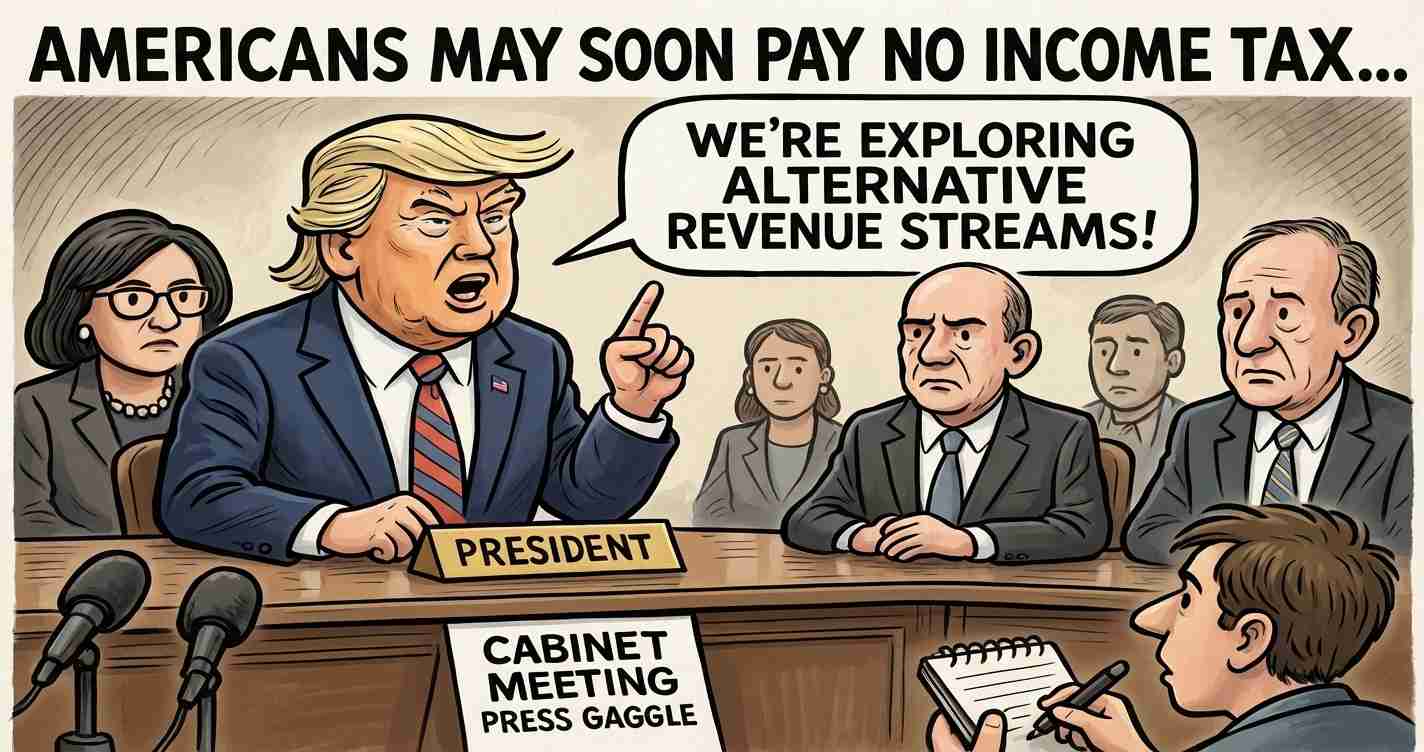
Trump Says Americans May Soon Pay No Income Tax, Urges Shift to Tariff Revenue to Fund Government
President Donald Trump proposed eliminating the federal income tax and replacing wage-based revenue with tariffs, saying border duties could fund government operations — a sweeping plan that would fundamentally reshape U.S. fiscal policy and trade relations.
Key takeaways
- Trump claims tariffs could replace income tax. See Fox Business for the president’s remarks.
- Treasury offers a more cautious read. Treasury Secretary Scott Bessent spoke of possible income tax relief, not full elimination — reporting by CPA Practice Advisor.
- Income tax now funds roughly half of federal receipts. Replacing ~54% of federal revenue with tariffs would be a major fiscal shift (CPA Practice Advisor).
Main story
The president’s pitch: “No income tax” in the near term
During a Dec. 2 cabinet meeting press gaggle, Trump told reporters that “at some point in the not too distant future you won’t even have income tax to pay,” saying revenue collection under his watch is “so great… so enormous.” On a Nov. 27 video call with service members he said tariff money would be “so large” that America could “substantially cut or maybe cut out income tax completely.”
“Whether you get rid of it or just keep it around for fun or have it really low, much lower than it is now, but you won’t be paying income tax.” — President Donald Trump
Full coverage of the remarks is available via Fox Business and video of the Nov. 27 address is posted to YouTube.
Tariffs as the proposed replacement: how the administration frames it
The administration describes a tariff revenue tax approach: collect large import duties at the border and use that money for federal programs, tax relief, and refunds to Americans. Trump said, “We’re going to be giving back refunds out of the tariffs because we’re taking in literally trillions of dollars,” and suggested tariff receipts could fund refunds or dividend-style stimulus checks.
Supporters argue higher trade barriers can both protect domestic industry and raise receipts; critics warn about higher consumer prices and retaliation. See analysis at CPA Practice Advisor.
White House and Treasury voices: mixed messages
Not everyone in the administration echoes the president’s sweeping language. Treasury Secretary Scott Bessent took a more measured tone, saying tariff revenue could permit income tax relief but did not promise full elimination. Bessent mentioned targeted breaks — such as no federal tax on tips, Social Security benefits, or overtime pay — and restoring certain interest deductions tied to American-made products (CPA Practice Advisor).
Interpretation: the gap between presidential rhetoric and Treasury caution suggests planning is preliminary; officials have not released a detailed plan showing how tariffs alone would replace the roughly half of federal revenue currently raised by income taxes.
Historical context: scale of a US tax system overhaul
Abolishing the income tax would be the most sweeping change to U.S. fiscal policy in more than a century. Since the early 20th century, the federal income tax has been the backbone of government finance. Today, income taxes account for an estimated 54% of federal receipts, meaning any replacement scheme would have to generate vast, stable sums (CPA Practice Advisor).
Economists and budget experts note several complexities: replacing that revenue with tariffs would likely require either permanently high tariff rates or new taxes/fees — outcomes that contradict messaging about tax relief — and would reshape trade, prices, and international relations.
Legislative, economic and practical hurdles
Abolishing federal income tax would require major changes to the tax code and substantial congressional action. Observers note that a narrow House majority and Senate dynamics could complicate passage of sweeping reform. Key risks flagged by economists and policy analysts include:
- Higher import prices for consumers and businesses, as tariffs are passed through.
- Retaliation from trading partners that could harm U.S. exporters and supply chains.
- Revenue volatility: successful tariffs that reduce imports would also shrink the tariff base.
- Program funding and distribution questions — defense, Social Security, Medicare and other obligations need reliable revenue streams.
The administration has not published a comprehensive budget blueprint showing how tariff collections would sustain current federal obligations.
Trump’s evolving stance on taxes
Trump’s views on taxation have changed over the years. In 1999 he proposed a one-time “net worth” tax on the very wealthy during a prospective Reform Party run. More recently, he has repeatedly suggested eliminating wage-based income taxes and using tariffs instead. Asked during a campaign interview about eliminating personal income taxes, he replied, “Yeah, sure, why not?” and tied that to tariff funding (Fox Business).
Implications for Utah
Economic impact
Utah could see both benefits and costs. A lower or eliminated federal income tax would increase household take-home pay and potentially boost local spending. However, higher tariffs could raise input costs for manufacturers, tech firms, and retailers, and retaliatory barriers could hurt Utah exporters in manufacturing and agriculture (CPA Practice Advisor).
Political consequences
For Utah’s conservative-leaning electorate, the proposal dovetails with small-government and pro-worker messaging. Local GOP leaders may welcome lower federal income taxes and protectionist measures that defend domestic jobs. Utah lawmakers, however, will weigh the tradeoffs for local industries and constituents’ pocketbooks (Fox Business).
Social and daily-life effects
Utah families might see immediate increases in take-home pay, easing household budgets. But rising prices on imports — electronics, clothing, auto parts — could offset gains, particularly for lower- and middle-income households. Public services reliant on federal funding could face uncertainty if revenue mixes change dramatically.
Practical considerations for Utah residents
Businesses that rely on imported materials should prepare contingency plans for higher input costs or supply disruptions. Consumers should watch for price changes and potential federal programs distributing tariff refunds or dividends. State and local officials will need to assess changes to federal funding and plan accordingly (CPA Practice Advisor; Fox Business).