Wild scene at Taco Giro: Protesters trap federal agents during Tucson ICE raid; Adelita Grijalva pepper‑sprayed
A multi‑agency federal raid at Taco Giro in Tucson escalated Friday as protesters surrounded agents, briefly trapping them in a gated lot; officers used chemical irritants and flash‑bang devices, several people were detained and others pepper‑sprayed.
Key takeaways
- Agents trapped: Protesters pressed against a gated parking lot and used a bike lock to briefly trap federal vehicles and officers.
- Use of force: Federal officers deployed pepper spray, pepper balls and flash‑bang‑type devices; journalists and bystanders were affected.
- Lawmakers targeted: U.S. Rep. Adelita Grijalva said she identified herself as a member of Congress and was pepper‑sprayed while seeking information.
- Multiple detentions: ICE confirmed multiple detentions tied to an investigation into alleged immigration and tax violations.
Federal operation and purpose
Federal officials said the operation was part of a years‑long investigation into alleged immigration and tax crimes linked to a restaurant chain. The Taco Giro location in Tucson was one of multiple sites searched under 16 federal search warrants in southern Arizona. ICE described the operation as targeting “immigration and tax violations” and confirmed that multiple people were taken into custody; full charging documents and the final number of defendants were not immediately released.
Where and when
The events unfolded outside the Taco Giro restaurant in the Barrio Hollywood neighborhood on North Grande Avenue. Agents arrived about 9 a.m. Friday and the confrontation continued through late morning.
Agencies involved
ICE Homeland Security Investigations and IRS Criminal Investigation led the operation, with other DHS partners assisting. The Tucson Police Department was on scene and said it did not deploy force, limiting its role to traffic control and perimeter management.
How the protest formed and escalated
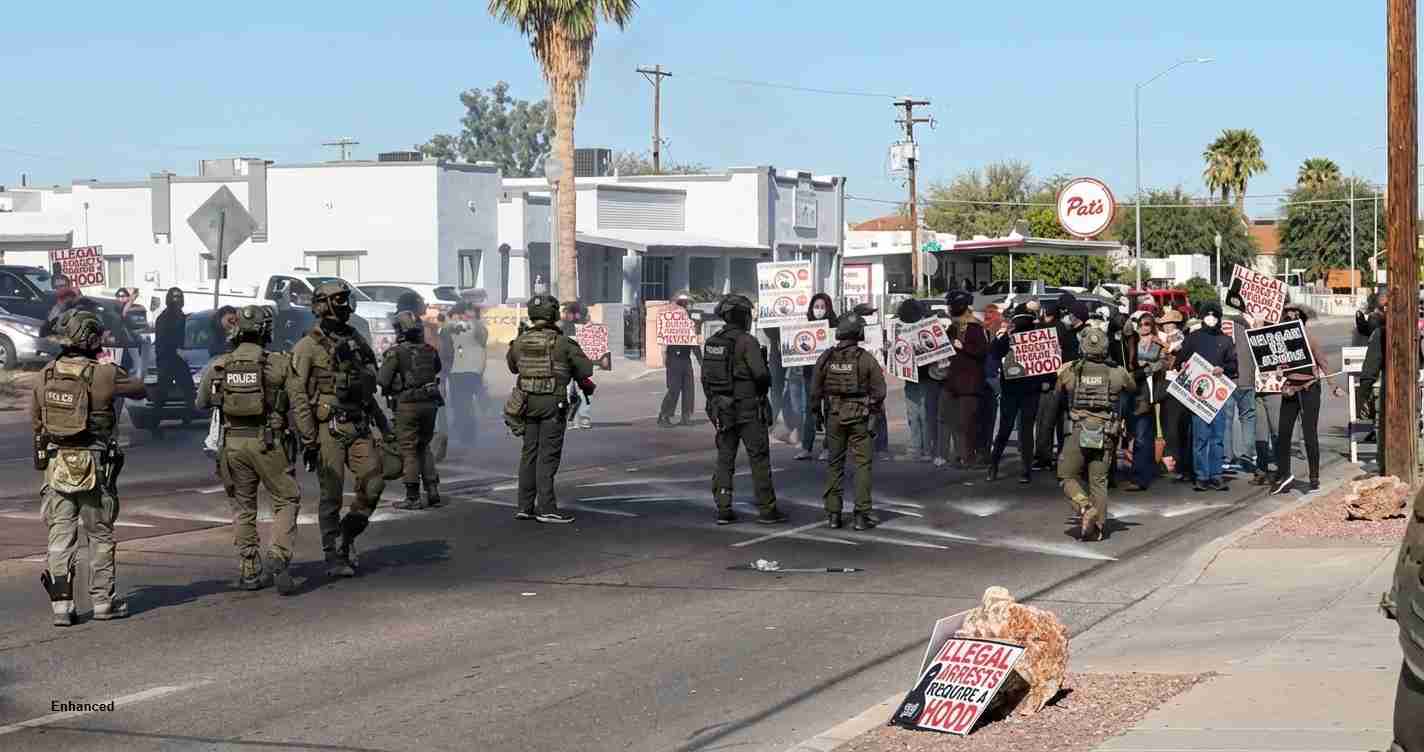
Witnesses and video show agents arriving before the restaurant opened. Within an hour, between about 100 and 200 people had gathered, chanting and carrying signs. Many identified as immigrant‑rights supporters. A smaller, confrontational group of roughly a dozen moved close to the gated parking lot where agents had parked, increasing tensions.
Trapping of federal agents in the parking lot
Protesters pressed against the gated lot while agents and vehicles were inside. Video shows a protester using a bike lock to secure the gate, temporarily trapping agents and their vehicles. Reporters said someone also threw a bottle at an ICE vehicle. Agents later cut the bike lock with a saw to exit the lot.
Use of force by federal agents
Federal officers used a range of less‑lethal tools while clearing the crowd and leaving the scene. Reports described flash‑bang‑type devices, pepper balls, and sprayed chemical irritants, producing visible smoke and causing coughing and eye irritation among protesters, journalists and bystanders. Tucson Police Department officials reiterated that TPD did not use force.
“Very aggressive,” Rep. Adelita Grijalva said of agents’ conduct when she identified herself and asked where detained people were being taken.
Pepper‑spraying of Rep. Adelita Grijalva and reporters
U.S. Rep. Adelita Grijalva, newly sworn in and representing the area, went to the scene and identified herself as a sitting member of Congress. Video shows Grijalva approaching agents to ask about detainees; she says she was pepper‑sprayed in the face and pushed while identifying herself. Local reporting and video indicate at least one Tucson Sentinel reporter and other observers were also hit by chemical spray during the dispersal.
Arrests and detentions
ICE confirmed multiple detentions tied to the underlying investigation. Media documented multiple men in handcuffs being led from a house near the restaurant and loaded into a federal vehicle. At the Taco Giro scene, at least two protesters were detained and placed in a van. DHS and ICE had not released names or detailed charges by the end of first‑day reporting; Tucson police said no city arrests were made at the scene.
Political and community response
City leaders and community advocates responded sharply. Tucson Mayor Regina Romero and Vice Mayor Lane Santa Cruz called the federal use of force “disproportionate”. Community groups framed the episode as part of broader federal immigration enforcement tactics they oppose and called for stronger local protections for immigrants. The events renewed debate in Tucson about sanctuary‑style policies following a 2019 ballot measure.
Follow‑on protest at the ICE field office
After the Taco Giro confrontation, a smaller group of demonstrators went to the ICE field office on Tucson’s south side. Video shows protesters banging on a fence and federal agents spraying people from inside the parking lot before Tucson police arrived. When officers arrived, roughly 25 protesters remained and dispersed without major injuries reported.
Implications for Utah
Economic and business impact
Utah businesses with immigrant employees often operate on thin margins. High‑profile federal raids can create labor uncertainty and disrupt staffing for small restaurants and service firms. Owners with family ties to the border region may alter hiring or payroll practices to reduce legal exposure. The Taco Giro raid underscores the importance of reviewing tax and immigration compliance.
Political consequences
Utah’s conservative leaders generally support firm border and immigration enforcement but also emphasize rule of law and public safety. This incident may intensify debate among Utah conservatives about enforcement tactics and interagency coordination, with some lawmakers praising enforcement while urging clearer protocols when federal agencies operate locally.
Social effects
Utah’s growing Hispanic and immigrant communities will watch events like the Tucson raid closely. Fear of aggressive enforcement can reduce trust in institutions and make immigrant families less likely to report crimes or cooperate with police. Community groups in Utah may increase outreach and legal‑aid efforts in response.
Cultural relevance
Images of agents trapped in a restaurant lot and a member of Congress pepper‑sprayed carry strong symbolic weight. For many Utah conservatives, concerns include maintaining public order and ensuring federal agents can perform duties without obstruction; others will emphasize measured enforcement that avoids inflaming neighborhoods.
Practical applications for residents
Utah employers should review immigration and payroll compliance and consider legal reviews of hiring and tax procedures. Local law enforcement and elected officials may push for clearer protocols for federal operations, including advance notice and communication plans to help avoid chaotic scenes that risk officers and bystanders.
Sources and video
Reporting and on‑scene footage used for this article include local and national outlets. See original coverage and video:
This reporting is based on initial public accounts and on‑scene video. Officials had not released full charging documents or a final tally of arrests at the time of reporting; Times Media Service will update coverage as federal agencies and the U.S. Attorney’s Office provide more information.